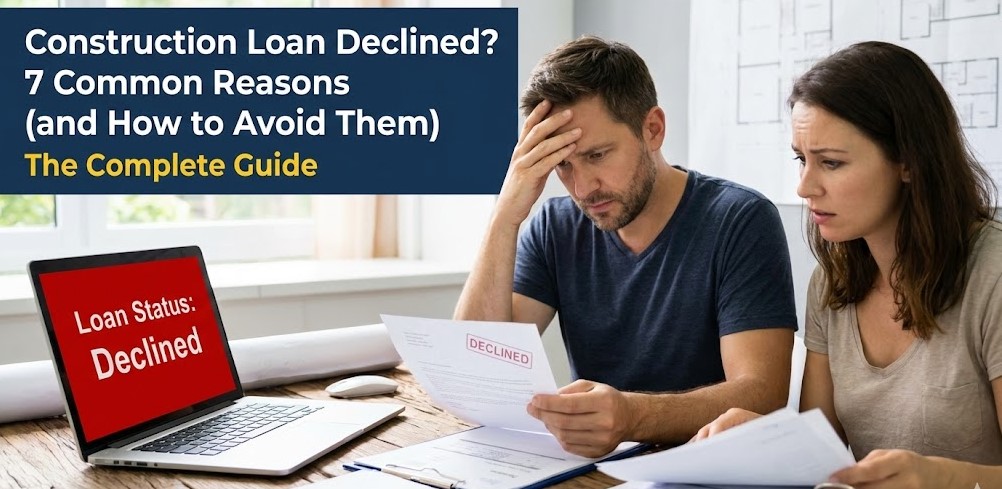
Getting your construction loan declined is one of the most frustrating things that can happen when you’re planning a build. You’ve found the land, chosen the builder, maybe even picked out benchtops. Then the bank says no.
But here’s what most people don’t realise: the majority of construction loan rejections are avoidable. They come down to a handful of recurring issues that a specialist broker sees (and heads off) every week. In our complete construction loan guide, we cover the full process from start to finish. This article zooms in on the specific reasons applications get knocked back, and what you can do about each one.
1. You Don’t Pass the 3% Serviceability Buffer
Every lender must test whether you can afford repayments at your loan rate plus 3%. If the construction loan rate is 6%, the bank assesses you at 9%, based on the full completed loan amount with principal and interest repayments. That’s a high bar.
Here’s the thing: borrowing power can vary by as much as $90,000 between lenders for the exact same applicant. Getting declined by one bank doesn’t mean you’ll be declined everywhere. A specialist who knows which lenders assess serviceability more favourably for your income type can make the difference.
2. The Valuation Comes Back Short
The lender orders an “as-if-complete” property valuation to estimate what your home will be worth once built. If that figure comes in lower than the combined land and build cost, you’ve got a shortfall: bigger deposit needed, LMI triggered, or reduced build scope.
This is especially common in new estates with limited comparable sales, or when you’re building the best house on the street (we see this more often than you’d think).
Challenging a construction loan valuation has less than a 5% success rate. The better strategy is to arrange valuations across multiple lenders before committing, so you identify and eliminate shortfalls early.
3. Your Building Contract Isn’t Right
Lenders strongly prefer fixed-price building contracts using standard HIA or Master Builders templates. Cost-plus contracts are significantly harder to get approved. And if your contract changes after formal approval, the lender may need to reassess the entire loan, adding weeks of delay.
The fix: finalise everything before you seek formal approval. Include all extras in the initial contract.
“Our most recent example was our concrete driveway. They came to us and said, ‘Look, you’ve got enough cubic meters of concrete to complete the driveway, but it’d be very narrow and skinny.’ We had to put further cash in to do it properly. So just keep that in mind when choosing your cheapest builder.”
– Craig Vaughan, Building Loans Australia
4. Builder-Related Issues
An unlicensed builder will mean automatic decline of your construction loan. Missing insurance (public liability, home warranty, construction insurance) is another deal-breaker. And with 3,217 construction firms entering insolvency in 2024, lenders are now running more thorough financial health checks on builders before approving loans.
How to avoid it: Before signing, verify your builder’s licence through your state’s building authority, confirm all insurances are current, and ask for recent references.
5. Incomplete or Incorrect Documentation
Construction loans require significantly more paperwork than a standard home loan. Common errors: submitting draft contracts that later change, missing council-approved plans, expired builder insurance certificates, and not including out-of-contract items. Submitting a complete, well-organised application from day one dramatically improves your chances. For a full breakdown of what you’ll need, see our construction pre-approval guide.
6. Self-Employed or Non-Standard Income
Most Big Four banks use a two-year average of business income from tax returns, weighted toward the lower year. Recently self-employed (under 12 months)? Your options narrow to specialist lenders offering low doc construction finance at higher rates and lower LVRs. Have your accountant prepare financials well ahead of time, or work with a broker who knows which lenders accept alternative income verification.
7. Your Build Type Is Too Complex for That Lender
Owner builder projects, duplex and dual occupancy builds, rural or acreage builds, and knockdown rebuilds all have fewer lender options than a standard house and land package. Most lenders cap owner builder LVR at 60%, meaning you need a 40% deposit. Going to the wrong lender will lead to a construction loan decline.
“Owner builder is higher risk because you’re managing the work yourself. There’s less certainty to the bank that you can do that. The bank doesn’t want to be left with a property that’s half completed by an owner builder.”
– Craig Vaughan, Building Loans Australia
A specialist construction broker knows which lenders suit your scenario and won’t waste your time (or your credit file) with applications that were never going to fly.
Frequently Asked Questions About Construction Loan Declines
Already Been Declined? Here’s Your Next Step
A construction loan rejection doesn’t mean your build is dead. In most cases, it means the application went to the wrong lender or the documentation wasn’t right. These are fixable problems.
At Building Loans Australia, we specialise in exactly these situations. Our Progress Protect™ method is designed to find the right pathway and get you approved with confidence.
Let’s Find Your Pathway to Approval
Book a free Progress Protect™ strategy session. We’ll review what went wrong, identify the right lender for your build, and map out a clear path forward.