
Reading Time: 12 minutes
Last Updated: November 2025
Ask anyone who’s built a home how they felt about their construction loan and they’ll usually reply with one word: “confused.”
And honestly? That’s completely understandable.
Although most Australians dream of building their perfect home, the construction loan process is fundamentally different from a standard home loan. You’re not just borrowing money once. You’re managing staged drawdowns, progress inspections, interest-only payments that triple over time, and a timeline that can stretch 18 months or more. Add in builder contracts, council approvals, and government grants worth up to $50,000, and it’s no wonder most people feel overwhelmed before they even break ground.
Here’s the reality: your typical mortgage broker probably handles one or two construction loans per year. They’re generalists who can help with standard home purchases, but when it comes to the complexity of construction finance, they simply don’t have the depth of experience you need.
“I founded Building Loans Australia in 2011. I just built my first house and realized this is way harder than it needed to be. So I thought I’d jump in and actually help solve that problem. Over the last 15 years or so, there isn’t really anything we haven’t seen from a building or construction perspective for a residential property.” – Craig Vaughan, Founder
This is precisely why we’ve specialized exclusively in construction finance since 2011.
In this comprehensive guide, we’ll walk you through everything you need to know about construction loans in Australia: from the 8 different build types and how they’re financed, to the 6 construction stages and exactly when money gets released, to the government grants you might be eligible for. We’ll show you real numbers from actual builds, reveal the top 6 mistakes that derail projects, and introduce you to the ProgressProtect™ method that’s helped thousands of families build with confidence.
By the end of this guide, you’ll understand exactly how construction loans work and what you need to navigate your build successfully.
Ready to explore your construction loan options? Book a free ProgressProtect™ consultation with our construction loan specialists.
Table of Contents
Which Build Type Are You Planning?
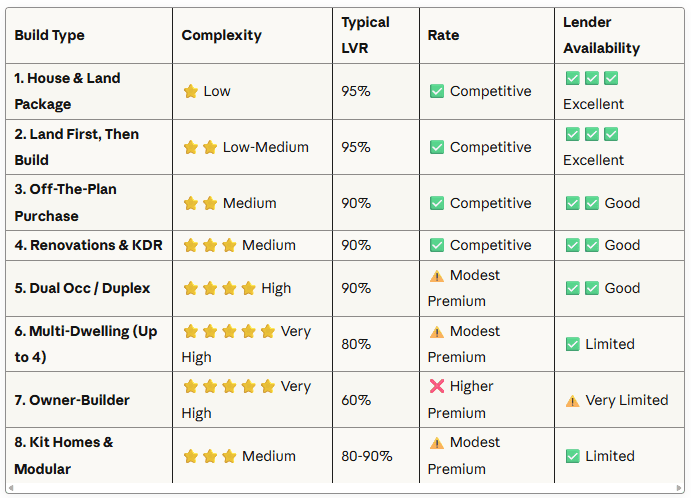
Before you can structure your construction loan properly, you need to understand which build scenario applies to your project. Not all construction loans are created equal: a house-and-land package has completely different financing requirements than an owner-builder project or a duplex development.
Let’s explore the 8 most common build scenarios and what each means for your finance options.
The 4 Most Common Construction Scenarios
1. House & Land Package (Most Common) ️
This is by far the most streamlined construction finance option. You’re purchasing a bundled deal from a developer where the land and build contract are signed together at the same time.
Think of it like this: You’ve gone to a big land release or estate, and builders have display homes set up right there. You walk through, pick your lot, and choose your house design from hundreds of pre-approved plans the builder already has ready to go. Done. Land contract and build contract signed simultaneously.
“A house and land package is when you go to an estate and say ‘I’ll have lot one here and I’ll have this house, please.’ You’re literally getting the land contract at the same time as getting the build contract, plans, and so on. It’s by far the most common and quite streamlined.” – Craig Vaughan
Why lenders love house-and-land packages:
- ✅ Lower risk profile (established builder, fixed price, proven designs)
- ✅ Faster approval timelines (streamlined process, known variables)
- ✅ Competitive interest rates similar to standard home loans
- ✅ Available from most major and non-bank lenders
Typical structure: One construction loan covering both land settlement and the build contract. The developer often has preferred lender relationships, which can speed up the process even further.
2. Land First, Then Build (Most Common)
With this approach, you buy land separately in one transaction, then source your own builder later in a second transaction.
The difference from a house-and-land package? You find the land yourself (it might be in an estate, or it might be a standalone block you’ve discovered). You settle on that land first. You now own the land, you’re paying a mortgage on it and paying council rates. Then you go find a builder to build your house on that land you already own.
The benefits:
- ✅ More flexibility in choosing your builder
- ✅ Greater control over design and contract terms
- ✅ Ability to wait for the right builder or timing
The slightly increased risk: You’ve purchased the land, you’ve settled on it, you’re making repayments. Let’s say you lose your job, or there’s a market downturn and property prices fall. You could find yourself owning a block of land that you can no longer afford to build on. Maybe at the time of buying, you could afford to build and there was enough value there. But by the time you came to build separately, valuations have fallen or you’ve increased your debt or your circumstances changed.
“Don’t take too long between buying the land and getting the builder underway. That’s where the slight increase in risk comes from. You could find yourself owning a block of land that you can no longer afford to build on.” – Craig Vaughan
That said, this scenario is manageable with proper planning. Just don’t leave your land sitting for 12+ months before starting the build.
3. Off-The-Plan Purchase
You’re paying at completion when the property is built by the developer. There are no progress payments during construction: you simply settle when it’s finished.
Key difference: This isn’t technically a construction loan in the traditional sense. You’re getting a standard home loan that settles upon completion. The developer carries all the construction risk and financing during the build phase, not you.
Higher risk considerations: If the developer encounters financial difficulties or the project is delayed, you may face extended waiting periods or, in worst cases, the development might not proceed. Always check the developer’s track record, financial stability, and contract terms before committing. Look for sunset clauses and what happens if completion dates aren’t met.
4. Renovations & Knock-Down Rebuild
This category covers extending or renovating an existing property, or demolishing completely and rebuilding from scratch.
Renovation loans might include:
- Kitchen and bathroom upgrades
- Second-storey additions or extensions
- Swimming pools and outdoor entertaining areas
- Structural changes and major improvements
Knock-down rebuild (KDR) means:
- Demolishing your existing home completely
- Building a new home on the same land
- Often used when the land is more valuable than the existing structure
- Popular in established suburbs where land values have grown significantly
Finance structure: If you already own the property, you’re using your existing equity to fund the work (essentially a construction loan secured against your current property). If you’re buying specifically to knock down and rebuild, you’ll need a construction loan for knock down rebuild that accounts for both the purchase price and the rebuild costs.
Yes, you do need a construction loan for major renovations unless you’re funding it with cash. If you’re borrowing for significant renovation work, this is generally structured as a construction loan with progressive drawdowns.

Less Common Construction Scenarios (Specialized)
1. Building a Dual Occupancy or Duplex
Two dwellings on one title: either side-by-side or a granny flat style arrangement.
Why consider this: Increase rental income and property yield. You can often get up to 90% LVR (Loan-to-Value Ratio) at normal interest rates (not commercial rates), which makes the investment strategy attractive.
The catch: Higher complexity in approvals. You’ll need detailed plans, council approval for dual occupancy (not all areas allow this), and a lender comfortable with this build type. Not all lenders offer competitive rates for duplexes: this is where specialist construction loan brokers make a significant difference in lender selection.
What to expect: Slightly more scrutiny, potentially slightly higher rates (0.25% to 0.5% premium), but still within residential lending territory as long as you stay under 4 dwellings.
2. Multi-Dwelling Projects (Up to 4 Units) ️
Small-scale development with 3-4 dwellings on one title: typically townhouses or apartment-style units.
Maximum 4 dwellings to stay within “residential construction loan” territory rather than commercial development finance. Beyond 4 units, you’re entering commercial lending with significantly different requirements, rates, and deposit levels.
Requires specialist lenders: Only a handful of lenders offer competitive construction finance for multi-dwelling projects. You’ll need generally some development experience, detailed feasibility studies, and often a higher deposit (20%+ is common).
3. Owner-Builder Projects
You act as your own builder and manage the construction yourself.
Why lenders are extremely cautious:
- Considered much higher risk (statistically higher rates of delays, cost overruns, incomplete builds)
- Generally requires proven construction experience and extensive documentation
- Typically limited to 60% LVR maximum (you need 40% deposit)
- ⚠️ Very limited lender options (most major banks won’t touch owner-builder projects)
- Higher interest rates (can be 1% to 2% above standard construction loans during the build phase generally reverting to regular interest rates once the build is complete)
What you’ll need: Generally a trade qualification or previous building experience, comprehensive plans and specifications and a full quantity surveyor’s report checking all your costs. Even with all this documentation, expect more scrutiny and higher rates.
“Owner-builder applications are seen as higher risk because the bank doesn’t want to be left with a property that’s half-completed. They’re also concerned about the quality. If you don’t do a good job and then disappear or go bankrupt, the bank’s got to sell that property to get their money back.” – Craig Vaughan
The bank needs assurance you actually know what you’re doing. They’ll require a full quantity surveyor’s check of your costs to make sure you know what your building is going to cost and that you can come in on budget.
4. Kit Homes & Modular Builds ️
Pre-fabricated or flat-pack homes assembled on-site.
Advantages: Faster construction time (generally), controlled factory environment, potentially lower costs, less weather-dependent construction.
Finance challenges:
- Limited lender options (many banks don’t understand modular construction)
- Restrictive loan terms
- “As if complete” valuations can be problematic if there’s limited comparable sales data
- Some lenders have concerns about resale values
The key is finding a lender familiar with modular construction who understands that these builds can be just as solid, valuable, and permanent as traditional stick-built homes. Not all banks recognize this yet, which limits your options.
How Construction Loans Actually Work
Here’s where construction loans diverge completely from standard home loans.
With a traditional home loan, you borrow the full amount once, settle on the property, and start making principal-and-interest repayments immediately. Simple.
Construction loans? Not even close.
The Progressive Drawdown System
Construction loans work on a staged drawdown schedule. Instead of receiving the full loan amount upfront, money is released progressively as your build reaches specific milestones: usually across 5 to 6 stages over 6 to 18 months (sometimes longer if there are delays).
Here’s why this matters:
For the lender: They’re only advancing money as value is actually being created. If your builder abandons the project halfway through, the lender hasn’t lost the full loan amount, only what’s been drawn so far. This is their risk management.
For you: Your interest costs build gradually. In month one, you might only be paying interest on $200,000. By month eighteen, you’re paying interest on the full $500,000. This creates what we call “interest creep”: a critical factor many first-time builders underestimate.
Interest-Only During Construction
During the construction phase, you will generally only be paying interest on the funds drawn so far, not principal repayments.
This keeps your repayments manageable while you’re potentially still paying rent or a mortgage somewhere else. But here’s the critical point: these interest-only payments can nearly triple from start to finish as more money is drawn.
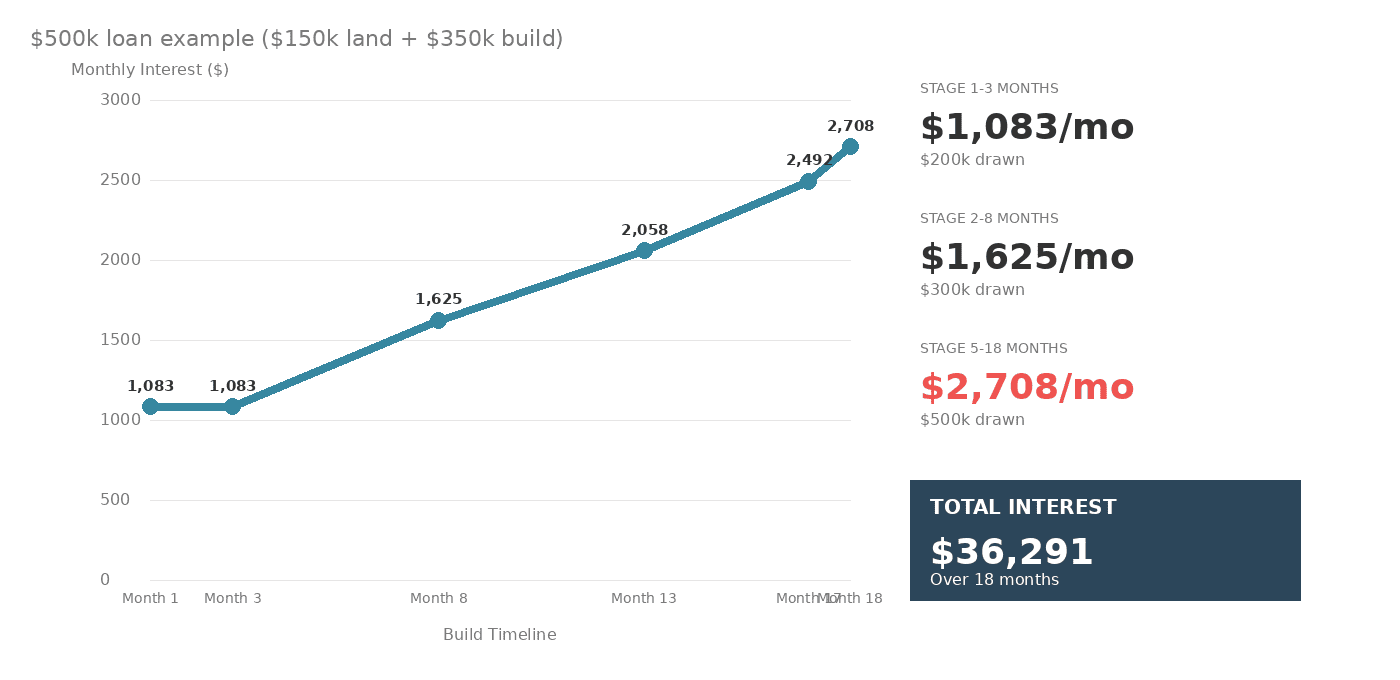
Real example on a $500,000 construction loan at 6.5% interest:
- Stage 1 (Month 1 to 3): $1,083/month interest on $200,000 drawn
- Stage 2 (Month 8): $1,625/month interest on $300,000 drawn
- Stage 5 (Month 18): $2,708/month interest on full $500,000 drawn
Many builders forget to budget for this escalation. They calculate based on the initial interest payment, then get a shock when it nearly triples by completion.
Total interest paid over 18 months: Approximately $36,291 in this example. That’s over $36,000 on top of your loan amount: money you’ll never get back.
How Construction Loans Compare to Standard Home Loans
| Feature | Standard Home Loan | Construction Loan |
|---|---|---|
| Loan drawdown | Full amount at settlement | Progressive over 5-6 stages |
| Repayments | Principal & Interest from day one | Interest-only during construction |
| Interest paid | Fixed monthly amount | Increases as funds drawn |
| Timeline | Immediate | 12-18+ months construction |
| Valuation | Current market value | “As if complete” valuation |
| Risk to lender | Property secures loan | Incomplete property during build |
| Approval complexity | Standard income/deposit check | Detailed builder contracts, plans, specs |
| Progress inspections | None | Required at each stage before release |
The “as if complete” valuation is particularly important. The lender values your property based on what it will be worth once finished, not what an empty block is worth today. This projected value determines your borrowing capacity.
The 6 Construction Stages Explained
Every construction loan is structured around specific build milestones. Understanding these stages and what percentage of funds releases at each helps you plan your cashflow and coordinate with your builder.
Here’s the standard 6-stage drawdown schedule (percentages can vary slightly by lender and builder, but this is typical):
Stage 0: Land Settlement & Deposit (5-10%)
Before construction even begins, you’ll need to settle on the land and pay your builder’s deposit.
What gets paid:
- Land purchase settlement
- Builder’s initial deposit (usually 5% to 10% of build contract)
- Any upfront loan fees (application fees, valuation fees)
When funds release: At land settlement and upon signing the building contract with deposit due.
Your interest payments start here: even though not a single brick has been laid yet.
Stage 1: Slab/Base Stage (10-15%)
The foundation stage includes all the groundwork and base preparation.
What’s completed:
- Site preparation, clearing, and cut/fill
- Footings and foundation work
- Concrete slab poured (or pier-and-beam base depending on your design)
- Underground plumbing and essential services
- Termite treatment if required
Progress inspection required: The lender sends a qualified building inspector to verify the stage is complete to the required standard before releasing funds. This usually takes 5 to 10 business days from your builder’s request for drawdown.
Typical drawdown: 10% to 15% of the total build cost.
Here’s how it works in practice: Your builder completes slab stage and requests the drawdown from the lender. The lender’s inspector visits (you typically pay around $200 per inspection fee), confirms it’s done properly, and then funds are released directly to your builder. You don’t handle the money: it goes straight from lender to builder.

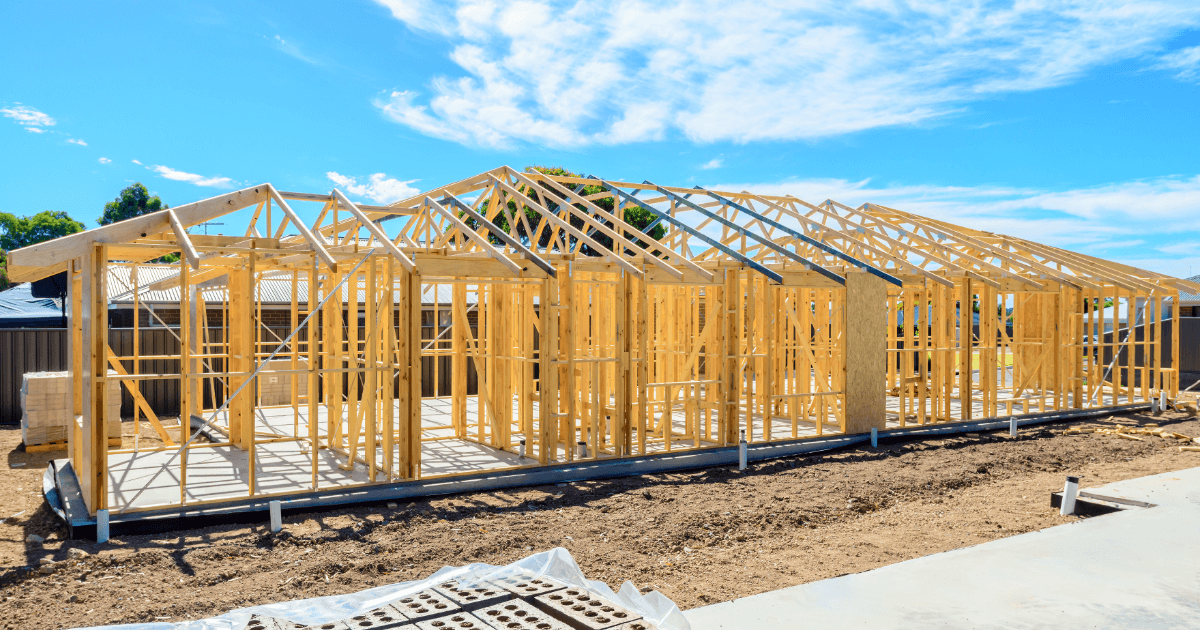
Stage 2: Frame Stage (20-25%)
The skeleton of your home takes shape. This is usually your biggest single-stage drawdown.
What’s completed:
- Timber or steel frame erected
- Roof trusses installed and secured
- External wall frames up
- Windows and external doors fitted
- Structural inspections passed
Why this is a big drawdown: The frame represents substantial material costs (timber, steel, trusses) and significant labour. This is typically your largest single-stage release.
Typical drawdown: 20% to 25% of build cost.
Stage 3: Lock-Up Stage (20-25%)
Your home becomes weatherproof and secure.
What’s completed:
- External cladding and rendering applied
- Roof tiles or metal roofing fully installed
- Garage doors fitted
- Property is fully enclosed and weatherproof
- Can be locked and secured
Why it’s called “lock-up”: The building is now protected from weather and can be locked. This is a significant milestone because internal work can proceed without weather delays affecting schedules.
Typical drawdown: 20% to 25% of build cost.
From this point forward, your builder should be able to work in all weather conditions, which theoretically means fewer weather-related delays (though tradespeople schedules can still cause timing issues).

Stage 4: Fixing/Fit-Out Stage (20-25%)
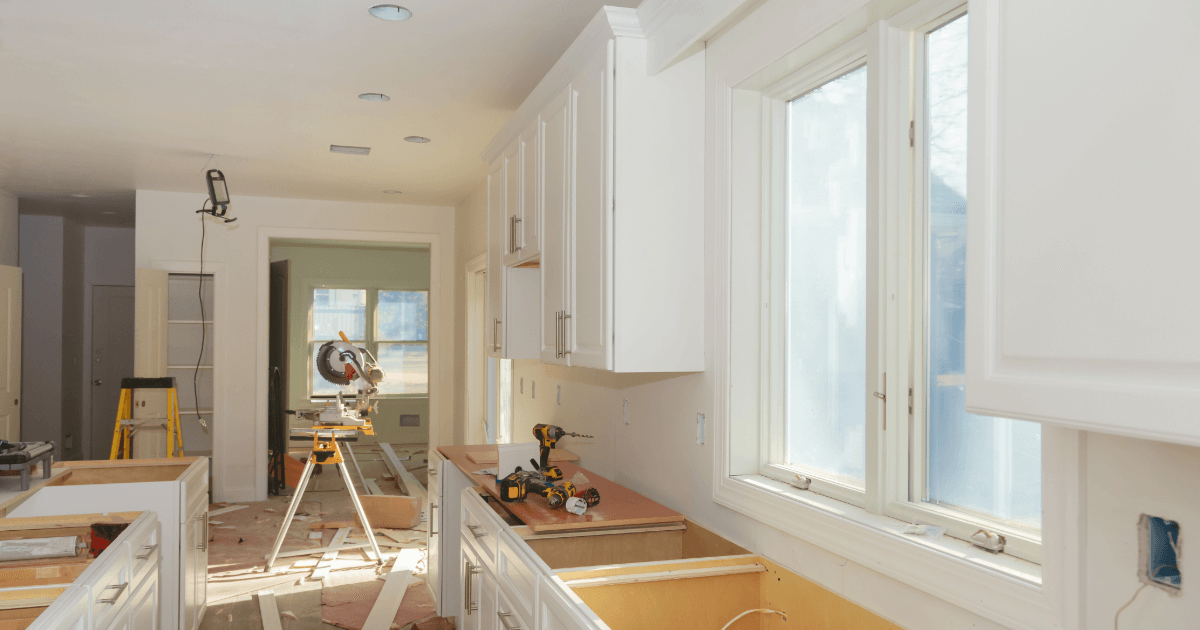
All the internal fixtures and finishes go in. This is where your house transforms from a shell into a home.
What’s completed:
- Plasterboard (gyprock) walls and ceilings installed
- Kitchen cabinetry and appliances fitted
- Bathroom fixtures, tiles, and vanities installed
- Flooring throughout (tiles, carpet, timber, vinyl)
- Internal doors and hardware
- Painting completed (walls, ceilings, trim)
- Light fittings, switches, and power points
- Major fixtures like ovens, cooktops, rangehoods
Why this stage takes time: This is where your selections and upgrades become reality. Delays in tile delivery, custom cabinetry lead times, or appliance availability can push this stage out by weeks. If you’ve added stone benchtops, custom joinery, or upgraded fixtures, expect longer lead times.
Typical drawdown: 20% to 25% of build cost.
Stage 5: Practical Completion & Final Inspection (10-15%)
The final drawdown happens when you get the keys.
What’s completed:
- Generarlly all defects identified and rectified
- Final clean completed throughout
- Occupancy Certificate or Certificate of Completion issued by council
- All warranties and manuals provided
- Keys handed over
The final inspection: Both the lender’s inspector and often the council do final checks. Your builder should walk you through the property for your “defects inspection”: this is your opportunity to identify any minor issues for rectification before final payment.
Loan conversion: Once this final payment is made, your construction loan automatically converts to a standard principal-and-interest home loan unless you have opted for a longer interest only period (eg, perhaps its an investment property and you wanted a 5 year interest only period). Your repayments will now increase because you’re now paying down principal, not just interest.

“Never rush practical completion. Take your time during the defects inspection. Once you sign off and the final payment is released, getting your builder back to fix issues becomes much harder. They’ve been paid in full, moved on to the next project.” – Craig Vaughan
Interest Costs During Your Build: The Reality Check
Let’s talk numbers, because understanding how interest accumulates during construction is critical to avoiding nasty surprises.
Real Example: $500K Construction Loan Over 18 Months
Here’s a typical scenario: $150,000 land purchase and $350,000 build contract (total $500,000), financed with a construction loan at 6.5% interest.
Months 1-3 (Land + Slab): $200,000 drawn
- Monthly interest payment: $1,083
- Total interest paid over 3 months: $3,250
Months 4-8 (Frame + Lock-Up): $300,000 drawn
- Monthly interest payment: $1,625
- Total interest paid over 5 months: $8,125
Months 9-12 (Fit-Out begins): $400,000 drawn
- Monthly interest payment: $2,167
- Total interest paid over 4 months: $8,668
Months 13-18 (Completion): $500,000 fully drawn
- Monthly interest payment: $2,708
- Total interest paid over 6 months: $16,248
Total interest paid over 18 months: $36,291
That’s over $36,000 in interest before you’ve paid down a single dollar of principal. And this is assuming an 18-month timeline. If your build runs to 20 or 24 months (not uncommon), add thousands more.
The Rent + Interest Overlap Nobody Warns You About
Here’s the financial reality most first-time builders don’t fully grasp until they’re in it:
You’ll likely be paying rent AND construction loan interest simultaneously for 12 to 18+ months.
Let’s say your rent is $2,000/month, and your construction loan interest starts at $1,083/month. In the first few months, you’re paying $3,083/month in combined rent plus interest. By month 18, your interest has grown to $2,708/month, so you’re paying $4,708/month total.
Budgeting tip: Calculate the average combined cost over your full build timeline and ensure you can afford it. Many builders budget for the initial payment only, then get shocked when combined costs push towards $5,000/month by completion.
“Budget 18 months even if you think 12. Delays happen: bad weather, material shortages, trade availability. And delays mean rent plus loan overlap extends. This is one of the most common sources of financial stress during builds.” – Craig Vaughan
For more detail see this article on Construction Loan Progress Payments.
How Construction Loan Rates Compare
Not all construction scenarios attract the same interest rate. Here’s what to expect in 2025:
Standard Builds: Competitive Rates (5.36% to 6.5%)
✅ House-and-land packages or turnkey homes
✅ Similar rates to regular home loans
✅ Available from most major and non-bank lenders
These are your lowest-risk builds from the lender’s perspective: fixed-price contracts, experienced licensed builders, standard residential construction. You’ll get competitive rates here.
Custom & Complex Builds: Modest Premium (6.0% to 7.0%)
⚠️ Acreage or rural builds
⚠️ Duplex or dual occupancy projects
⚠️ Vacant land in fringe or regional areas
May attract a 0.25% to 0.75% rate premium due to fewer lender options and slightly higher perceived risk. Still very manageable, but not quite as competitive as standard house-and-land packages.
Owner-Builder: Higher Rates (6.5% to 8.5%+)
Considered significantly higher risk by lenders
Requires extensive experience documentation
Rates generally 1% to 2% higher than standard builds
⚠️ Very few lenders will consider owner-builder projects
Why the substantial premium? Statistically, owner-builder projects have higher rates of delays, cost overruns, and incomplete builds. Lenders price for this elevated risk. If you’re serious about owner-building, factor these higher rates into your feasibility calculations.
What You’ll Need to Get Approved
Getting construction loan approval requires significantly more documentation than a standard home loan. Here’s your complete checklist.
Build Documentation
This is what differentiates a construction loan from a regular mortgage:
✅ Fixed-price building contract with detailed plans and specifications
✅ Builder’s license (copy of current QBCC, VBA, or relevant state license)
✅ Contract works insurance (also called home warranty insurance)
✅ Council approvals before build begins (your builder typically arranges this)
✅ Soil test results if required for your site
The building contract is critical. Lenders want to see a comprehensive fixed-price contract that details exactly what’s included, what’s excluded, and the full scope of works. Vague or incomplete contracts will delay (or derail) your approval.
Financial Documentation
Standard lending documentation plus some construction-specific items:
✅ Proof of income: Payslips (recent 3 months), tax returns (1-2 years if self-employed), PAYG summaries
✅ Bank statements: 3 to 6 months showing savings pattern and spending behavior
✅ Proof of deposit funds: Evidence your deposit has been genuinely saved or gifted (lenders track this closely). Note there are exceptions for genuine savings with a Guarantor Construction Loan or Rent as Genuine Savings Construction Loan.
✅ Existing debts documentation: Credit cards, car loans, personal loans, HECS debt
✅ Living expenses breakdown: Detailed monthly expenses (rent, groceries, transport, childcare, etc.)
Land & Valuation
✅ Contract of sale (if you haven’t settled yet) or Council rates notice (if you already own the land)
✅ “As if complete” valuation arranged by your broker (they organize this)
The “as if complete” valuation is crucial. The bank is valuing your property based on what it will be worth once built, not what an empty block is worth today. This projected value determines your maximum borrowing capacity.
If the valuation comes in lower than expected, your LVR (Loan-to-Value Ratio) increases, which might mean you need a bigger deposit or have to pay Lenders Mortgage Insurance (LMI).
Timeline expectation: From lodging your complete application to formal approval typically takes 5 to 10 days for straightforward cases. Complex scenarios (owner-builder, acreage, self-employed) can take longer.
Government Grants & Incentives by State (2025)
Don’t leave thousands of dollars on the table. Here’s what’s available across Australia as of late 2025. To get the latest grants and schemes available visit the firsthome.gov.au website.
First Home Guarantee (National Scheme)
Deposit required: As low as 5% (instead of 20%)
What you save: Avoid Lenders Mortgage Insurance (LMI), saving $15,000 to $30,000+
Eligibility: Must be first home buyer OR not owned a property in Australia in the last 10 years
Available for: New builds and established homes
This is a federal government scheme where the government guarantees part of your loan, allowing you to borrow with just 5% deposit without paying LMI. For construction loans, this is incredibly valuable because LMI on a $500,000 loan with 10% deposit can easily be $15,000 to $20,000.
First Home Owner Grants by State (2025)
These are cash grants paid directly to you for building or purchasing a new home. Note that state governments change these programs regularly, so always verify current eligibility before proceeding here.
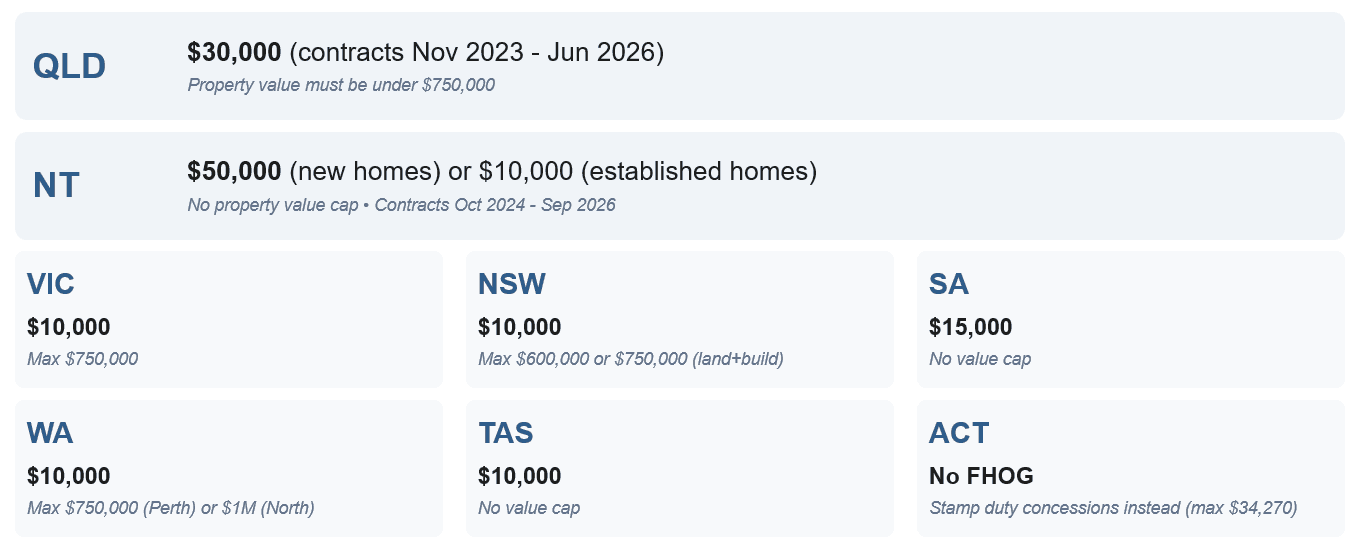
Queensland: $30,000
Amount: $30,000 cash grant
For contracts signed: November 2023 to June 2026
Property value cap: Must be under $750,000 (for land and build combined)
Requirements: New home, must move in within 12 months of completion
This is one of the most generous grants currently available. If you’re building in Queensland, this $30,000 can cover a significant portion of your deposit or upgrades.
Northern Territory: $50,000 (New) / $10,000 (Established)
Amount: $50,000 for new homes OR $10,000 for established homes
For contracts signed: October 2024 to September 2026
Property value cap: No value cap
Requirements: New home or established, must move in as primary residence
The NT has the highest grant available nationally: $50,000 is substantial. No value cap makes this particularly attractive for higher-end builds.
New South Wales: $10,000
Amount: $10,000
Property value cap: Maximum $600,000 for existing home OR $750,000 for house-and-land package
Requirements: New home, must move in within 12 months
NSW has one of the lower grants, but combined with stamp duty concessions (which can save another $20,000 to $30,000 for first home buyers), it’s still valuable.
Victoria: $10,000
Amount: $10,000
Property value cap: Maximum $750,000
Requirements: New home, must move in within 12 months
Victoria also offers substantial stamp duty concessions for first home buyers on top of this grant.
South Australia: $15,000
Amount: $15,000
Property value cap: No cap
Requirements: New home, must move in within 12 months
No value cap in SA means even higher-value builds qualify, which is attractive in the higher-end Adelaide market.
Western Australia: $10,000
Amount: $10,000
Property value cap: Maximum $750,000 (Perth metro) OR $1,000,000 (regional WA)
Requirements: New home, must move in within 12 months
Regional WA has a higher cap reflecting different market conditions outside Perth.
Tasmania: $10,000
Amount: $10,000
Property value cap: No cap
Requirements: New home, must move in within 12 months
No value cap makes this accessible across Tasmania’s diverse property markets.
Australian Capital Territory: No FHOG
Instead: Stamp duty concessions available
Maximum saving: Up to $34,270 in stamp duty exemptions for eligible first home buyers
Requirements: Various thresholds and criteria apply
ACT doesn’t offer a cash grant but provides substantial stamp duty relief instead, which can be just as valuable depending on your property value.
Stamp Duty Concessions
In addition to cash grants, most states offer stamp duty concessions or exemptions for first home buyers. These can save $10,000 to $30,000+ depending on your property value and state.
“We help you maximize the grants, make sure they’re paid on time, and you know when they’re going to be paid so you can manage your cashflow. We’ll also help you include extras from the start: pools, fences, things like that. Save you cash or just get you the complete property you want.” – Craig Vaughan
Pro tip: Engage with a construction loan specialist broker (like Building Loans Australia) to ensure you’re accessing all available grants and incentives. We’ll make sure grants are applied for on time, paid when expected, and factored into your cashflow planning so you’re not caught short.
Top 6 Construction Loan Pitfalls (And How to Avoid Them)
These are real mistakes that cost Australians thousands of dollars: prevented with the right structure and specialist guidance from day one.
❶ Underestimating Build Timeline
The mistake: Budgeting for a 12-month build when reality is closer to 18 months (or longer).
Why it happens: Optimism bias. Your builder gives you a 12-month estimate (or less), and you budget based on that. But delays happen: bad weather, material shortages (timber, bricks, windows are common culprits), trade availability issues, council inspection delays.
What it costs you: Every extra month means another month of:
- Rent payments (if you’re still renting): $2,000 to $3,000/month
- Construction loan interest: $1,000 to $2,700/month (escalating)
- Land holding costs: Rates, water, maintenance
How to avoid it: Budget for 18 months minimum, even if your builder says 12. If it finishes early, that’s a bonus. If it runs to 18 months (very common), you’re financially prepared.
❷ Choosing the Cheapest Builder Without Due Diligence
The mistake: Going with the lowest quote without thoroughly reviewing the contract and understanding what’s included (and what’s not).
Why it happens: Price pressure. When you’re stretching your budget, that builder who comes in $30,000 cheaper looks incredibly attractive.
What it costs you: The “cheap” builder hasn’t allowed enough concrete for the driveway. They’ve excluded retaining walls you need. They’ve underspecified materials. Suddenly you’re hit with $15,000 to $40,000 in variations mid-build.
“Cheap is okay, but often there will be extras you have to pay for. For example, they haven’t allowed enough concrete for the driveway, or they’ve missed other things. So review the contract carefully: what’s included, what’s excluded, and whether the price is genuinely fixed or if there are likely variations ahead.” – Craig Vaughan
How to avoid it: Don’t choose on price alone. Review contracts meticulously. Ask:
- What’s specifically excluded?
- How do variations work and what’s the pricing?
- What’s your track record on finishing on time and on budget?
Sometimes paying $20,000 more upfront for a reputable builder saves you $50,000 in variations and stress.
❸ No Contingency Buffer
The mistake: Building a budget with $0 contingency for cost overruns or unexpected expenses.
Why it happens: You’ve maximized your borrowing capacity to get the house you want. There’s no room in the budget for extras.
What it costs you: When the inevitable variation arises (different soil conditions requiring extra foundation work, need for retaining walls, upgrade materials because original selection is discontinued), you have no buffer. Builders turn to credit cards at 15% to 22% interest or stress about how to pay.
How to avoid it: Build a 5% to 10% contingency buffer into your budget from the start. On a $400,000 build, that’s $20,000 to $40,000 set aside for unknowns.
If you don’t have cash savings for this, work with your broker to structure the loan to include a reasonable buffer. It’s far cheaper to borrow an extra $30,000 at 6.5% construction loan rates than to hit a credit card at 20% when you run short.
Where the buffer helps:
- Soil testing reveals poor ground requiring deeper footings
- Council requires additional engineering work
- Material selections are discontinued, upgrades needed
- Site access issues require crane or special equipment
- Upgrade opportunities mid-build (better fixtures, stone benchtops)
❹ Ignoring Interest Creep
The mistake: Budgeting based on your initial interest payment ($1,000/month) and forgetting it nearly triples by completion ($2,700/month).
Why it happens: Nobody explains the progressive drawdown impact clearly upfront. Builders see that initial $1,000/month and think “I can afford that” without realizing it escalates every few months.
What it costs you: Financial stress mid-build when interest payments hit $2,500 to $2,700/month combined with ongoing rent. Some builders find themselves unable to afford the increasing payments and get into arrears.
How to avoid it:
- Calculate your average interest payment over the full timeline (not just the initial amount)
- Budget for the maximum payment you’ll face in the final months
- Create a monthly cashflow forecast showing escalating interest alongside your rent
- Set aside extra buffer in the early months when interest is low to offset higher costs later
We covered the real numbers earlier: on a $500,000 loan, you go from $1,083/month to $2,708/month. That’s a $1,625/month increase over 18 months. Plan for it.
❺ Not Reading Contract Fine Print
The mistake: Assuming the builder’s contract is “standard” and signing without detailed review or legal advice.
Why it happens: Excitement. You’ve chosen your design, you love the builder, you just want to get started. Reading 50 pages of legal contract feels tedious.
What it costs you: Risky clauses can cost you tens of thousands:
- No Liquidated Damages clause: If your builder finishes 6 months late, you have no recourse for your extra rent and interest costs
- Variation pricing: Variations priced at builder’s discretion with no cap
- Payment terms: Overly aggressive payment schedule that doesn’t align with work completed
How to avoid it:
- Engage a building solicitor to review your contract ($500 to $1,500: worth every cent)
- Ensure there’s a Liquidated Damages clause (typically $70 to $200/day for delays)
- Understand the variation process and pricing methodology
- Review the payment schedule against HIA/MBA recommended guidelines
❻ Not Communicating Changes or Delays to Your Lender
The mistake: Your build is running late, or you need a variation, but you don’t tell your lender until the last minute.
Why it happens: Fear. You’re worried the lender will say no or cause problems, so you avoid the conversation.
What it costs you: Your loan approval might lapse if construction takes longer than the approved construction period (usually 12 months). Suddenly you need to re-apply, re-value the property, potentially face different lending criteria. Or your variation isn’t approved and your builder stops work while you scramble to find alternative funding.
“Tell your lender about delays EARLY. They’ll work with you if you’re upfront. But if you wait until your approval is about to lapse, your options become much more limited and stressful. Communication is key.” – Craig Vaughan
How to avoid it:
- Keep your broker (and through them, your lender) updated monthly on build progress
- Flag potential delays or variations as soon as you become aware of them
- Many lenders will extend construction periods if notified early
- Variation approvals are faster when raised proactively rather than reactively
With Building Loans Australia’s ProgressProtect™ Builder-Lender Sync system, we keep everyone connected: lender, builder, valuer, and you. We track lender timeframes to ensure approvals don’t lapse and handle variations quickly to avoid construction delays.
Real Case Study: Sarah’s Brisbane Build
Let’s look at a real example to see how all these pieces come together. This is based on an actual client build (names and minor details changed for privacy).
The Project
Location: North Lakes, Brisbane (northern growth corridor)
Build type: House-and-land package
Land cost: $180,000
Build cost: $380,000
Total project: $560,000
Sarah’s Starting Position
Age: 32, first home buyer
Employment: Full-time marketing manager
Income: $120,000 per year (stable employment, 3+ years same employer)
Deposit saved: $80,000 (14.3% of project cost)
Current situation: Renting at $2,100/month
The Challenge
Sarah had saved diligently but only had $80,000 deposit: just over 14%. For a $560,000 build, a traditional 20% deposit would require $112,000. She was short $32,000.
Without specialist construction finance advice, she would have:
- Needed to save another 18 to 24 months to reach 20% deposit
- Paid significant Lenders Mortgage Insurance (LMI) if she proceeded with under 20%
- Potentially missed out on builder incentives and grant timing
The Solution: Structured Correctly from Day One
Working with Building Loans Australia, we structured Sarah’s build to maximize available assistance:
Grants Applied:
- ✅ First Home Guarantee: Approved for 5% deposit scheme
- ✅ Queensland First Home Owner Grant: $30,000 cash grant
Impact of First Home Guarantee:
- Saved approximately $18,000 by avoiding Lenders Mortgage Insurance
- Allowed her to proceed with just 14.3% deposit instead of waiting for 20%
Impact of QLD Grant:
- $30,000 cash paid shortly after build commencement
- Effectively increased her equity position to 19.6% ($80k plus $30k equals $110k)
- Provided buffer for any variations or unexpected costs
Final Loan Structure
Total project cost: $560,000
Less: Cash deposit: $80,000
Less: QLD Grant: $30,000
Less: Stamp duty concession: $0 (first home buyer, new build)
Loan amount: $465,000 (after QLD grant applied)
Loan details:
- Interest rate: 5.36% (excellent rate for construction loan in 2025)
- LVR: 83% (under the 85% threshold, which helped secure better rate)
- Construction period: 18 months
- Lender: Major bank with strong construction lending expertise
The Build Timeline & Cashflow
Here’s how Sarah’s actual drawdowns and costs flowed over her 18-month build:
Months 1-3: Land + Slab
- Drawdown: $200,000 (land $180k plus slab $20k)
- Monthly interest: $893/month
- Monthly rent: $2,100/month
- Combined: $2,993/month
Months 4-8: Frame + Lock-Up
- Drawdown: $315,000 (frame $80k plus lock-up $35k progression)
- Monthly interest: $1,405/month
- Monthly rent: $2,100/month
- Combined: $3,505/month
- QLD Grant received Month 5: $30,000 hit her offset account, reducing effective loan
Months 9-14: Fit-Out
- Drawdown: $425,000 (fit-out stages $110k)
- Monthly interest: $1,898/month
- Monthly rent: $2,100/month
- Combined: $3,998/month
Months 15-18: Final Stages + Completion
- Drawdown: $465,000 (final $40k completion payment)
- Monthly interest: $2,076/month
- Months 15-17 rent: $2,100/month (combined $4,176/month)
- Month 18: Moved in, stopped paying rent (interest only $2,076/month)
Total Interest Paid During Build: $38,760 over 18 months
Total Finance Costs:
- Interest during build: $38,760
- Application fees, valuation, inspections: $3,350
- Total: $42,110
The Outcome
Final position at completion:
- Property value (independent valuation): $620,000
- Final loan amount: $465,000 (after QLD grant applied)
- Instant equity: $155,000 (24.8% equity)
What Sarah avoided:
- ❌ Lenders Mortgage Insurance: Saved $18,000
- ❌ Waiting 2+ years to save 20% deposit: Started building immediately
- ❌ Financial stress: Comprehensive cashflow planning meant she knew exactly what to expect each month
- ❌ Builder disputes: ProgressProtect™ Builder-Lender Sync kept everything coordinated
What Sarah achieved:
- ✅ Brand new 4-bedroom home in growth corridor worth $620,000
- ✅ Walked in with $155,000 equity (24.8%)
- ✅ No stress with progress payments: all handled smoothly
- ✅ Completed on time (18 months as budgeted)
- ✅ No cost overruns (5% buffer included in structure, not needed)
Key Lessons from Sarah’s Build
- Specialist expertise matters: General mortgage brokers wouldn’t have known about First Home Guarantee timing or how to structure around the QLD grant optimally
- Grants are significant: $30,000 cash made a material difference to Sarah’s equity position and buffer
- Planning prevents stress: Sarah knew her exact monthly costs 18 months in advance: no surprises
- Timeline realism: We budgeted 18 months from the start; build finished in 18 months
- Interest creep is real: Her interest payments more than doubled from Month 1 to Month 18
Sarah’s story represents what’s possible with the right structure and specialist guidance. If you’re in a similar position (good income, solid deposit but not quite 20%, first home buyer), you might be surprised what’s achievable with the right construction finance strategy.
The ProgressProtect™ Method: Your Build Finance Safety Net
After 15 years specializing exclusively in construction finance and our team having helped thousands of Australian families build their homes, we’ve refined our approach into a proven three-stage system.
We call it ProgressProtect™: specifically designed to safeguard your timeline, budget, and peace of mind from pre-approval through to final settlement.
“Too many Australians struggle with generic lending advice. We built ProgressProtect™ to ensure you never do. It’s not only our expertise and knowledge in getting you approved, but also making sure your timeline is protected, your budget is protected, and you have peace of mind throughout the build: not living on baked beans and stressing about money.” – Craig Vaughan
The ABC System for Construction Finance
Think of ProgressProtect™ as your ABC’s:
A equals Approval
B equals Build
C equals Cashflow
Let’s break down each stage.
A: Approval (Clear-Path Approval Methodology)
Navigate complexity with confidence
Most mortgage brokers handle one or two construction loans per year. They’re generalists. When your application hits their desk, they’re often learning alongside you: which is why so many construction loan approvals get delayed or declined unnecessarily.
Our Clear-Path Approval methodology is built on 15 years of construction lending exclusively. Here’s what it delivers:
Avoid restrictive lenders
Not all lenders understand construction. Some have overly restrictive policies that will cause problems mid-build. We know which lenders are flexible with owner-builders, which ones handle acreage builds well, which ones have fast progress payment processes. We match you to the right lender for your specific build type from day one.
Maximize government grants
We ensure you’re accessing every grant and incentive you’re eligible for: First Home Guarantee, state First Home Owner Grants, stamp duty concessions. We’ll make sure grants are applied for correctly, on time, and that you understand exactly when they’ll be paid so you can manage your cashflow around that timing.
Include extras from the start
Want a swimming pool? Fence? Driveway? Landscaping? Many builders exclude these from the main contract to keep the quote competitive. But paying for them separately means using your savings or (worse) credit cards at 20% interest.
We structure your loan to include these extras upfront where possible. You’re borrowing at 6% instead of paying cash or using high-interest debt. This gives you the complete property you actually want: not a half-finished home where you’re saving for years to add the pool.
Fund out-of-contract items through your own contractors
Sometimes you can save money by engaging your own contractors for specific items (fencing, driveways, landscaping). We can structure finance to accommodate this, releasing funds directly to you for these components rather than everything going through the builder.
Secure faster approvals
We know exactly what documentation each lender requires, what they scrutinize, and how to present your application for fastest possible approval. For straightforward scenarios, we’re talking 7 to 10 days to formal approval. Even complex scenarios (owner-builder, self-employed) are handled efficiently because we’ve done hundreds of them.
Outcome: You get approved fast, with the right lender for your build, accessing maximum grants, and including everything you want in the structure from day one. No surprises, no restrictions, no re-applications mid-build.
B: Build (Builder-Lender Sync System)
Keep your build moving smoothly
This is where many construction loans fall apart. Your builder and your lender operate on different timelines, different documentation requirements, and often poor communication between them. The result? Delayed progress payments, frustrated builders, construction delays, and stress for you.
Our Builder-Lender Sync System prevents this.
Align builder and lender processes
We act as the intermediary coordinating between your builder’s progress claims and your lender’s inspection and payment processes. When your builder says “frame stage is complete,” we know exactly what documentation the lender needs, what inspections are required, and how to fast-track the payment release.
Handle variations fast
Need to add something mid-build? Need to address an unexpected issue? Variations can delay everything if not handled correctly. We manage the lender approval process for variations, ensuring funding is available when your builder needs it and your build doesn’t stop.
Track lender timeframes to avoid lapses
Construction loan approvals have expiry dates (usually 12 months). If your build extends beyond that (common), you need to re-apply. We track these timeframes proactively, arranging extensions before approvals lapse. You never face the nightmare scenario of being mid-build with no active loan approval.
Keep everyone connected
We maintain regular contact with your builder, your lender, your valuer (who does progress inspections), and you. Everyone knows where the build stands, what’s coming next, and what actions are required. No communication gaps, no surprises.
Prevent funding gaps
Construction stops fast if the builder isn’t getting paid on time. We ensure drawdown requests are submitted correctly, inspections are scheduled promptly, and funds flow to your builder according to the agreed schedule. Your builder stays on-site, your build stays on track.
Outcome: Smooth progress payments, no funding delays, happy builder, construction timeline maintained. You avoid the chaos and stress of misaligned builder-lender processes.
C: Cashflow (Buffer & Breathe)
Protect your finances during build
Building a home is expensive. Not just the obvious costs (land, construction), but the ongoing costs during the build that catch people off-guard: rent plus escalating interest, rates, inspections, variations, moving costs.
Our Buffer & Breathe approach ensures you can afford every stage without financial stress.
Plan repayments for each stage
Before you start building, we create a detailed month-by-month cashflow forecast showing:
- What your interest payments will be at each stage (from $1,000/month initially to $2,700/month at completion)
- Your ongoing rent (if renting)
- When grants will be paid and how that affects your cash position
- When major costs hit (land settlement, builder deposits, etc.)
You walk into your build knowing exactly what you’ll pay every month for the next 18 months. No surprises, no panic.
Create clear cashflow plans
We help you understand the overlap period: how long you’ll be paying rent AND construction interest simultaneously. We identify the peak cost months (usually months 12 to 18 when interest is highest and you’re still renting). We ensure you can actually afford this before you commit.
Many builders find out mid-construction they can’t afford the combined costs. By then, it’s too late: you’ve already signed contracts and started building. We prevent this with upfront cashflow reality checks.
Set aside buffers early
We structure your loan to include a contingency buffer (typically 5% to 10% of build cost) from the start where possible. This buffer sits in an offset account against your loan, reducing interest costs until needed, but available immediately if variations or unexpected costs arise.
You’re not scrambling to find $15,000 cash mid-build when the builder identifies poor soil conditions. The buffer is already there, already approved, ready to deploy.
Understand when incentives and grants are paid
The $30,000 QLD First Home Grant isn’t paid at settlement: it’s paid early in construction (often after slab stage). We ensure you know exactly when each grant hits your account so you can plan around it. Need the grant to cover a variation? We time the drawdowns accordingly.
Support through every stage until keys are in hand
We don’t disappear after approval. We’re with you throughout the entire build: fielding questions, coordinating payments, managing lender extensions if needed, providing guidance when issues arise. You have an expert construction finance partner from start to finish.
Outcome: Financial stability throughout your build. No credit card debt, no stress about affording next month’s payments, peace of mind that you can complete your build without financial strain.
Why ProgressProtect™ Works
The traditional construction loan approach is fragmented:
- Your broker gets you approved (maybe), then disappears
- You’re left coordinating between builder and lender alone
- Nobody’s checking if you can actually afford the escalating costs
- Variations and delays throw everything into chaos
- You’re stressed, your builder’s frustrated, and the lender is just a faceless bureaucracy
ProgressProtect™ is different: It’s an end-to-end system that safeguards every stage. Approval is just the beginning: we protect your timeline, budget, and mental health throughout the entire build process.
That’s the difference between generalist mortgage brokers and construction finance specialists.
If you’re ready to build with confidence rather than confusion, book a free ProgressProtect™ consultation with our construction loan specialists. We’ll review your build plans, show you exactly how our three-stage system keeps your project on track, and create your customized construction finance roadmap.
Frequently Asked Questions
Loan Structure & Mechanics
Q: What does “interest-only during construction” really mean and how will it affect my repayments?
A: During construction, you only pay interest on the funds drawn so far: not principal repayments. This keeps repayments lower while you’re potentially still paying rent. However, once construction completes, your loan will generally automatically convert to principal-and-interest, and your repayments will increase significantly (often 30% to 40% higher) because you’re now paying down the loan principal as well as interest.
Q: How long can my construction loan drawdown period be before I must convert to a regular home loan?
A: Most lenders approve construction periods of 12 months initially. If your build extends beyond that (common), you need to request an extension. Most lenders will grant 6 to 12 month extensions if you’re making progress and keeping them informed. The key is communicating delays early: don’t wait until your approval is about to lapse.
Q: Can I combine land purchase plus build into one construction loan, or do I need separate loans?
A: Yes, you can absolutely combine both into one construction loan (this is very common with house-and-land packages). However, if you purchase land separately first, then want to build later, you might have two transactions: a land loan that converts to a construction loan, or a land loan that you refinance into a construction loan when you’re ready to build. A specialist broker can structure this efficiently to minimize costs.
Q: Can I include a pool, shed, or use a different contractor than the builder to save money on things like fencing?
A: Yes! This is exactly what we help with in the ProgressProtect™ Clear-Path Approval stage. You can often structure your construction loan to include out-of-contract items like pools, sheds, fences, driveways, and landscaping. You can sometimes engage your own contractors for these items (often cheaper than the builder’s subcontractors) and have funds released directly to you or those contractors. This is a huge advantage if structured correctly from day one.
Build Issues & Property Valuations
Q: What happens if the build doesn’t finish on schedule or costs more than expected?
A: For delays: You’ll pay more interest because the loan is drawn for longer. If your delay extends beyond your approved construction period, you’ll need a lender extension (usually granted if you communicate early). For cost overruns: If you have a fixed-price contract, the builder generally wears cost overruns (that’s why fixed-price contracts are valuable). If you’re owner-builder or cost-plus contract, you’ll need access to additional funds: either your contingency buffer, additional borrowing (if equity allows), or your own savings.
Q: How do lenders value the property “as if complete” and why does this affect my borrowing capacity?
A: Lenders order an “as if complete” valuation which values your property as though it’s already built (not just the empty land). A qualified valuer reviews your plans, specifications, and comparable completed sales in the area to estimate final value. This projected value determines your LVR (Loan-to-Value Ratio) and maximum borrowing capacity. If the valuation comes in lower than expected, you might need a bigger deposit or have to reduce the build scope.
Q: Can I use the equity in my land or existing home to fund a construction loan?
A: Absolutely. If you already own land or another property with sufficient equity, you can use that equity as your “deposit” for the construction loan. This is common for renovations, knock-down rebuilds, or if you purchased land years ago that’s now increased in value. Your broker will calculate available equity: (Property value times 80%) minus existing debt equals usable equity.
Eligibility & Special Situations
Q: What deposit is typically needed for a construction loan?
A: For standard builds with good credit: 5% to 20% deposit. With the First Home Guarantee scheme, first home buyers can go as low as 5% for new builds and avoid LMI. For owner-builder projects: Usually 30% to 40% deposit minimum (60% LVR maximum). For complex builds (acreage, duplex, multi-dwelling): Usually 10% to 20% deposit. The deposit level affects your interest rate: higher deposits generally mean better rates.
Q: Are owner-builder construction loans treated differently, and what are the extra requirements?
A: Yes, very differently. Requirements include:
- Much larger deposit (30% to 40%)
- Trade qualifications or proven building experience
- Detailed plans and specifications
- Full quantity surveyor’s report verifying your cost estimates
- A detailed construction schedule
- Higher interest rates (1% to 2% premium)
- Very limited lender options
Lenders see owner-builder as much higher risk due to statistically higher rates of delays, cost overruns, and incomplete projects.
Q: If I’m doing a major renovation (not a full new build), do I need a construction loan or can I use a standard home loan?
A: For major renovations (anything over approximately $50,000 with staged construction work), you’ll generally need a construction loan. Standard home loans provide the full amount at settlement: not suitable for progressive drawdowns as renovation work completes. For minor renovations ($10,000 to $50,000), you might be able to get a standard loan releasing equity without the need to go through progressive drawdowns.
How to Get Started: Your Next Steps
Building a home is one of the biggest financial and emotional decisions you’ll make. After reading this comprehensive guide, you now understand:
✅ The 8 different build types and how they’re financed
✅ How construction loans work with progressive drawdowns
✅ The 6 construction stages and when money is released
✅ Interest costs and how they nearly triple during your build
✅ Documents and approvals you’ll need
✅ Government grants worth thousands (up to $50,000 in some states)
✅ The top 6 mistakes that derail builds and how to avoid them
✅ Real case study numbers showing how it all comes together
✅ The ProgressProtect™ method for safeguarding your build
But knowledge alone doesn’t get your house built: action does.
Option 1: Book Your Free ProgressProtect™ Consultation
If you’re serious about building in the next 6 to 12 months, the most valuable next step is a strategy session with our construction loan specialists.
In this free consultation, we’ll:
- Review your specific build plans and financial position
- Identify which build type and lender best suit your project
- Calculate exactly how much you can borrow (including out-of-contract items like pools and fences)
- Show you which government grants you’re eligible for and when they’ll be paid
- Create a month-by-month cashflow forecast so you know exactly what to expect
- Explain how ProgressProtect™ would safeguard your specific build
No obligation. No pressure. Just expert guidance to help you build with confidence.
Call us today: 1300 410 149
Or book online: buildingloansaustralia.com.au/book-strategy-session
Option 2: Download Our Free Construction Loan Guide
Want to dive deeper before booking a consultation? Download our comprehensive Quick-Start Guide to Building & Construction Loans.
Why Building Loans Australia?
Since 2011, we’ve specialized exclusively in construction finance. We’ve helped thousands of Australian families build their dream homes across every build type imaginable: from standard house-and-land packages to complex owner-builder projects, from duplexes to knock-down rebuilds.
What makes us different:
- Specialists, not generalists: Construction loans are all we do, every day
- Access to 50+ lenders: We find the right lender for your specific build type
- ️ ProgressProtect™ Method: End-to-end support from approval through completion
- Maximize grants: We ensure you access every dollar you’re entitled to
- ⚡ Fast approvals: 5 to 10 days for standard builds, even complex scenarios handled efficiently
- Builder-Lender Coordination: We keep everyone connected so your build stays on track
“Over the last 15 years or so, there isn’t really anything we haven’t seen from a building or construction perspective. We built the ProgressProtect™ method to ensure your timeline is protected, your budget is protected, and you have peace of mind throughout the build: not living on baked beans and stressing about money.” – Craig Vaughan, Founder
Ready to Start Building?
Your dream home doesn’t build itself. The families who succeed are the ones who take the first step: getting expert guidance before signing contracts, choosing builders, or committing to timelines.
Whether you’re planning a simple house-and-land package or a complex owner-builder project, whether you have 5% deposit or 40%, whether you’re in Brisbane, Sydney, Melbourne, or regional Australia: we can help structure your construction finance correctly from day one.
Let’s build your dream home together.
1300 410 149
buildingloansaustralia.com.au
About the Author
Craig Vaughan, Founder — Building Loans Australia
Craig founded Building Loans Australia in 2011 after building his first home and realizing the construction loan process was unnecessarily complicated and poorly explained by general mortgage brokers. With over 20 years of experience in finance and 15 years specializing exclusively in construction lending, Craig and his team have helped thousands of Australian families navigate the complexities of building finance.
Craig developed the ProgressProtect™ methodology based on decades of real-world construction lending experience: identifying the common failure points in the traditional approach and systematizing solutions that protect timeline, budget, and client peace of mind from approval through completion.
Disclaimer: This content is for general information and educational purposes only. It does not constitute financial, legal, or taxation advice. All rates, fees, grant amounts, and eligibility criteria are current as of November 2025 and subject to change. Lender and government program requirements may vary. Individual circumstances differ: always seek professional advice for your specific situation.