Building Loans Australia

Building Loans for every Australian

Australia-wide:

1300 410 149

Australia-wide:

1300 410 149

  • Home
  • Free Guide
  • Home Loans
    • Land Loans
      • No Deposit with Guarantor
      • 95% Land Loan (genuine & non-geniune savings)
      • Rural Land Loans
      • Acreage Loans
      • Vacant Land Considerations
    • House and Land Package Home Loan
      • No Deposit with Guarantor
      • House and Land Packages
      • First Home Buyers – Government Incentives
    • Construction Loans
      • No Deposit with Guarantor
      • 95% Land Loan (genuine & non-geniune savings)
      • Construction Pre-Approval Home Loan
      • Low Doc Construction Loan
      • Rural Home Loans
    • Investment
      • Investment Construction
      • Government Grants/Incentives for Investors
      • NRAS Loans
    • Other Types Of Construction
      • Off the Plan Construction Home Loan
      • KnockDown Rebuild Home Loans: The Complete Guide 2026
      • Home Renovation Loan
      • Low Valuation Shortfall Home Loan
      • Owner Builder Loan
      • Extension Home Loan
      • Home Equity Loan
  • FAQ
    • Frequently Asked Questions
    • Construction & Building Guide
    • Construction Loans – How They Work
    • Fixed Rates Loans for Construction
    • First Home Buyers – Government Incentives
    • Valuation Myths for Residential Property
  • Blog
  • About
    • Testimonials
  • Contact
  • Free Strategy Session

Construction Loan Declined? 7 Common Reasons (and How to Avoid Them)

February 19, 2026 by Craig Vaughan

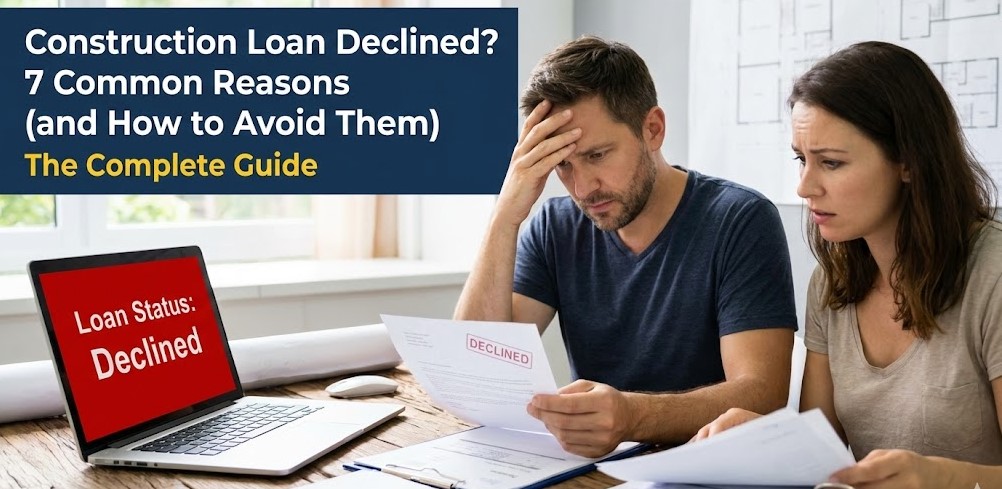
Construction loan declined on left showing worried homeowner

Getting your construction loan declined is one of the most frustrating things that can happen when you’re planning a build. You’ve found the land, chosen the builder, maybe even picked out benchtops. Then the bank says no.

But here’s what most people don’t realise: the majority of construction loan rejections are avoidable. They come down to a handful of recurring issues that a specialist broker sees (and heads off) every week. In our complete construction loan guide, we cover the full process from start to finish. This article zooms in on the specific reasons applications get knocked back, and what you can do about each one.

1. You Don’t Pass the 3% Serviceability Buffer

Every lender must test whether you can afford repayments at your loan rate plus 3%. If the construction loan rate is 6%, the bank assesses you at 9%, based on the full completed loan amount with principal and interest repayments. That’s a high bar.

Here’s the thing: borrowing power can vary by as much as $90,000 between lenders for the exact same applicant. Getting declined by one bank doesn’t mean you’ll be declined everywhere. A specialist who knows which lenders assess serviceability more favourably for your income type can make the difference.

2. The Valuation Comes Back Short

The lender orders an “as-if-complete” property valuation to estimate what your home will be worth once built. If that figure comes in lower than the combined land and build cost, you’ve got a shortfall: bigger deposit needed, LMI triggered, or reduced build scope.

This is especially common in new estates with limited comparable sales, or when you’re building the best house on the street (we see this more often than you’d think).

⚠️ Valuation Shortfall

Challenging a construction loan valuation has less than a 5% success rate. The better strategy is to arrange valuations across multiple lenders before committing, so you identify and eliminate shortfalls early.

3. Your Building Contract Isn’t Right

Lenders strongly prefer fixed-price building contracts using standard HIA or Master Builders templates. Cost-plus contracts are significantly harder to get approved. And if your contract changes  after formal approval, the lender may need to reassess the entire loan, adding weeks of delay.

The fix: finalise everything before you seek formal approval. Include all extras in the initial contract.

“Our most recent example was our concrete driveway. They came to us and said, ‘Look, you’ve got enough cubic meters of concrete to complete the driveway, but it’d be very narrow and skinny.’ We had to put further cash in to do it properly. So just keep that in mind when choosing your cheapest builder.”

– Craig Vaughan, Building Loans Australia

4. Builder-Related Issues

An unlicensed builder will mean automatic decline of your construction loan. Missing insurance (public liability, home warranty, construction insurance) is another deal-breaker. And with 3,217 construction firms entering insolvency in 2024, lenders are now running more thorough financial health checks on builders before approving loans.

How to avoid it: Before signing, verify your builder’s licence through your state’s building authority, confirm all insurances are current, and ask for recent references.

5. Incomplete or Incorrect Documentation

Construction loans require significantly more paperwork than a standard home loan. Common errors: submitting draft contracts that later change, missing council-approved plans, expired builder insurance certificates, and not including out-of-contract items. Submitting a complete, well-organised application from day one dramatically improves your chances. For a full breakdown of what you’ll need, see our construction pre-approval guide.

6. Self-Employed or Non-Standard Income

Most Big Four banks use a two-year average of business income from tax returns, weighted toward the lower year. Recently self-employed (under 12 months)? Your options narrow to specialist lenders offering low doc construction finance at higher rates and lower LVRs. Have your accountant prepare financials well ahead of time, or work with a broker who knows which lenders accept alternative income verification.

7. Your Build Type Is Too Complex for That Lender

Owner builder projects, duplex and dual occupancy builds, rural or acreage builds, and knockdown rebuilds all have fewer lender options than a standard house and land package. Most lenders cap owner builder LVR at 60%, meaning you need a 40% deposit. Going to the wrong lender will lead to a construction loan decline.

“Owner builder is higher risk because you’re managing the work yourself. There’s less certainty to the bank that you can do that. The bank doesn’t want to be left with a property that’s half completed by an owner builder.”

– Craig Vaughan, Building Loans Australia

A specialist construction broker knows which lenders suit your scenario and won’t waste your time (or your credit file) with applications that were never going to fly.

📋 Not sure where you stand?
Download our free Quick-Start Guide to Construction Loans and get clear on what lenders need before you apply.

Download Free Guide →


Frequently Asked Questions About Construction Loan Declines

Can I reapply after being declined?
+
Yes, however we need to be careful here. Each application leaves a mark on your credit file, and multiple rejections can make future applications harder. Work with a specialist who identifies the issue first, fixes it, then submits to the right lender.
My regular broker said construction loans are too complex. What now?
+
This is one of the most common things we hear. General mortgage brokers handle construction loans occasionally, but it’s not their core business. A specialist construction finance broker works with 40+ lenders and understands the documentation, valuation, and builder requirements that trip up generalist brokers. Learn how we approach construction finance differently.
What if my builder goes bankrupt before the build is finished?
+
Home warranty insurance can cover completion costs but these are last-resort policies with strict conditions. The best protection is thorough builder vetting before you sign: check their licence, confirm insurances, and ask for recent client references.

Already Been Declined? Here’s Your Next Step

A construction loan rejection doesn’t mean your build is dead. In most cases, it means the application went to the wrong lender or the documentation wasn’t right. These are fixable problems.

At Building Loans Australia, we specialise in exactly these situations. Our Progress Protect™ method is designed to find the right pathway and get you approved with confidence.

Let’s Find Your Pathway to Approval

Book a free Progress Protect™ strategy session. We’ll review what went wrong, identify the right lender for your build, and map out a clear path forward.
Book Free Strategy Session →
📞 1300 410 149


Related Resources

  • The Complete Australian Construction Loan Guide 2025–2026
  • Construction Loan Deposits: How Much Do You Actually Need?
  • Construction Loan Pre-Approval: What You Need to Know
  • How Construction Loans Work in Australia

Filed Under: Uncategorized

House and Land Package vs Land First Build: Which Construction Loan Structure is Best?

December 9, 2025 by Craig Vaughan

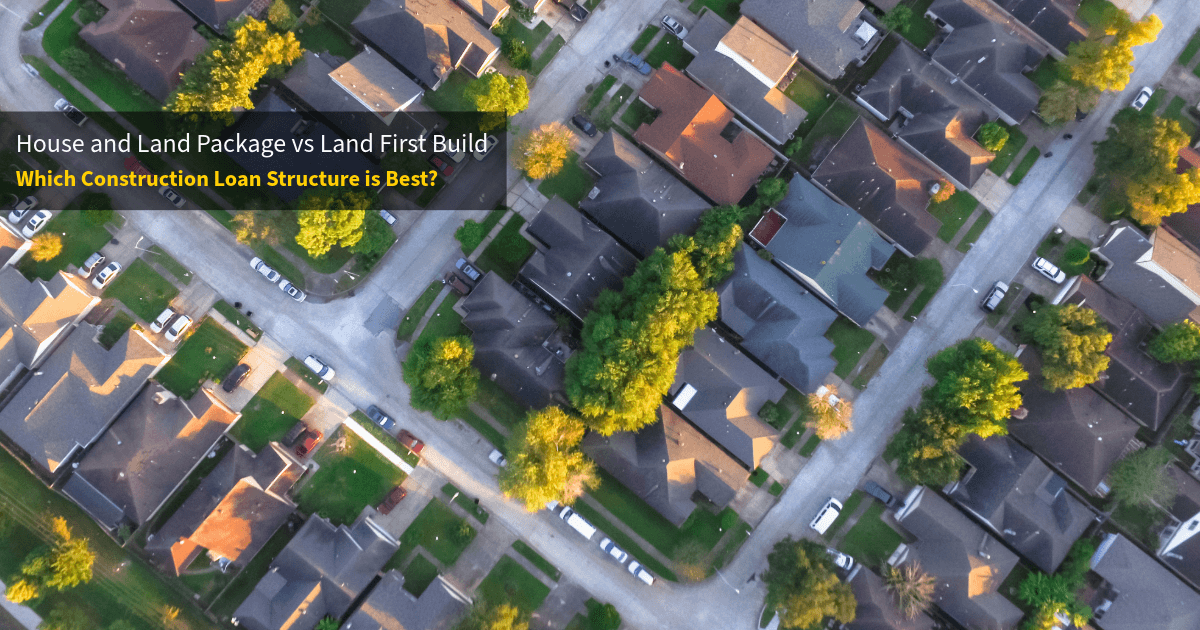
House and land package construction site showing new home builds in Australian estate

If you’re planning to build your dream home, one of the first decisions you’ll face is whether to go with a house and land package or buy the land first and build later. While this might seem like just a lifestyle choice, it has major implications for your construction loan approval, timeline, and overall costs.

The difference between these two approaches can mean thousands of dollars in interest savings, weeks or months in approval time, and significantly different risk profiles with lenders. Let’s break down exactly what each option means for your construction finance.

For the complete step-by-step construction loan process, see our Complete Australian Construction Loan Guide.


What’s the Difference? House and Land Package vs Land First Build

House and Land Package

A house and land package is a bundled deal where you purchase both the land and the building contract at the same time, typically from the same developer or builder in a new estate.

How it works:

  • You find a display home you like in a new estate
  • You choose your block of land
  • You sign contracts for both the land and the house essentailly at the same time
  • One streamlined approval process covers both components
  • Construction begins shortly after land settlement

Common scenario: You visit a new housing estate in Melbourne’s growth corridors, fall in love with a display home, select lot 23, and sign up for the complete package that day.

Land First and Build

With this approach, you purchase vacant land first as a separate transaction, settle on it, and then find a builder and arrange construction finance later.

How it works:

  • You find and purchase a block of land (estate or standalone)
  • You settle on the land and take ownership
  • You start paying a mortgage on the vacant land
  • Later, you find a builder and arrange construction finance
  • The construction loan funds the build

Common scenario: You find the perfect block in an established suburb, purchase it, and over the next 1-12 months you research builders and finalize your house plans before starting construction.

The Construction Loan Differences That Actually Matter

Approval Speed and Complexity

House and Land Package: When you apply for finance on a house and land package, lenders see this as lower risk because:

  • The builder and land are pre-vetted (usually from known estates)
  • The contract is standardized and complete
  • The timelines are more predictable
  • It’s one single approval process

Result: Faster approval times and higher approval rates.

Land First Build: This approach involves two separate approval processes:

  1. Initial land purchase approval
  2. Later construction loan approval

The second approval can be more complex because:

  • Your financial position may have changed since buying the land
  • You’ve taken on land debt, affecting your borrowing capacity
  • Lenders need to assess your builder and plans from scratch
  • There’s increased scrutiny on whether the project is viable

Result: Longer overall timeline and more risk if something changes between time you purchased the land and time you are ready to build.

The Cost Comparison: What You’ll Actually Pay

Additional Holding Costs

When you own vacant land, you’re also responsible for:

  • Council rates (from settlement)
  • Land tax (if applicable in your state)

These can add another $100-300+ per month depending on your location.

House and land packages avoid there being a long gap because your land settlement and construction commencement are coordinated, minimizing the period where you’re paying for land without a house being built.

Risk Profile: What Lenders Actually Consider

House and Land Package = Lower Perceived Risk

Lenders can favor house and land packages because:

  • The developer has pre-approved the builder
  • The estate infrastructure is guaranteed
  • The package is a proven, repeatable product
  • Timeline risks are lower
  • Property valuation is more predictable

This often translates to:

  • Better interest rates (sometimes 0.1-0.2% lower)
  • Higher maximum LVR (Loan-to-Value Ratio) options because often lenders will not lend high LVR on just vacant land
  • More lenient deposit requirements
  • Faster approval processes

Land First Build = Higher Scrutiny

When you already own land and are seeking construction finance, lenders see additional risks:

  • You’ve already committed capital to land
  • Your borrowing capacity has decreased
  • If you can’t get construction approval, you’re stuck with vacant land
  • If market conditions change, you might not be able to afford to build

This can mean:

  • More conservative lending (lower LVR)
  • Stricter deposit and savings requirements
  • Potentially higher interest rates or more restrictions

“The risk is that you’ve purchased the land, you’ve settled on the land, you’re making repayments on the land and let’s say you lose your job or there’s a downturn and property prices fall- you could find yourself owning a block of land that you can no longer afford to build on.” – Craig Vaughan, Building Loans Australia

Flexibility vs Certainty: The Trade-Off

Why Choose Land First Build?

Despite the financial costs and risks, there are legitimate reasons to buy land first:

Greater flexibility:

  • Choose exactly the location you want (not limited to estates)
  • Take your time finding the perfect builder
  • Customize your house design extensively
  • Build when market conditions are favorable
  • Secure land in an established area or specific street

Control over timing:

  • Don’t feel rushed to finalize house plans
  • Can wait for the right builder or better pricing
  • Opportunity to save additional funds for upgrades

Strategic advantages:

  • Lock in land in a rising market
  • Secure a unique or limited-availability block
  • Build when your personal circumstances are ideal

Why Choose House and Land Package?

Financial efficiency:

  • Limit the gap period paying interest on vacant land whilst finding a builder
  • Lower overall borrowing costs
  • Streamlined approval = less time paying rent elsewhere

Speed and simplicity:

  • One approval process, not two
  • Faster path from decision to moving in
  • Less documentation and complexity

Lower risk:

  • Pre-coordinated builder and land
  • Established estates with guaranteed infrastructure
  • More lender competition (better rates)

Making Your Decision: Questions to Ask Yourself

Consider a house and land package if:

  • Speed to move in is important
  • You want to minimize overall costs
  • You prefer a streamlined, lower-risk process
  • You’re a first-time builder and want simplicity
  • You’re comfortable with estate living

Consider land first build if:

  • You’ve found a unique or perfect block
  • You want maximum design flexibility
  • You have time to plan carefully
  • You can comfortably afford the gap period costs
  • Location in an established area is your priority

The ProgressProtect™ Difference: How We Help With Both

Regardless of which path you choose, Building Loans Australia’s ProgressProtect™ method ensures:

A: Approval – We match you with the right lender for your specific build structure

  • House and land packages: We leverage lender appetite for these deals
  • Land first builds: We present your application to maximize approval chances

B: Build – We keep your project moving smoothly

  • Coordinate timelines between land settlement and construction start
  • Handle any variations or re-approvals if plans change

C: Cashflow Management – We protect your budget

  • For land first: We help you plan for the gap period costs
  • For packages: We optimize your drawdown schedule
  • Both: We create a clear cashflow plan so you’re never caught off guard

Common Questions We Hear

Q: Can I change my mind after buying land separately? Yes, but you’re committed to that land. You can choose different builders and house plans, but you’ll continue paying for the land while you decide.

Q: Do house and land packages limit my design choices? Somewhat. You typically choose from the builder’s standard range with some limited customization options. Full custom designs are rare in packages.

Q: Can I get a house and land package outside of new estates? Yes, but you need to coordinate with the seller of the land to give you time to get a build contract together so you have both the land and build contract at the same time before applying for finance. Generally speaking, outside of estates, land-first is usually the only option but if the seller will give you a 4-6 week finance period, then you may be able to get a build contract prepared so you can present to the bank both the land contract and the build contract at the same time.

Q: Which approach is better for first home buyers? Generally house and land packages, because they’re more streamlined and you can access First Home Buyer grants more easily with a coordinated settlement.

The Bottom Line

Choose a house and land package if you prioritize financial efficiency, speed, and lower risk. You’ll save thousands in gap-period interest and potentially months of rent payments.

Choose land first build if you’ve found the perfect location or need maximum flexibility, but go in with eyes open about the additional costs and cashflow pressure during the planning phase.

Either way, the key to success is working with a construction loan specialist who understands your specific build type and can match you with the right lender and structure.

If you’re trying to decide which path makes sense for your situation, book a free ProgressProtect™ consultation with Building Loans Australia. We’ll review your plans, run the numbers, and show you exactly which approach will save you the most money while keeping your build on track.

Ready to explore your construction loan options? Book your free strategy session here or call us on 1300 410 149.

Related Resources

  • Complete Australian Construction Loan Guide
  • Construction Loan Requirements: What Lenders Actually Look For
  • First Home Buyer Construction Loan Guide
  • Owner Builder Finance Options

About the Author: Craig Vaughan is the founder of Building Loans Australia with over 20 years of experience in construction finance. Since 2011, Building Loans Australia has helped hundreds of Australian families navigate the construction loan process with confidence through the proven ProgressProtect™ method.

Filed Under: Uncategorized Tagged With: house and land package land first build construction loan comparison building loan australia construction finance

Construction Loan Deposit Requirements: How Much Do You Actually Need?

December 2, 2025 by Craig Vaughan

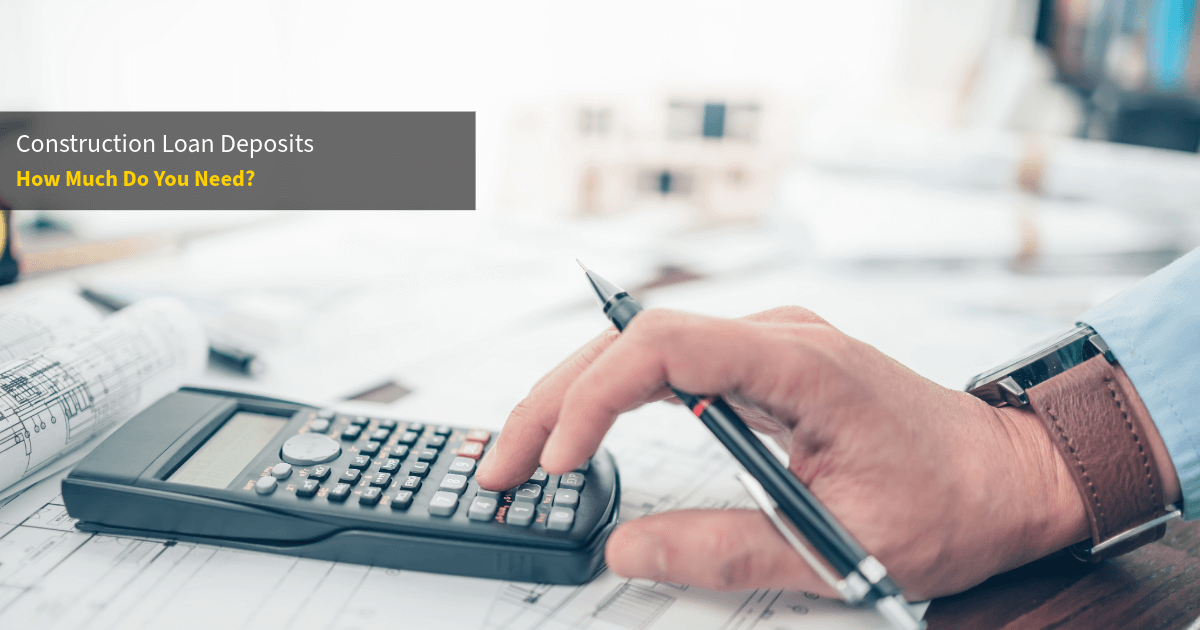
Calculator and Australian house plans showing construction loan deposit calculation with percentage requirements

Reading Time: 5 minutes
Last Updated: November 2025

Ask anyone planning to build what they’re most worried about, and “the deposit” is right at the top of the list.

How much do you actually need? Can you build with 5%? Do you need the full 20%? And why do owner-builders need 40%?

If you’re planning to build in Australia, understanding construction loan deposit requirements is critical before you sign any contracts or commit to a builder. The deposit you need depends entirely on your build type, and getting this wrong can delay your project by months—or stop it altogether.

Here’s the reality: deposit requirements for construction loans vary dramatically based on what you’re building. A house-and-land package? You might build with just 5% deposit. Owner-builder project? You’ll need 40%. The difference is massive, and most first-time builders don’t discover this until they’re already deep into planning.

In this guide, we’ll break down exactly how much deposit you need for every build scenario, how the First Home Guarantee can slash your deposit requirement from 20% to just 5%, and the strategies for building when you’re short on cash. For the complete construction loan picture, see our comprehensive Australian Construction Loan Guide.

Let’s dive in.

The Short Answer: 5% to 40% Depending on Your Build Type

Here’s what you need to know upfront:

“Look, 5-20%. If you’re doing owner builder or something more exotic, it might go up to 30-40%.”
— Craig Vaughan, Building Loans Australia (Video timestamp: 31:00-31:15)

That’s the reality in 2025. Your deposit requirement isn’t fixed—it scales based on risk from the lender’s perspective.

Quick Reference Table:

Build Type Minimum Deposit Typical Deposit With First Home Guarantee
House & Land Package 5% 10-20% 5% (no LMI)
Land First, Then Build 10% 10-20% 5% (no LMI)
Knock Down Rebuild 10% 10-20% 5% (no LMI)
Renovation 10% 10-20% 5% (if eligible)
Duplex/Dual Occupancy 10% 10-20% Not usually eligible
Owner-Builder 30-40% 40% Not eligible
Multi-Dwelling (3-4 units) 20% 20-30% Not eligible

Let’s break down each scenario and why these deposit requirements exist.

Standard Construction Builds: 5% to 20% Deposit

For the majority of Australian construction loans—house-and-land packages, land-first-then-build, knock-down rebuilds, and renovations—you’re looking at a 5% to 20% deposit requirement.

Why 20% is the Traditional Standard

Banks traditionally require 20% deposit because:

Loan-to-Value Ratio (LVR) protection: At 20% deposit (80% LVR), the lender has a comfortable equity buffer. If property values fall 10-15%, they can still recover their full loan amount by selling the property.

Lenders Mortgage Insurance (LMI) threshold: Below 20% deposit (above 80% LVR), you’ll generally need to pay Lenders Mortgage Insurance—a one-time premium that protects the lender (not you) if you default. LMI can cost $15,000 to $30,000+ depending on your loan size and deposit.

Demonstrated saving capacity: A 20% deposit shows lenders you can save consistently and manage money responsibly.

Real Numbers: What 20% Deposit Looks Like

Example 1: $450,000 House & Land Package

  • Land: $180,000
  • Build: $270,000
  • Total project: $450,000
  • 20% deposit required: $90,000
  • Loan amount: $360,000

Example 2: $600,000 Knock Down Rebuild

  • Existing property purchase: $450,000
  • Demolition + rebuild: $150,000
  • Total project: $600,000
  • 20% deposit required: $120,000
  • Loan amount: $480,000

For many builders, saving $90,000 to $120,000 takes years. That’s where lower-deposit options become game-changing.

The First Home Guarantee: Build with Just 5% Deposit

The First Home Guarantee is a federal government scheme that allows eligible first home buyers to build with as little as 5% deposit while avoiding Lenders Mortgage Insurance.

How It Works

The Australian Government guarantees up to 15% of your loan, allowing you to borrow up to 95% LVR (5% deposit) without paying LMI.

What this saves you:

On a $500,000 construction loan with 10% deposit ($50,000), your LMI would typically be $15,000 to $20,000. With the First Home Guarantee, you pay $0 in LMI and only need $25,000 deposit (5%).

Eligibility Requirements (2025):

  • ✅ Must be Australian citizen or permanent resident
  • ✅ Be 18 years or older
  • ✅ First home buyer (or haven’t owned property in Australia for 10+ years)
  • ✅ Property value under scheme caps (vary by location, typically $600,000 to $950,000)
  • ✅ Move into the property as your primary residence

For construction loans specifically:

  • Available for new builds, house-and-land packages, and land-first-then-build
  • Can be used for knock-down rebuilds
  • Generally not available for owner-builder projects or investment properties

Real Example: First Home Guarantee in Action

Sarah’s Brisbane Build (from our pillar case study):

  • Total project: $560,000 ($180,000 land + $380,000 build)
  • Sarah’s deposit: $80,000 (14.3%)
  • First Home Guarantee: Approved at 5% minimum
  • LMI saved: ~$18,000
  • Queensland First Home Grant: $30,000 cash

By using the First Home Guarantee, Sarah avoided $18,000 in LMI and could have proceeded with as little as $28,000 deposit (5%) if needed. Combined with the $30,000 QLD grant, she effectively had $110,000 equity in a $560,000 property after just the first drawdown.

The impact: Sarah started building immediately instead of saving for another 2+ years to reach 20% deposit.

Using Equity as Your “Deposit”

Don’t have cash saved? If you already own property (land or an existing home), you can use the equity in that property as your deposit for a construction loan.

How Equity Works as a Deposit

Equity calculation: (Property value × 80%) – Existing debt = Usable equity

Example 1: You Own Land

  • Land purchased 3 years ago: $150,000
  • Current value: $200,000
  • Mortgage remaining: $0 (fully paid)
  • Available equity: ($200,000 × 80%) – $0 = $160,000

You can use this $160,000 equity as your “deposit” to fund a $400,000 build without needing any cash. The lender will structure it as a construction loan secured against your land.

Example 2: You Own Your Home

  • Current home value: $600,000
  • Mortgage remaining: $300,000
  • Available equity: ($600,000 × 80%) – $300,000 = $180,000

You can use this $180,000 equity to fund a knock-down rebuild or build on a separate block of land you purchase.

The 95% Land Loan Strategy

Here’s a powerful strategy many builders don’t know about:

  1. Purchase land with a 95% land loan (5% deposit)
  2. Use your equity in an existing property to cover the 5% land deposit
  3. Immediately structure a construction loan for the build
  4. Use remaining equity to fund the build deposit

This allows you to acquire land and build with minimal cash outlay, leveraging property you already own.

Owner-Builder Deposit Requirements: 30% to 40%

Owner-builder projects face dramatically higher deposit requirements, and for good reason.

“They are treated differently. You need a bigger deposit. You got less lender requirements. They require a full quantity surveyor sort of check of your costs so to make sure that you know what your building is gonna come in on budget.”
— Craig Vaughan (Video timestamp: 31:15-32:00)

Why Owner-Builders Need 40% Deposit

Maximum 60% LVR: Most lenders will only lend up to 60% of property value for owner-builder projects, meaning you need 40% deposit.

Higher risk profile: Banks view owner-builders as significantly riskier because:

  • Statistically higher rates of incomplete builds
  • Quality concerns if the owner-builder doesn’t have professional experience
  • Longer build timelines (tradespeople prioritize paying clients)
  • Cost overruns more common

“Higher risk because you’re managing the work yourself. And so it’s just less certainty to the bank that you can do that. The bank doesn’t want to be left with a property that’s half completed and half completed by an owner builder. Also, they’re concerned about the quality. If you don’t do a good job and then you disappear or go bankrupt, the bank’s got to sell that property to get their money back. And if the property’s sort of not built that well, then they might have trouble selling it.”
— Craig Vaughan (Video timestamp: 32:00-32:30)

Real Numbers: Owner-Builder Deposit

Example: $400,000 Owner-Builder Project

  • Land: $200,000 (already owned)
  • Build cost: $200,000 (materials + trades you’ll coordinate)
  • Total project value: $400,000
  • Maximum LVR: 60%
  • Maximum loan: $240,000
  • Deposit required: $160,000 (40%)

If you’re building on land you already own, the bank will value the land-plus-completed-build at (say) $500,000 “as if complete.” At 60% LVR, they’ll lend $300,000. If your land is worth $200,000, you can borrow $300,000 – $200,000 = $100,000 for the build, meaning you need to fund the remaining $100,000 yourself (assuming your $200,000 build cost).

Additional Owner-Builder Requirements

Beyond the 40% deposit, you’ll also need:

  • Quantity surveyor’s report: Full cost breakdown reviewed by a qualified QS ($2,000 to $5,000)
  • Trade qualifications or experience: Proof you can manage the build
  • Detailed construction schedule: Month-by-month plan
  • Trade quotes and contracts: Pre-arranged subcontractors
  • Building permits and approvals: All council requirements satisfied

Learn more about owner-builder construction loans and requirements.

Duplex & Multi-Dwelling Deposits: 10% to 30%

Duplexes, dual-occupancy properties, and small multi-dwelling projects (3-4 units) typically require 10% to 20% deposit, but can go up to 30% depending on complexity.

Why Deposits Vary

Dual occupancy or duplex (2 dwellings):

  • 10-20% deposit with most specialist lenders
  • Can often achieve 90% LVR (10% deposit) at competitive rates
  • Treated as residential lending, not commercial

3-4 dwelling projects:

  • 20-30% deposit required
  • Fewer lender options (specialist construction lenders only)
  • Slightly higher rates (0.5% to 1% premium)
  • Must stay under 4 dwellings to avoid commercial lending territory

Beyond 4 dwellings:

  • Enters commercial development finance
  • 30-40% deposit standard
  • Commercial rates and terms apply

Real Example: Duplex Construction

Example: $700,000 Duplex Build

  • Land: $300,000
  • Build: $400,000 (2 × $200,000 dwellings)
  • Total project: $700,000
  • Deposit required: $70,000 to $140,000 (10-20%)
  • Loan amount: $560,000 to $630,000

At 10% deposit ($70,000), you’re accessing 90% LVR. This is achievable with specialist construction lenders who understand duplex projects and their rental income potential.

Renovation & Knock-Down Rebuild Deposits: 10% to 20%

Major renovations and knock-down rebuilds typically require 10% to 20% deposit, similar to standard new builds.

Using Your Existing Home Equity

Most people funding renovations or KDRs already own the property, so they use equity rather than cash deposits.

Example: Knock-Down Rebuild

  • Existing home value: $500,000
  • Mortgage remaining: $150,000
  • Demolition + rebuild cost: $350,000
  • Total project value post-rebuild: $750,000 (projected)

Available equity: ($500,000 × 80%) – $150,000 = $250,000

This $250,000 equity can fund your entire $350,000 knock-down rebuild without needing cash deposit. The lender structures it as a construction loan, using your existing property as security.

Learn more about knock-down rebuild finance.

Major Renovation Deposits

“If you’re doing a major renovation, do I need a construction loan? Yeah, you do need a construction loan for a major renovation. Unless you can just fund it cash, obviously if you’ve got some cash you can fund that yourself, but otherwise that is actually a construction loan.”
— Craig Vaughan (Video timestamp: 31:45-32:00)

For major renovations (typically $50,000+), you’ll need a construction loan with progressive drawdowns. The deposit requirement is usually 10-20% of the total project cost, which can often be covered by your existing property equity.

Learn more about renovation construction loans.

What If You Don’t Have Enough Deposit?

If you’re short on deposit, here are proven strategies:

1. First Home Guarantee (5% Deposit)

If eligible, this cuts your deposit from 20% to just 5% and eliminates LMI. On a $500,000 build, that’s reducing your required deposit from $100,000 to just $25,000.

2. Family Guarantor

A family member (usually parents) uses equity in their property to guarantee part of your loan, allowing you to borrow with little to no deposit.

How it works:

  • Your parents guarantee 20% of your loan using their home equity
  • You build with 0-5% cash deposit
  • Once you have 20% equity (through property value growth or paying down the loan), the guarantee is released
  • Your parents don’t need to provide cash—just equity security

This is particularly powerful for first home buyers with high income but low savings.

3. Genuine Savings Alternatives

Some lenders accept “genuine savings” alternatives if you’ve been renting and can demonstrate consistent rent payments at or above your projected mortgage repayments for 12+ months.

Rent-to-own equity recognition: If you’ve been paying $2,500/month rent for 2+ years ($60,000+ total), some lenders will consider this as evidence of savings discipline even if you don’t have $60,000 in your bank account.

4. Government Grants as Part of Deposit

First Home Owner Grants (up to $50,000 in some states) count toward your deposit once paid. Structure your application so the grant payment timing aligns with your deposit requirements.

Example: Queensland

  • QLD First Home Grant: $30,000
  • Paid early in construction (typically after slab stage)
  • Can be used to reduce your cash deposit requirement upfront if your broker structures the approval correctly

5. Using Gift Funds

Many lenders accept genuine gift funds from immediate family members as part of your deposit. Requirements:

  • Written gift declaration (not a loan to be repaid)
  • Evidence of the donor’s funds (bank statements)
  • Gift paid directly into your account (traceable)

Typically, lenders want to see at least 5% genuine savings from your own efforts, with the remainder potentially coming from gifts.

Deposit vs. Total Funds Required: Understanding the Full Picture

It’s critical to understand that your “deposit” is just one component of the total cash you’ll need.

Total Upfront Costs Beyond Deposit

Example: $500,000 House & Land Package with 10% Deposit

Cost Item Amount
Deposit (10%) $50,000
Stamp duty (varies by state, first home buyer concessions may apply) $0 to $20,000
Loan application fee $600 to $1,200
Valuation fee $300 to $800
Conveyancing/legal fees $1,500 to $3,000
Builder’s deposit (5-10% of build cost, separate from loan deposit) $15,000 to $30,000
TOTAL CASH NEEDED UPFRONT $67,400 to $105,000

Many builders focus only on the “deposit” and forget about stamp duty, legal fees, and the builder’s upfront deposit. Budget for the full amount to avoid surprises.

Ongoing costs during construction:

  • Interest payments (escalating from $1,000 to $2,700/month)
  • Rent (if still renting during build): $2,000 to $3,000/month
  • Rates and utilities on land while building
  • Progress payment inspection fees: $200 × 6 stages = $1,200

Ensure you can afford not just the deposit, but the ongoing costs throughout your 12 to 18-month build period.

How ProgressProtect™ Maximizes Your Deposit Strategy

At Building Loans Australia, we’ve helped thousands of builders structure their deposits optimally through our ProgressProtect™ Clear-Path Approval methodology.

We Help You:

Maximize government grants:

“We will help you avoid restrictive lenders, maximize the grants, make sure they’re paid on time and you know when they’re going to be paid so you can manage your cash flow.”
— Craig Vaughan (Video timestamp: 33:00-33:20)

We ensure you’re accessing every dollar of government assistance—First Home Guarantee, state grants, stamp duty concessions—and structure your approval so grant timing aligns with your deposit requirements.

Access low-deposit pathways: We know which lenders offer the most competitive rates for 5-10% deposits, and which lenders specialize in equity-based lending when you’re using existing property as security.

Include extras from the start: Instead of saving cash for pools, fences, landscaping, we structure your loan to include these items upfront:

“Include extra from the start like pool or fences and things like that to save you cash or just to get you the best property you know a complete product that you want.”
— Craig Vaughan (Video timestamp: 33:20-33:30)

This preserves your cash reserves for contingencies and ongoing costs during the build.

Navigate complex scenarios: Owner-builder, duplex, land-first-then-build with equity—these require specialist lender knowledge. We match your specific situation to the right lender with the best deposit requirements.

Your Next Steps

Understanding construction loan deposit requirements is the first step to making your build financially achievable. Now you know:

✅ Standard builds require 5-20% deposit (5% with First Home Guarantee)
✅ Owner-builders need 30-40% deposit due to higher risk
✅ You can use equity in existing property as your “deposit”
✅ Total cash needed upfront is more than just the loan deposit
✅ Strategic structuring can minimize your deposit requirement

But knowing the requirements and actually structuring your finance optimally are two different things. The families who build successfully are the ones who work with construction finance specialists who understand every deposit strategy, lender requirement, and government scheme available.

Ready to find out exactly how much deposit you need for your specific build?

Book a free ProgressProtect™ consultation with Building Loans Australia. We’ll review your financial position, build plans, and show you the exact deposit required—plus strategies to minimize it where possible.

Or call us today: 1300 410 149

For more construction loan guidance:

  • Complete Australian Construction Loan Guide
  • Construction Loans Australia
  • Owner Builder Loans
  • 95% Land Loans
  • Download: The Quick-Start Guide to Construction Loans

About the Author

Craig Vaughan, Founder — Building Loans Australia
Craig founded Building Loans Australia in 2011 after building his first home and realizing the construction loan process was unnecessarily complicated. With over 20 years of experience in finance and 15 years specializing exclusively in construction lending, Craig and his team have helped thousands of Australian families navigate the complexities of building finance through the proven ProgressProtect™ methodology.


Disclaimer: This content is for general information and educational purposes only. It does not constitute financial, legal, or taxation advice. Deposit requirements, LVR limits, and eligibility criteria vary by lender and may change. Individual circumstances differ: always seek professional advice for your specific situation.

Filed Under: Uncategorized

Book Your Free Consult

"*" indicates required fields

We respect your privacy.

Just wanted to stop for a minute and express that how grateful we are for all the help and professionalism you have demonstrated thus far. You have shown an utmost customer service in addition to your knowledge and experience. You have made this experience a pleasure for us and I am very happy to refer your services to others and also provide a formal reference. Once again, many thanks.

David Singh (Western Australia)

Special thanks to Craig Vaughan, who all though the process was very forthcoming and always available to my queries. Job well done!

Srindhi Alphonse

Extremely helpful and prompt in service. Dealing with Ian and his team was easy and we will not hesitate recommending his services, and using his services in the future.

Kirsty Jackson

CALL 1300 410 149

Talk to the experts

  • Australia wide
  • Free service
Enquire Online Now

Our Partners

logo_afg
logo_amp
logo_anz
logo_bankwest
logo_cba
logo_heritage
logo_ingdirect
logo_nab
logo_stgeorge
logo_suncorp
logo_westpac
Footer Logo

Building Loans Australia are Australia's #1 Specialists in Helping Professionals Get Fast Home Loan Approval, at a Great Rate.

Footer Logo

Contact Building Loans Australia

1300 410 149

Offices in Sydney, Melbourne and Brisbane

© buildingloanaustralia.com.au | Copyright . All Rights Reserved. | Privacy Statement

Please enter your email to gain Free Instant Access to...

"The Quick-Start Guide To Building & Construction Loans"

Discover how to save time, money and stress when building your dream home or investment property.

We respect your privacy

Book Your Free Consult

We respect your privacy

90%

Please enter your email to gain Free Instant Access to ...

“The Quick-Start Guide to Building & Constraction Loans”

Discover how to save time, money and stress when building your dream home or investment property.

We respect your privacy