
Reading Time: 8 minutes
Last Updated: November 2025
If you’ve ever wondered why construction loans feel so much more complicated than regular home loans, the answer comes down to two words: progress payments.
Unlike standard mortgages where the full amount is released at settlement, construction loans work on a staged drawdown schedule. Money is released progressively as your build reaches specific milestones—typically across 5 to 6 stages over 12 to 18 months.
Here’s the reality: most first-time builders don’t fully understand how construction loan progress payments work until they’re already mid-build. They don’t realize that their builder won’t get paid until after each stage is inspected and approved. They’re surprised when the bank requests documentation they didn’t know existed. And they’re caught off-guard when progress payment delays create tension with their builder and push out their timeline.
If you’re planning to build in Australia, understanding the construction loan progress payment process is absolutely critical—not just for avoiding delays, but for maintaining a healthy relationship with your builder and protecting your project timeline.
In this guide, we’ll walk you through exactly how the 6-stage drawdown process works, what triggers each payment release, why banks structure it this way, and the critical payment limits that protect both you and your builder. For the complete construction loan picture, see our comprehensive Australian Construction Loan Guide.
Let’s dive in.
Why Construction Loans Use Progress Payments (And Why It Protects You)
Before we break down the stages, it’s important to understand why banks use this progress payments system.
Think about it from the lender’s perspective: if they handed over $500,000 upfront for a $250,000 land purchase and $250,000 build, what happens if your builder goes bankrupt halfway through? The bank has released all the money, but you’ve only got a half-finished house. The bank would lose their money, and you’d be stuck with an incomplete build.
Progress payments protect everyone involved:
For the lender: They’re only advancing money as actual value is being created. If your builder disappears after slab stage, the bank has only released funds for work that’s actually complete. They still have funds remaining to help you engage a new builder to finish the job.
For you: You’re not paying for work that hasn’t been done yet. The bank’s inspection process at each stage verifies that the work is complete to the required standard before releasing funds.
For your builder: They receive regular, predictable payments as they complete each milestone. This keeps their cashflow healthy and incentivizes them to complete each stage properly.
“The banks don’t want to just hand over the entire amount for the land and the entire amount for the build because there’s nothing built yet. If they handed over $500,000 and the builder went bankrupt, the bank would lose their money. So what they do to protect themselves is they fund the build in what we call progress draws. They fund the build as work is done. Only once the work is done do they fund it.”
— Craig Vaughan, Building Loans Australia
The Critical Payment Limits: Front-Loading vs. Completion Incentives
Here’s something most builders don’t know until they’re negotiating their build contract: banks have strict limits on how much can be paid at each stage.
Why? Two reasons:
1. Preventing Front-Loaded Payments
Banks don’t want builders receiving too much money upfront before substantial work is complete. If a builder gets 50% of the total contract value after just the slab and frame (representing maybe 30% of actual work), they have less financial incentive to finish the build on time.
Typical bank limits:
- Deposit + Slab: Maximum 15-20% of total build cost
- Frame stage: Maximum 40-45% cumulative
- Lock-up stage: Maximum 65-70% cumulative
These limits prevent builders from being “over-paid” relative to work completed, which protects you from abandonment risk.
2. Ensuring Completion Incentive (The “Carrot”)
Just as importantly, banks want to ensure the builder has a sufficient “carrot” remaining to complete the final stages. The last 10-15% of your build cost (practical completion payment) must be substantial enough that your builder is financially motivated to finish every detail, attend to defects, and hand over keys.
“The bank needs to have a big enough carrot remaining to finish the build. They don’t want the builder to have received 95% of the payment with 20% of the work still to do-that’s when builders lose motivation and delays happen.”
— Craig Vaughan
What this means for your build contract:
When you review your builder’s proposed progress payment schedule, check that it aligns with industry standards and lender requirements. If your builder is requesting 25% at slab stage and 35% at frame stage (60% total for just two stages), that’s front-loaded and will likely be rejected or modified by your lender.
HIA and Master Builders recommended schedules:
- Housing Industry Association (HIA) payment guidelines provide industry-standard payment schedules
- Master Builders Australia also publishes recommended progress payment structures
These schedules are designed to balance builder cashflow with completion incentives, and most major lenders follow these guidelines closely.
The 6 Construction Stages: When Money Gets Released
Now let’s break down the typical 6-stage progress payment schedule. While percentages can vary slightly by lender and builder, this represents the standard structure across Australian construction loans.
Stage 0: Land Settlement & Builder’s Deposit (5-10%)
What happens:
- You settle on the land purchase
- You pay your builder’s initial deposit (typically 5-10% of build cost)
- Your construction loan is activated
What gets paid:
- Full land purchase price
- Builder’s deposit (e.g., $35,000 on a $350,000 build)
- Any upfront loan establishment fees
Your interest starts here: Even though not a single brick has been laid, you’re now paying interest on the land purchase amount plus the builder’s deposit. This is why understanding interest creep is so critical (we’ll cover this shortly).
Timeline: This happens at land settlement, before construction begins.
Stage 1: Slab/Base Stage (10-15%)
What’s completed:
- Site preparation, clearing, and excavation
- Footings and foundation work
- Concrete slab poured (or pier-and-beam base)
- Underground plumbing and essential services
- Termite treatment if required
Progress inspection required: This is your first experience with the lender’s inspection process. Your builder will request the drawdown, and the lender will send a valuer to verify the stage is complete to the required standard.
Inspection timeline: Typically 3-7 business days from your builder’s drawdown request to funds release. During busy periods (summer building season), this can extend to 10 to 14 days.
Inspection fee: You’ll pay approximately $200 for each progress inspection (this is separate from your loan interest and repayments).
Typical drawdown: 10-15% of total build cost (e.g., $35,000 to $52,500 on a $350,000 build)
“The slab goes down and the builder wants to be paid 10 to 15% for that slab, and the bank will fund that. At land stage, they’ve funded the land. If the builder goes bankrupt here, no stress—just find any builder. The bank won’t lose out and nor will you as the client.”
— Craig Vaughan (Video timestamp: 9:00-10:00)
How it works in practice:
- Your builder completes slab stage
- Builder requests drawdown from lender (through you or your broker)
- Lender’s inspector visits site (you pay ~$200 inspection fee)
- Inspector confirms slab is complete
- Funds released directly to your builder (typically 3-5 business days after approval)
- You don’t handle the money—it goes straight from lender to builder

Stage 2: Frame Stage (20-25%)
What’s completed:
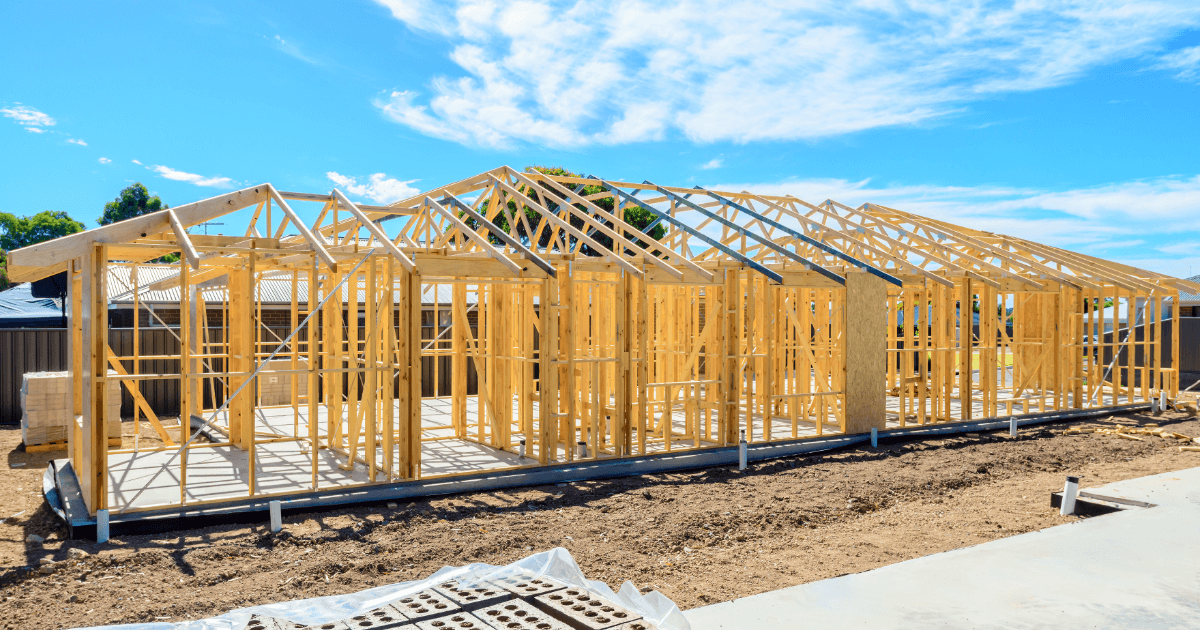
- Timber or steel frame erected and secured
- Roof trusses installed
- External wall frames constructed
- Windows and external doors fitted
- Structural inspections passed
Why this is your biggest single drawdown: The frame represents substantial material costs (timber, steel, trusses) and significant labour. This is typically your largest single-stage release percentage.
Typical drawdown: 20-25% of build cost (e.g., $70,000 to $87,500 on a $350,000 build)
Cumulative amount drawn: After frame stage, you’ve now drawn approximately 35-50% of your total loan. Your interest payments have increased significantly from Stage 1.
Timeline: Frame stage usually takes 4 to 8 weeks after slab completion, depending on weather, material availability, and trade schedules.
Stage 3: Lock-Up Stage (20-25%)
What’s completed:
- External cladding and rendering applied
- Roof tiles or metal roofing fully installed
- Garage doors fitted
- All external doors and windows installed and sealed
- Property is fully enclosed, weatherproof, and can be locked
Why it’s called “lock-up”: Your house is now protected from weather and can be secured with a key. This is a significant milestone because internal work can proceed regardless of weather conditions (theoretically—trade availability can still cause delays).
Typical drawdown: 20-25% of build cost (e.g., $70,000 to $87,500 on a $350,000 build)
Cumulative amount drawn: You’ve now drawn approximately 65-75% of your total loan.
What this means for interest: Your monthly interest payments are now more than double what you were paying at slab stage. If you started at $1,200/month interest, you’re now paying $2,600+ per month.

Stage 4: Fixing/Fit-Out Stage (20-25%)
What’s completed:
- Plasterboard (gyprock) walls and ceilings installed
- Kitchen cabinetry, benchtops, and appliances fitted
- Bathroom fixtures, tiles, vanities installed
- Flooring throughout (tiles, carpet, timber, vinyl)
- Internal doors and hardware
- Painting completed (walls, ceilings, trim)
- Light fittings, switches, power points installed
- Major fixtures like ovens, cooktops, rangehoods
Why this stage takes the longest: This is where your selections and upgrades become reality. Delays in tile delivery, custom cabinetry lead times, or appliance availability can push this stage out by weeks or even months.
Typical drawdown: 20-25% of build cost (e.g., $70,000 to $87,500 on a $350,000 build)
Cumulative amount drawn: You’ve now drawn approximately 85-95% of your total loan. You’re nearly at maximum interest payments.

Stage 5: Practical Completion & Final Inspection (10-15%)
What’s completed:
- All defects identified and rectified (from your pre-settlement inspection)
- Final clean completed throughout
- Occupancy Certificate or Certificate of Completion issued by council
- All warranties, manuals, and documentation provided
- Keys handed over to you
The final inspection process:
- Builder’s defects inspection: Your builder will walk you through the property for your “defects inspection.” This is your opportunity to identify any minor issues (paint touch-ups, fixture adjustments, etc.) for rectification before final payment.
- Lender’s final inspection: The lender’s inspector does a final check to confirm the build is complete and matches the approved plans and specifications.
- Council’s occupancy certificate: Council inspects and issues your Occupancy Certificate, confirming the build complies with all regulations and is safe to occupy.
Critical advice:
“Never rush practical completion. Take your time during the defects inspection. Once you sign off and the final payment is released, getting your builder back to fix issues becomes much harder. They’ve been paid in full and moved on to the next project.”
— Craig Vaughan
Typical drawdown: 10-15% of build cost (e.g., $35,000 to $52,500 on a $350,000 build)
This is the “carrot”: This final payment is substantial enough (often $35,000 to $75,000 depending on your build cost) to ensure your builder is motivated to complete every detail, rectify all defects, and ensure you’re 100% satisfied before receiving their final payment.
Loan conversion: Once this final payment is made, your construction loan will automatically convert to a standard principal-and-interest home loan (unless you’ve arranged for a longer interest-only period, perhaps for an investment property).

Progress Payment Fees: What You’ll Actually Pay
Beyond your interest payments, there are specific fees associated with the progress payment process:
Inspection fees: $150 to $300 per stage (typically $200)
- You’ll typically pay this 2-3 times throughout your build
- Total inspection fees: $300-$600
Construction loan progress payments admin fees: $150 to $200 per drawdown
- Charged by some lenders each time they process a progress payment
- Total admin fees: $900 to $1,200 over 6 stages
“The only real additional fee for a construction loan is you’ve often got to pay like a $150 to $300 admin payment every time the bank does a progress payment. So when they pay for the slab, they’re going to charge you $150. When they pay for the frame, $150.”
— Craig Vaughan (Video timestamp: 15:00-16:00)
These fees are in addition to standard loan fees (application fees, valuation fees, etc.) and your interest costs.
How Interest Payments Escalate: The Reality Most Builders Miss
Let’s talk about what happens to your interest payments as money is progressively drawn.
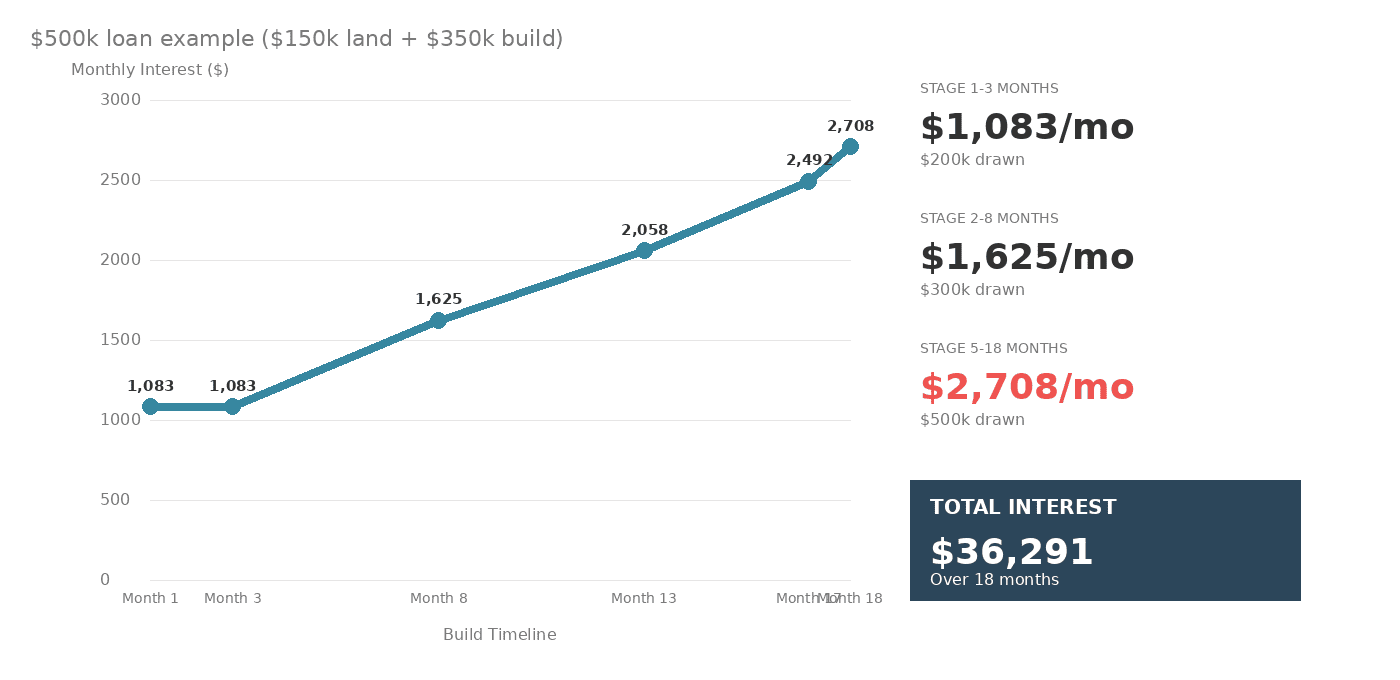
Real example: $500,000 construction loan at 6.5% interest over 18 months
| Stage | Amount Drawn | Monthly Interest | Timeline |
|---|---|---|---|
| Land + Deposit | $200,000 | $1,083/month | Months 1-3 |
| Slab | $250,000 | $1,354/month | Months 4-5 |
| Frame | $325,000 | $1,760/month | Months 6-9 |
| Lock-up | $400,000 | $2,167/month | Months 10-13 |
| Fit-out | $475,000 | $2,573/month | Months 14-17 |
| Completion | $500,000 | $2,708/month | Month 18 |
Your interest payments nearly triple from $1,083/month to $2,708/month over the 18-month build period.
Total interest paid over 18 months: Approximately $36,291
The rent + interest overlap: If you’re renting at $2,200/month while building, you’re paying combined costs of:
- Months 1-3: $3,283/month (rent + initial interest)
- Months 14-18: $4,908/month (rent + maximum interest)
This is why cashflow planning is absolutely critical. Many builders budget for the initial $1,083/month interest payment and get shocked when combined rent + interest hits nearly $5,000/month by completion.
With Building Loans Australia’s ProgressProtect™ Buffer & Breathe methodology, we create a detailed month-by-month cashflow forecast showing exactly what you’ll pay at each stage—so there are no surprises.
What Slows Down Progress Payments (And How to Avoid Delays)
The most common causes of delayed progress payments:
1. Incomplete Stage Documentation
Your builder submits a drawdown request, but hasn’t provided all required documentation (insurances, licences, invoices, etc.). The lender won’t process until everything is complete.
Solution: Use a construction finance specialist broker who knows exactly what each lender requires and ensures your builder submits complete documentation first time.
2. Failed Inspections
The lender’s inspector identifies defects or incomplete work. Funds won’t release until issues are rectified.
Solution: Your builder should do their own quality checks before requesting the drawdown. Reputable builders rarely fail inspections.
3. Lender Processing Delays
Some lenders are simply slower than others at processing progress payments. While most release funds within 7-10 days, some take 14-21 days.
Solution: Work with a broker who knows which lenders have fast progress payment processes and avoids slow lenders for construction finance.
Progress Payments for Different Build Types
Not all builds follow the same drawdown schedule:
Owner-builder projects:
- Generally require 6-8 stages instead of 5-6 (more frequent inspections due to higher risk)
- More detailed quantity surveyor involvement at each stage
- Often stricter inspection requirements
- Funds may be released to you rather than directly to tradespeople
Learn more about owner-builder construction loans.
Renovations:
- Payment stages based on specific renovation milestones (demolition, structural work, fit-out, completion)
- Often 4-5 stages instead of 6
- May require before-and-after valuations
Knock-down rebuilds:
- Additional stage for demolition (typically 5% of build cost)
- Otherwise follows standard 6-stage process
How ProgressProtect™ Keeps Your Payments Flowing
At Building Loans Australia, we’ve seen hundreds of builds delayed simply because progress payment coordination broke down between builder and lender.
Our ProgressProtect™ Builder-Lender Sync system prevents this:
We act as the intermediary coordinating between your builder’s progress claims and your lender’s inspection and payment processes. When your builder says “frame stage is complete,” we know exactly:
- What documentation the lender needs
- What inspections are required
- How to fast-track the payment release
We track lender timeframes proactively, arranging extensions before approvals lapse (construction loan approvals typically expire after 12 months—if your build extends beyond that, you need to re-apply, which we handle before it becomes urgent).
We keep everyone connected: builder, lender, valuer, and you. Everyone knows where the build stands, what’s coming next, and what actions are required.
Result: Smooth progress payments, no funding delays, happy builder, construction timeline maintained.
Your Next Steps
Understanding the 6-stage progress payment process is critical to managing your build successfully. Now you know:
✅ Why banks use construction progress payments/drawdowns (to protect everyone)
✅ The critical payment limits that prevent front-loading and ensure completion incentives
✅ Exactly what happens at each of the 6 stages
✅ How much you’ll pay in inspection and admin fees
✅ How your interest payments escalate throughout the build
✅ What causes payment delays and how to avoid them
But knowledge alone doesn’t keep your build moving smoothly. The families who succeed are the ones who work with construction finance specialists who coordinate the entire process from approval through completion.
Ready to build with confidence?
Book a free ProgressProtect™ consultation with Building Loans Australia. We’ll review your build plans, show you exactly how our Builder-Lender Sync system keeps payments flowing smoothly, and create your customized construction finance roadmap.
Or call us today: 1300 410 149
For more construction loan guidance:
- Complete Australian Construction Loan Guide
- Construction Loans Australia
- Download: The Quick-Start Guide to Construction Loans
About the Author
Craig Vaughan, Founder — Building Loans Australia
Craig founded Building Loans Australia in 2011 after building his first home and realizing the construction loan process was unnecessarily complicated. With over 20 years of experience in finance and 15 years specializing exclusively in construction lending, Craig and his team have helped thousands of Australian families navigate the complexities of building finance through the proven ProgressProtect™ methodology.
Disclaimer: This content is for general information and educational purposes only. It does not constitute financial, legal, or taxation advice. Progress payment structures, percentages, and fees vary by lender and may change. Individual circumstances differ: always seek professional advice for your specific situation.