Building Loans Australia

Building Loans for every Australian

Australia-wide:

1300 410 149

Australia-wide:

1300 410 149

  • Home
  • Free Guide
  • Home Loans
    • Land Loans
      • No Deposit with Guarantor
      • 95% Land Loan (genuine & non-geniune savings)
      • Rural Land Loans
      • Acreage Loans
      • Vacant Land Considerations
    • House and Land Package Home Loan
      • No Deposit with Guarantor
      • House and Land Packages
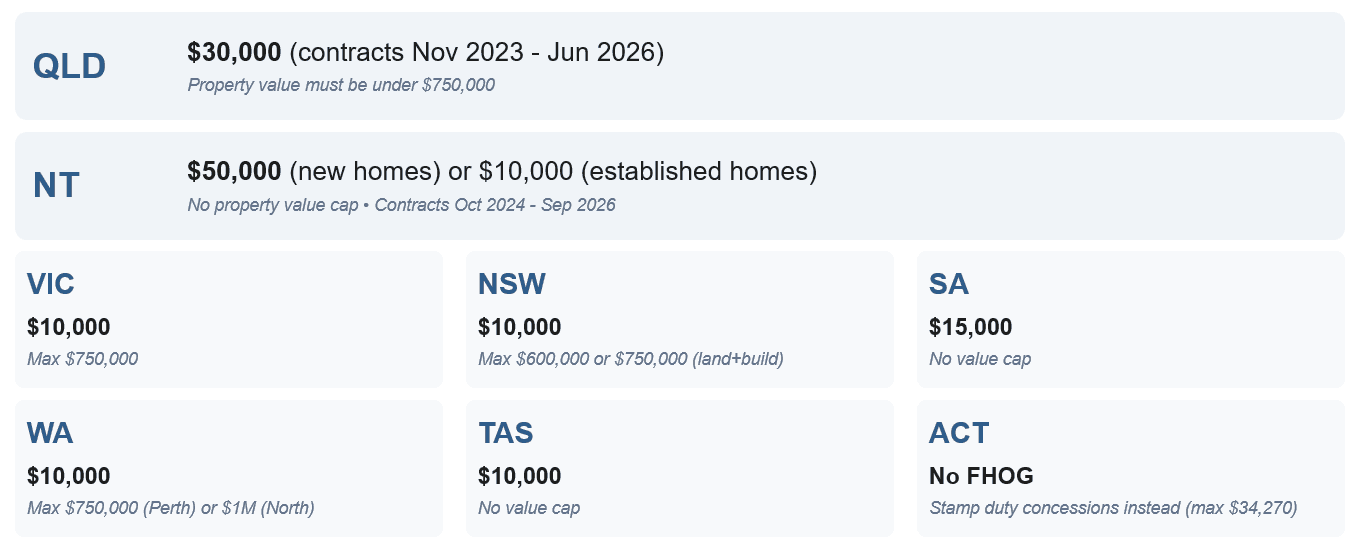
      • First Home Buyers – Government Incentives
    • Construction Loans
      • No Deposit with Guarantor
      • 95% Land Loan (genuine & non-geniune savings)
      • Construction Pre-Approval Home Loan
      • Low Doc Construction Loan
      • Rural Home Loans
    • Investment
      • Investment Construction
      • Government Grants/Incentives for Investors
      • NRAS Loans
    • Other Types Of Construction
      • Off the Plan Construction Home Loan
      • KnockDown Rebuild Home Loans: The Complete Guide 2026
      • Home Renovation Loan
      • Low Valuation Shortfall Home Loan
      • Owner Builder Loan
      • Extension Home Loan
      • Home Equity Loan
  • FAQ
    • Frequently Asked Questions
    • Construction & Building Guide
    • Construction Loans – How They Work
    • Fixed Rates Loans for Construction
    • First Home Buyers – Government Incentives
    • Valuation Myths for Residential Property
  • Blog
  • About
    • Testimonials
  • Contact
  • Free Strategy Session

Construction Loan Mistakes: 7 Costly Errors to Avoid (2026)

February 13, 2026 by Craig Vaughan

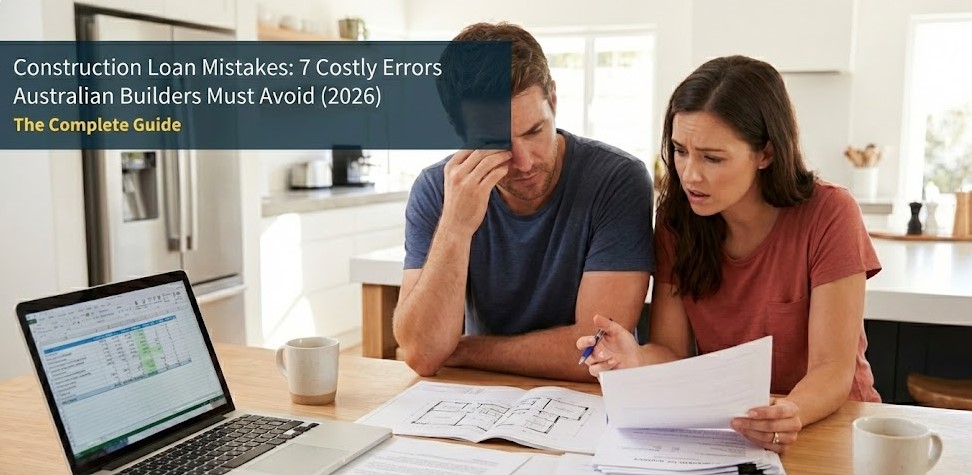
Australian couple reviewing construction loan documents with house plans, avoiding common construction loan mistakes

Building your own home should be one of the most exciting things you ever do. But construction loan mistakes can turn that excitement into a financial nightmare, and they almost always happen before you even break ground. With 3,217 construction companies collapsing in 2024 and build costs up 30.8% since COVID, the margin for error has never been thinner.

Construction finance is fundamentally different from a standard home loan. Staged drawdowns, builder dependencies, as-if-complete valuations, rising interest during the build: these are the moving parts that catch even experienced property buyers off guard. If you’ve ever worried about budget blowouts, approval delays, or what happens if your builder goes under, you’re not alone (we hear this every single week).

In this guide, we’ll walk you through the seven most expensive building loan errors we see in practice, with real dollar figures and the steps to avoid each one. For a broader overview of how construction finance works, see our complete Australian construction loan guide.

Let’s unpack what goes wrong, and how to make sure it doesn’t.

In this guide:

  • Why These Errors Cost More in 2026
  • Mistake 1: Underestimating Your Build Timeline
  • Mistake 2: Not Vetting Your Builder’s Financial Health
  • Mistake 3: Choosing the Cheapest Builder
  • Mistake 4: Ignoring the Contract Fine Print
  • Mistake 5: Skipping Construction Loan Pre-Approval
  • Mistake 6: Forgetting About Interest Creep and Hidden Costs
  • Mistake 7: Using a Generalist Broker for Specialist Finance
  • How Building Loans Australia Helps You Avoid These Errors
  • Frequently Asked Questions About Construction Loan Mistakes

Why Construction Loan Mistakes Cost More in 2026

The construction lending landscape has shifted significantly in the last 12 months. The RBA raised the cash rate to 3.85% in February 2026, the first hike since November 2023. Builder insolvencies hit a record 3,217 in calendar year 2024, up 26% on the year before. And construction costs are now 30.8% higher than pre-COVID levels, according to Housing Industry Association data.

Here’s the silver lining, though. APRA’s new debt-to-income lending limits, activated in February 2026, explicitly exempt construction loans. That gives borrowers building new homes a genuine advantage over buyers of existing property. But only if you avoid the errors that derail builds every day.

3,217
Builder insolvencies in 2024 (ASIC)
30.8%
Build cost increase since COVID
69%
Of projects exceed budget by 10%+ (KPMG)

Mistake 1: Underestimating Your Build Timeline

This is the single most common construction loan pitfall we see. Everyone wants to believe their build will take six to nine months. The reality? The national average for a detached house is now 11.5 months, and that’s the average. Queensland builds come in around 9 months, but Western Australia averages over 15 months.

Why does this matter for your loan? Because every extra month means extra interest payments, continued rent, council rates, and holding costs you didn’t budget for. An 18-month build at 6% on a $450,000 loan costs roughly $40,500 in interest alone. Budget for nine months instead, and you’re $13,500 short before you even factor in rent.

“Everyone wants to think their build only takes six or nine months. I’ve had this happen recently: just finished building two houses that were supposed to finish in nine months and took two years.”

– Craig Vaughan, Building Loans Australia

Our recommendation? Budget for 18 months and hope to be pleasantly surprised. We call this the “Buffer and Breathe” approach, and it’s baked into every construction finance plan we build. If the build finishes early, you’ve saved money. If it runs over (and most do), you’re prepared.

Mistake 2: Not Vetting Your Builder’s Financial Health

With 3,217 construction companies entering insolvency in 2024, builder vetting isn’t optional anymore. It’s essential. Construction accounts for roughly 25% of all company failures nationally, making it the single largest sector for insolvencies.

The collapse of Porter Davis Homes alone left 1,700+ homes unfinished. Roberts Co’s Victorian arm abandoned 8 major projects in March 2025. And here’s the part most people don’t realise: your builder deposit is not ring-fenced in a trust account. Builders can, and do, spend customer deposits as general operating cash.

Home warranty insurance exists, but coverage varies wildly by state.

Before you sign a contract, check your builder’s licence status through the QBCC (QLD), Fair Trading (NSW), or the VBA (VIC). Ask for references from recently completed builds. And request a copy of their contract works insurance.

Mistake 3: Choosing the Cheapest Builder (Not the Right One)

A lower quote doesn’t always mean a better deal. In fact, the cheapest builder often ends up being the most expensive one.

The reason? Low quotes usually mean low inclusions. That attractive price might not cover things you’ll absolutely need: a full-width driveway, blinds, landscaping, fencing, or even adequate site preparation. These become variations or out-of-pocket costs that blow your budget after the contract is signed.

Craig knows this firsthand:

“Our most recent example was our concrete driveway. They came to us and said, ‘Look, you’ve got enough just for it, but it’d be very narrow and skinny.’ So just keep that in mind when choosing your cheapest builder.”

– Craig Vaughan, Building Loans Australia

ACTION ITEM: Ask every builder for a detailed inclusions list before comparing quotes. Compare like for like: same specifications, same inclusions, same allowances. A $20,000 difference in quotes often disappears once you equalise the inclusions.

Mistake 4: Ignoring the Contract Fine Print

Your building contract is a legal document, not a formality. And there are clauses buried in the fine print that can cost you tens of thousands of dollars if you miss them.

Liquidated damages clauses are the big one. These determine what the builder pays you per day if they run over schedule. In standard HIA contracts, this figure is often set at $1 per day, or nothing at all. Think about that: your builder overruns by six months, and your compensation is $180 while you’re paying $2,500 a month in interest and rent.

“We had a contract where there was a no-media clause: you weren’t allowed to contact media, meaning I almost couldn’t provide a testimonial or feedback on the builder on Google or Facebook. Look very closely at the fine print for liquidated damages. If they are delayed, you want to be compensated and paid for those delays.”

– Craig Vaughan, Building Loans Australia

Cost escalation clauses are another trap. In NSW, Queensland, SA, and other states, no such prohibition exists. If your contract includes a cost escalation clause, your “fixed price” might not be fixed at all.

Have your contract reviewed by a construction-savvy solicitor or conveyancer before signing. The few hundred dollars in legal fees could save you five figures.

📘 Want the full picture?
Download our free Quick-Start Guide to Construction Loans: covers everything from pre-approval to settlement, including a contract review checklist.

Download Free Guide →

Mistake 5: Skipping Construction Loan Pre-Approval

Signing a building contract before getting construction loan pre-approval is one of the most expensive construction finance mistakes you can make. And it happens more often than you’d think.

Here’s why it’s so risky. The bank will do an “as-if-complete” valuation, assessing what the property will be worth once the build is finished. If that valuation comes in lower than the combined land and build cost, you’ll face a shortfall. Challenging a low valuation has less than a 5% success rate.

A worked example: on a $600,000 block with a $400,000 build, if the valuation comes back at $900,000 instead of $1,000,000, an 80% LVR allows only $720,000 in lending. After the land loan, only $240,000 remains for construction: a $160,000 shortfall you’ll need to fund from somewhere else.

💡 Pro Tip

Get your pre-approval sorted before you sign the building contract. If the valuation comes back low, you still have options: adjusting the build, switching lenders, or restructuring. Once you’ve signed, your options shrink dramatically. Learn more about how the construction loan process works.

Mistake 6: Forgetting About Interest Creep and Hidden Costs

Most people budget for the land, the build, and maybe the deposit. But the costs that accumulate during construction catch families off guard more than almost anything else.

Your repayments start small (interest-only on the land portion) but grow with every progress payment drawdown. By lock-up stage, you could be paying $2,500+ per month in interest alone, often while still paying rent or a mortgage on your current home. Borrowers on extended builds report combined monthly costs approaching $4,900.

“We just built a house: ours took two years to build. You’ve got to cover the rates throughout the build. So we had two years of rates, two years of water. And if you’re not living there, you might need to pay someone to mow the lawn, otherwise you will annoy your neighbours.”

– Craig Vaughan, Building Loans Australia

Then there are the admin fees most borrowers don’t know about. Every time the bank processes a progress payment, you’ll typically pay $150 to $300 per drawdown. Add in progress inspection fees ($200 per inspection) and the initial as-if-complete valuation ($300 to $800), and total admin costs can reach $2,000 to $4,000 across a standard five to six stage build.

For a real-world example: Sarah’s build (a house and land package at $560,000) cost $42,110 in interest and fees over 18 months. That’s real money that needs to be in your budget from day one.

[IMAGE: Diagram showing how construction loan repayments increase at each build stage from land settlement through to completion, with example dollar amounts]

Mistake 7: Using a Generalist Broker for Specialist Finance

Here’s the truth: most mortgage brokers handle construction loans occasionally. Maybe a handful a year. That means they’re learning your build’s quirks on the job, at your expense.

A generalist broker might not know that Westpac only accepts five progress payments (not the standard six), that CBA now offers drawdowns during off-site prefab construction, or that some lenders charge a flat $400 for all drawdowns while others charge $300 per stage. These details matter. They affect your total cost, your approval timeline, and whether your build stays on track.

Think of it like a funnel:

“If you picture a funnel: for a standard build, you might have 30 lenders that will help you. Maybe something more complex, it’s only 10. But it’s still mainstream good lenders with competitive rates.”

– Craig Vaughan, Building Loans Australia

A specialist construction loan broker knows which lenders sit at every level of that funnel. They know who’s fastest on drawdowns, who accepts owner builder applications, who funds pools and sheds through external contractors, and who’ll give you the best rate for your specific build type. That knowledge is the difference between a smooth build and a stressful one.

How Building Loans Australia Helps You Avoid These Construction Finance Mistakes

This is exactly what we specialise in. Since 2011, Building Loans Australia has guided hundreds of construction loan borrowers from pre-approval through to settlement, across every build type: house and land packages, knockdown rebuild projects, duplex and dual occupancy builds, and everything in between.

We do this through our Progress Protect™ Method: the ABC system for construction finance.

Our Progress Protect™ Method

The proven ABC system for construction loan success

A
Approval: Navigate Complexity With Confidence
“Clear-Path” Loan Approval Methodology

We structure your loan to avoid restrictive lenders, maximise government grants, include extras from the start, and manage paperwork so you get faster approvals with fewer surprises.

B
Build: Keep Your Build Moving Smoothly
“Builder-Lender Sync” Methodology

We align builder and lender processes for smooth progress payments, handle variations fast, track timeframes so approvals don’t lapse, and keep everyone connected throughout construction.

C
Cashflow: Protect Your Finances During the Build
“Buffer & Breathe” Mantra

We plan repayments for each stage, create a clear cashflow plan for the rent-plus-mortgage period, build in buffers for delays or rate changes, and support you until keys are in hand.

Learn how Progress Protect™ works for your build →

Frequently Asked Questions About Construction Loan Mistakes

What happens if my builder goes bankrupt during construction?
+
Your home warranty insurance should cover the cost of completing the build. You’ll need to wait at least five weeks after the insolvency event before you can claim. Your construction loan specialist can help you find a new builder and restructure the remaining drawdowns.
How much contingency should I budget for a construction loan?
+
We recommend a minimum 10% contingency buffer on top of your build cost, plus a separate cashflow buffer for at least 18 months of combined interest and living expenses. KPMG data shows only 31% of construction projects complete within 10% of budget, so this isn’t being pessimistic: it’s being realistic.
Can I switch lenders during construction if I got a bad deal?
+
Switching mid-build is possible but complicated and often expensive. It typically requires a new valuation, new approval, and potentially a break fee. The better strategy is to get the right lender from the start. Once the build is complete, you can refinance to a standard home loan at a more competitive rate if needed.
What deposit do I need for a construction loan in 2026?
+
Most lenders require 5 to 20% of the total project cost (land plus build). However, if you already own land or an existing home, your equity can often serve as your deposit. First home buyers may qualify for just 5% through the First Home Guarantee scheme, which now has no cap on places and no income limits. Read more about construction loan deposit requirements.
Are construction loans exempt from APRA’s new DTI limits?
+
Yes. APRA’s debt-to-income lending limits, activated in February 2026, explicitly exempt loans for the purchase or construction of new dwellings. This gives construction borrowers a material advantage over buyers of existing homes in a tighter lending environment. The 3% serviceability buffer still applies, but the DTI exemption means your borrowing capacity won’t be artificially capped.
What’s the real cost of a construction loan versus a normal home loan?
+
Interest rates for standard builds (house and land packages, land and builds) are broadly similar to regular home loan rates. The real extra cost comes from progress payment admin fees ($150 to $300 per drawdown), inspection fees (~$200 each), and the as-if-complete valuation ($300 to $800). Across a full build, these add up to $1,000 to $2,000. The larger hidden cost is the interest you pay during construction while the build is underway, which depends entirely on build duration and loan size.

Ready to Build With Confidence?

Construction loan mistakes are expensive, but they’re also avoidable. Every error on this list has a clear prevention strategy, and it starts with getting the right guidance before you break ground.

You’ve got the knowledge. Now let’s put it to work.

Book Your Free Progress Protect™ Strategy Session

Our construction loan specialists will review your situation, run the numbers, map out every cost, and show you the clearest path to approval. No obligation, no pressure.

Book Free Strategy Session →
📞 1300 410 149

Craig Vaughan, Founder of Building Loans Australia, has been specialising in construction finance since 2011. He’s personally built five houses (most of which overran), guided hundreds of clients from slab to settlement, and developed the Progress Protect™ methodology to help Australian families build with confidence, not stress.

Related Resources

  • The Complete Australian Construction Loan Guide (2025-2026)
  • Construction Loan Progress Payments Explained
  • Construction Loan Deposit Requirements: How Much Do You Actually Need?
  • Construction Loan Pre-Approval: Get Approved Before You Build
  • What To Do About a Low Valuation Shortfall
  • Download the Free Quick-Start Guide to Construction Loans
Filed Under: Construction Loan Guides

Duplex Construction Loan: Dual Occupancy Finance Guide (2026)

February 12, 2026 by Craig Vaughan

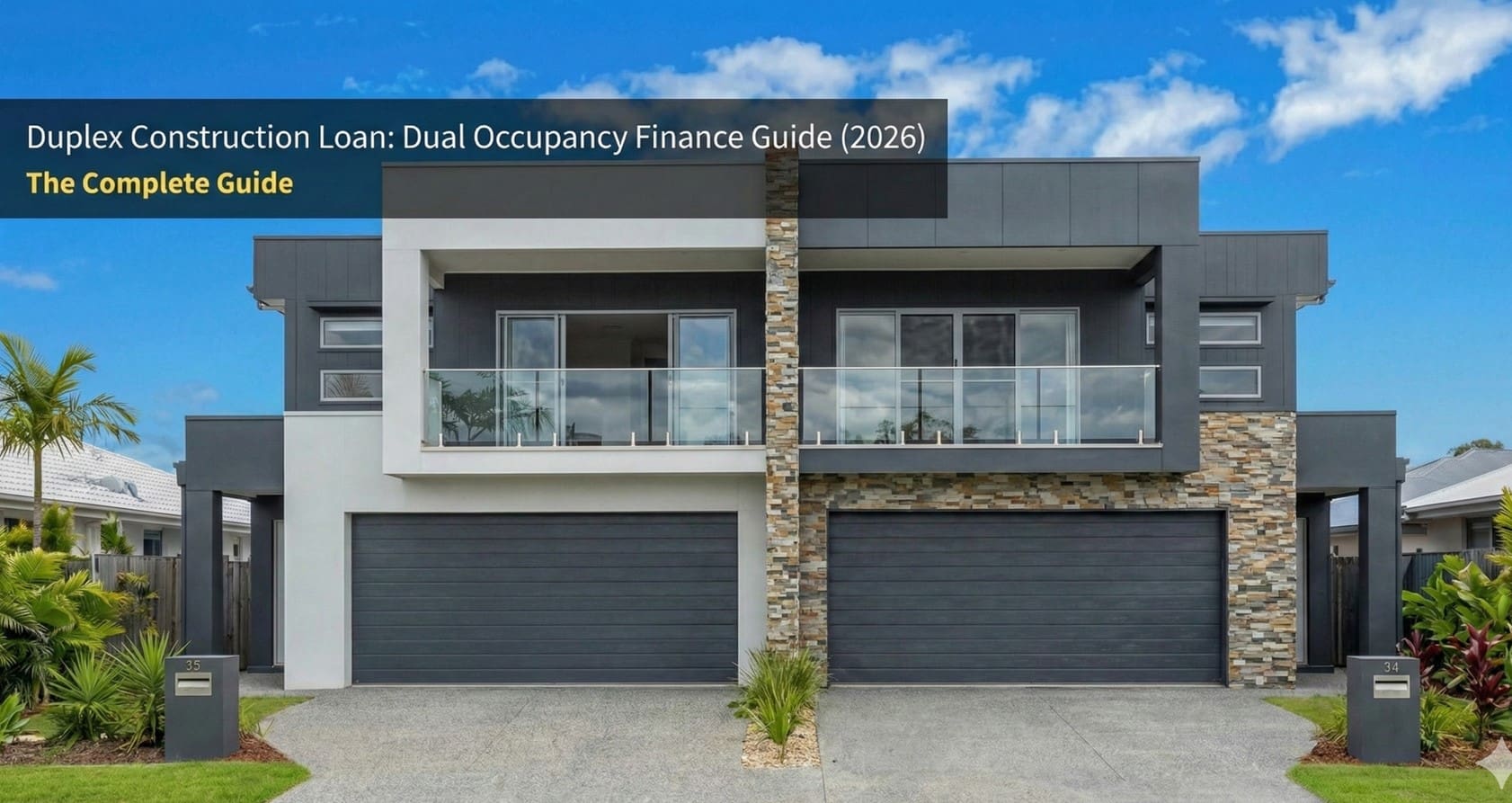
Duplex construction loan project with two modern dwellings under construction on one residential block in Australia

If you’re planning to build two dwellings on one block, getting a duplex construction loan approved is one of the first hurdles you’ll face. It’s also where most people hit a wall.

The challenge? Not every lender will touch a dual occupancy build. And the ones that will often have specific requirements around titling, valuation, and deposit that a standard home construction loan doesn’t have. If you’ve been told your project is “too complex” by a general mortgage broker, you’re not alone (we hear this almost every week).

For a complete overview of construction finance, see our complete Australian construction loan guide. This article focuses specifically on what changes when you’re building two dwellings instead of one. Here’s what you need to know.

In this guide:

  • Duplex vs Dual Occupancy: What’s the Difference?
  • How Does a Duplex Construction Loan Work?
  • Deposit Requirements and Lender Options
  • Recent Planning Reforms Are Opening Up Opportunities
  • How Building Loans Australia Can Help
  • Frequently Asked Questions

Duplex vs Dual Occupancy: What’s the Difference?

First, the terminology. These two terms get used interchangeably, but they mean different things for your finance.

A duplex is two dwellings on one block that have been (or will be) strata-titled. Think 1 John Street and 2 John Street. You can sell them separately, keep one and sell one, or hold both as investments.

A dual occupancy (or “dual occ”) is two dwellings on one title that haven’t been subdivided. A granny flat behind your main home is a common example. You can’t sell the dwellings individually until you go through the strata-titling process.

Duplex vs Dual Occupancy: Key Differences

Feature Duplex (Strata-Titled) Dual Occupancy (One Title)
Titling Separate titles (can sell individually) Single title (sold together only)
Lender appetite Broader, but still fewer than standard builds More limited, varies by lender policy
Typical deposit 10-20% of total project cost 10-20% (some lenders require more)
Exit strategy Sell one, keep one (or sell both) Must strata-title before selling separately
Common examples Side-by-side townhouses, front-and-back builds Granny flat, secondary dwelling on existing lot

Why does this distinction matter for your finance? Because lenders assess each structure differently. It doesnt matter that much to the lender whether its a dual occ or a duplex construction. Initially its building 2 properties on one title. Where it does matter is if you want to sub divide/strata title once built and whether the land and zoning allow for this.

How Does a Duplex Construction Loan Work?

The mechanics are the same as any staged construction drawdown. Your lender releases funds in stages as each phase of the build is completed: slab, frame, lock-up, fixing, and final completion.

But here’s where it gets more nuanced. Because you’re building two dwellings, the valuer conducts an “as-if-complete” valuation on the entire project. They’re assessing: what will these two dwellings be worth once they’re finished? That combined end value is what the bank lends against.

Lenders will want to see your DA approval, building contracts for each dwelling (if applicable), and evidence that the project is feasible from a planning perspective. Your council’s dual occupancy rules vary by local government area, so what flies in one suburb might not work in another.

Planning a duplex or dual occ build?
Download our free Quick-Start Guide to Construction Loans for a step-by-step overview of what you’ll need.
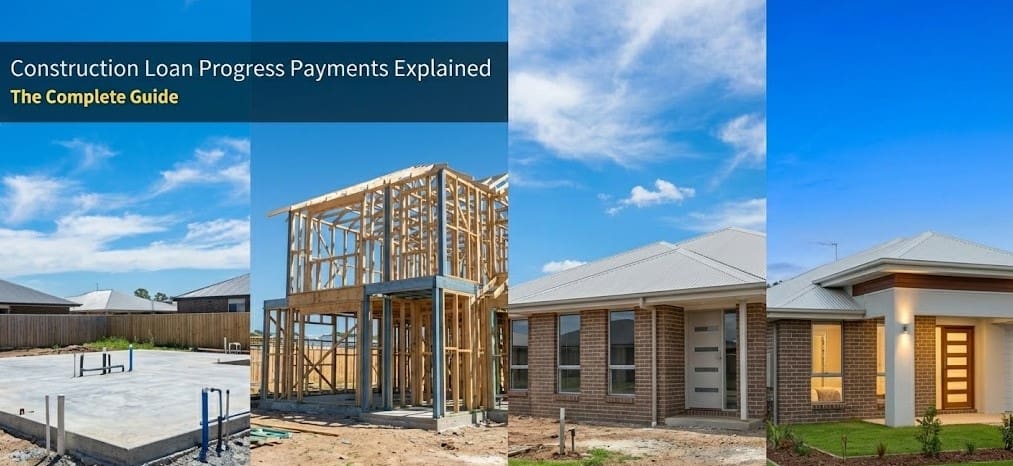
Download Free Guide →

Deposit Requirements and Lender Options

For a standard house and land package, you might have 20 lenders competing for your business. With a duplex build, that number narrows. But it’s still mainstream lenders offering competitive rates.

“If you picture a funnel: for a standard build, you might have 30 lenders that will help you. Maybe something more complex, it’s only 10. But it’s still mainstream good lenders with competitive rates.”

– Craig Vaughan, Building Loans Australia

Most lenders will want 10-20% of the total project cost as a deposit. If you already own the land, your existing equity often covers this, meaning you may not need additional cash savings. According to the Australian Bureau of Statistics, multi-dwelling approvals have been trending upward in recent years, and lenders are gradually becoming more comfortable with these projects.

That said, not all lenders treat two-dwelling builds the same way. This is precisely why working with a specialist construction broker matters: we know which lenders will say yes to your specific project type (and which ones will waste your time).

Recent Planning Reforms Are Opening Up Opportunities

Recent planning reforms across several states are making dual occupancy builds easier to approve. In NSW, the NSW Planning Portal outlines low-rise housing diversity provisions that allow complying development for dual occupancy in many residential zones.

More approvals means more lender confidence. As councils streamline the DA process for dual occ projects, lenders are following suit with more flexible policies. Queensland and Victoria have introduced similar reforms targeting medium-density housing in established suburbs.

Craig has seen this shift firsthand:

“I’ve just finished doing one recently. It’s currently rented out and in the process of being strata-titled so that I can sell one and keep one, or sell both separately.”

– Craig Vaughan, Building Loans Australia

Whether you’re looking at a duplex as a wealth-building strategy or simply to offset your mortgage with rental income, the finance is achievable. It just takes the right lender match and a well-structured application.

How Building Loans Australia Can Help

This is exactly what we specialise in. Unlike general mortgage brokers who might handle one or two dual occ loans a year, Building Loans Australia works with duplex and dual occupancy clients every week.

Our Progress Protect™ method is built for exactly this kind of complexity:

  • A: Approval – We match your project to lenders who actually approve two-dwelling builds, maximise government grants where eligible, and structure your application to avoid unnecessary delays.
  • B: Build – Our Builder-Lender Sync process keeps progress payments flowing smoothly across your build stages, so your builder isn’t chasing you for payment and you’re not chasing the bank.
  • C: Cashflow – We plan your repayments at each drawdown stage and build in buffers, so you’re not stretched thin during the construction phase (especially if you’re paying rent or another mortgage at the same time).

Frequently Asked Questions

How much deposit do I need for a duplex construction loan?
+
Most lenders require 10-20% of the total project cost (land plus both dwellings). If you already own your land or existing home, your equity often serves as your deposit. Some lenders you may only need a 5% deposit.
What’s the difference between a duplex and a dual occupancy for finance purposes?
+
A duplex has been strata-titled into separate lots, meaning each dwelling can be sold independently. A dual occupancy sits on a single title. Lenders generally view them as the same when it comes to financing, but lender selection matters.
Can I get a construction loan for a granny flat?
+
Yes. A granny flat is a form of dual occupancy (two dwellings on one title). Some lenders will finance this through a standard construction loan, while others may offer a renovation or extension loan depending on the scope of work. Building Loans Australia can help you find the right structure.
Are interest rates higher for a duplex build?
+
Not necessarily. For mainstream duplex builds, rates are typically the same as a standard construction loan. There may be a small premium if the project is more complex (e.g. four dwellings on one title), but you can often refinance to a better rate once the build is complete.
Do I need separate building contracts for each dwelling?
+
Most lenders prefer a single fixed-price contract covering both dwellings, and practically speaking this is the only realistic way to do it. Your construction loan broker can advise on what your chosen lender requires before you sign anything.

Ready to Explore Your Options?

Building two dwellings on one block is one of the smartest ways to build wealth through property. The finance is more nuanced than a standard build, but with the right broker in your corner, it’s entirely achievable.

Whether you’re planning a strata-titled duplex, a granny flat, or a side-by-side dual occ, Building Loans Australia has the specialist knowledge to match you with the right lender and keep your build moving from approval to handover.

You’ve got the knowledge. Now let’s put it to work.

Build Two. Finance Smart.

Book a free Progress Protect™ strategy session with our construction loan specialists. We’ll review your project, run the numbers, and show you exactly what’s possible.

Book Free Strategy Session →
📞 1300 410 149

Craig Vaughan, Founder of Building Loans Australia, has 20+ years experience in construction finance and has personally built multiple duplex and dual occupancy projects.

Related Resources

  • The Complete Australian Construction Loan Guide 2025-2026
  • Construction Loan Deposit Requirements: How Much Do You Actually Need?
  • Construction Loan Progress Payments Explained
  • Investment Construction Loans
  • Home Equity Loans
  • Download the Free Quick-Start Guide to Construction Loans

Filed Under: Construction Loan Guides

Construction Loan Progress Payments Explained

November 25, 2025 by Craig Vaughan

Construction Loan Progress Payments Explained

Reading Time: 8 minutes
Last Updated: November 2025

If you’ve ever wondered why construction loans feel so much more complicated than regular home loans, the answer comes down to two words: progress payments.

Unlike standard mortgages where the full amount is released at settlement, construction loans work on a staged drawdown schedule. Money is released progressively as your build reaches specific milestones—typically across 5 to 6 stages over 12 to 18 months.

Here’s the reality: most first-time builders don’t fully understand how construction loan progress payments work until they’re already mid-build. They don’t realize that their builder won’t get paid until after each stage is inspected and approved. They’re surprised when the bank requests documentation they didn’t know existed. And they’re caught off-guard when progress payment delays create tension with their builder and push out their timeline.

If you’re planning to build in Australia, understanding the construction loan progress payment process is absolutely critical—not just for avoiding delays, but for maintaining a healthy relationship with your builder and protecting your project timeline.

In this guide, we’ll walk you through exactly how the 6-stage drawdown process works, what triggers each payment release, why banks structure it this way, and the critical payment limits that protect both you and your builder. For the complete construction loan picture, see our comprehensive Australian Construction Loan Guide.

Let’s dive in.


Why Construction Loans Use Progress Payments (And Why It Protects You)

Before we break down the stages, it’s important to understand why banks use this progress payments system.

Think about it from the lender’s perspective: if they handed over $500,000 upfront for a $250,000 land purchase and $250,000 build, what happens if your builder goes bankrupt halfway through? The bank has released all the money, but you’ve only got a half-finished house. The bank would lose their money, and you’d be stuck with an incomplete build.

Progress payments protect everyone involved:

For the lender: They’re only advancing money as actual value is being created. If your builder disappears after slab stage, the bank has only released funds for work that’s actually complete. They still have funds remaining to help you engage a new builder to finish the job.

For you: You’re not paying for work that hasn’t been done yet. The bank’s inspection process at each stage verifies that the work is complete to the required standard before releasing funds.

For your builder: They receive regular, predictable payments as they complete each milestone. This keeps their cashflow healthy and incentivizes them to complete each stage properly.

“The banks don’t want to just hand over the entire amount for the land and the entire amount for the build because there’s nothing built yet. If they handed over $500,000 and the builder went bankrupt, the bank would lose their money. So what they do to protect themselves is they fund the build in what we call progress draws. They fund the build as work is done. Only once the work is done do they fund it.”
— Craig Vaughan, Building Loans Australia


The Critical Payment Limits: Front-Loading vs. Completion Incentives

Here’s something most builders don’t know until they’re negotiating their build contract: banks have strict limits on how much can be paid at each stage.

Why? Two reasons:

1. Preventing Front-Loaded Payments

Banks don’t want builders receiving too much money upfront before substantial work is complete. If a builder gets 50% of the total contract value after just the slab and frame (representing maybe 30% of actual work), they have less financial incentive to finish the build on time.

Typical bank limits:

  • Deposit + Slab: Maximum 15-20% of total build cost
  • Frame stage: Maximum 40-45% cumulative
  • Lock-up stage: Maximum 65-70% cumulative

These limits prevent builders from being “over-paid” relative to work completed, which protects you from abandonment risk.

2. Ensuring Completion Incentive (The “Carrot”)

Just as importantly, banks want to ensure the builder has a sufficient “carrot” remaining to complete the final stages. The last 10-15% of your build cost (practical completion payment) must be substantial enough that your builder is financially motivated to finish every detail, attend to defects, and hand over keys.

“The bank needs to have a big enough carrot remaining to finish the build. They don’t want the builder to have received 95% of the payment with 20% of the work still to do-that’s when builders lose motivation and delays happen.”
— Craig Vaughan

What this means for your build contract:

When you review your builder’s proposed progress payment schedule, check that it aligns with industry standards and lender requirements. If your builder is requesting 25% at slab stage and 35% at frame stage (60% total for just two stages), that’s front-loaded and will likely be rejected or modified by your lender.

HIA and Master Builders recommended schedules:

  • Housing Industry Association (HIA) payment guidelines provide industry-standard payment schedules
  • Master Builders Australia also publishes recommended progress payment structures

These schedules are designed to balance builder cashflow with completion incentives, and most major lenders follow these guidelines closely.


The 6 Construction Stages: When Money Gets Released

Now let’s break down the typical 6-stage progress payment schedule. While percentages can vary slightly by lender and builder, this represents the standard structure across Australian construction loans.

Stage 0: Land Settlement & Builder’s Deposit (5-10%)

What happens:

  • You settle on the land purchase
  • You pay your builder’s initial deposit (typically 5-10% of build cost)
  • Your construction loan is activated

What gets paid:

  • Full land purchase price
  • Builder’s deposit (e.g., $35,000 on a $350,000 build)
  • Any upfront loan establishment fees

Your interest starts here: Even though not a single brick has been laid, you’re now paying interest on the land purchase amount plus the builder’s deposit. This is why understanding interest creep is so critical (we’ll cover this shortly).

Timeline: This happens at land settlement, before construction begins.


Stage 1: Slab/Base Stage (10-15%)

What’s completed:

  • Site preparation, clearing, and excavation
  • Footings and foundation work
  • Concrete slab poured (or pier-and-beam base)
  • Underground plumbing and essential services
  • Termite treatment if required

Progress inspection required: This is your first experience with the lender’s inspection process. Your builder will request the drawdown, and the lender will send a valuer to verify the stage is complete to the required standard.

Inspection timeline: Typically 3-7 business days from your builder’s drawdown request to funds release. During busy periods (summer building season), this can extend to 10 to 14 days.

Inspection fee: You’ll pay approximately $200 for each progress inspection (this is separate from your loan interest and repayments).

Typical drawdown: 10-15% of total build cost (e.g., $35,000 to $52,500 on a $350,000 build)

“The slab goes down and the builder wants to be paid 10 to 15% for that slab, and the bank will fund that. At land stage, they’ve funded the land. If the builder goes bankrupt here, no stress—just find any builder. The bank won’t lose out and nor will you as the client.”
— Craig Vaughan (Video timestamp: 9:00-10:00)

How it works in practice:

  1. Your builder completes slab stage
  2. Builder requests drawdown from lender (through you or your broker)
  3. Lender’s inspector visits site (you pay ~$200 inspection fee)
  4. Inspector confirms slab is complete
  5. Funds released directly to your builder (typically 3-5 business days after approval)
  6. You don’t handle the money—it goes straight from lender to builder

Concrete slab foundation being poured during Stage 1 of construction loan drawdown for Australian home build showing site preparation and base construction phase


Stage 2: Frame Stage (20-25%)

What’s completed:

  • Timber or steel frame erected and secured
  • Roof trusses installed
  • External wall frames constructed
  • Windows and external doors fitted
  • Structural inspections passed

Why this is your biggest single drawdown: The frame represents substantial material costs (timber, steel, trusses) and significant labour. This is typically your largest single-stage release percentage.

Typical drawdown: 20-25% of build cost (e.g., $70,000 to $87,500 on a $350,000 build)

Cumulative amount drawn: After frame stage, you’ve now drawn approximately 35-50% of your total loan. Your interest payments have increased significantly from Stage 1.

Timeline: Frame stage usually takes 4 to 8 weeks after slab completion, depending on weather, material availability, and trade schedules.

House frame structure with roof trusses during Stage 2 of construction loan drawdown showing timber framing and structural work for Australian residential build


Stage 3: Lock-Up Stage (20-25%)

What’s completed:

  • External cladding and rendering applied
  • Roof tiles or metal roofing fully installed
  • Garage doors fitted
  • All external doors and windows installed and sealed
  • Property is fully enclosed, weatherproof, and can be locked

Why it’s called “lock-up”: Your house is now protected from weather and can be secured with a key. This is a significant milestone because internal work can proceed regardless of weather conditions (theoretically—trade availability can still cause delays).

Typical drawdown: 20-25% of build cost (e.g., $70,000 to $87,500 on a $350,000 build)

Cumulative amount drawn: You’ve now drawn approximately 65-75% of your total loan.

What this means for interest: Your monthly interest payments are now more than double what you were paying at slab stage. If you started at $1,200/month interest, you’re now paying $2,600+ per month.

House at lock-up stage with external cladding, windows and doors installed during Stage 3 of construction loan drawdown showing weatherproof exterior for Australian residential build


Stage 4: Fixing/Fit-Out Stage (20-25%)

What’s completed:

  • Plasterboard (gyprock) walls and ceilings installed
  • Kitchen cabinetry, benchtops, and appliances fitted
  • Bathroom fixtures, tiles, vanities installed
  • Flooring throughout (tiles, carpet, timber, vinyl)
  • Internal doors and hardware
  • Painting completed (walls, ceilings, trim)
  • Light fittings, switches, power points installed
  • Major fixtures like ovens, cooktops, rangehoods

Why this stage takes the longest: This is where your selections and upgrades become reality. Delays in tile delivery, custom cabinetry lead times, or appliance availability can push this stage out by weeks or even months.

Typical drawdown: 20-25% of build cost (e.g., $70,000 to $87,500 on a $350,000 build)

Cumulative amount drawn: You’ve now drawn approximately 85-95% of your total loan. You’re nearly at maximum interest payments.

Kitchen installation in progress during Stage 4 fixing stage of construction loan drawdown showing cabinets, benchtops and appliances being fitted for Australian home build


Stage 5: Practical Completion & Final Inspection (10-15%)

What’s completed:

  • All defects identified and rectified (from your pre-settlement inspection)
  • Final clean completed throughout
  • Occupancy Certificate or Certificate of Completion issued by council
  • All warranties, manuals, and documentation provided
  • Keys handed over to you

The final inspection process:

  1. Builder’s defects inspection: Your builder will walk you through the property for your “defects inspection.” This is your opportunity to identify any minor issues (paint touch-ups, fixture adjustments, etc.) for rectification before final payment.
  2. Lender’s final inspection: The lender’s inspector does a final check to confirm the build is complete and matches the approved plans and specifications.
  3. Council’s occupancy certificate: Council inspects and issues your Occupancy Certificate, confirming the build complies with all regulations and is safe to occupy.

Critical advice:

“Never rush practical completion. Take your time during the defects inspection. Once you sign off and the final payment is released, getting your builder back to fix issues becomes much harder. They’ve been paid in full and moved on to the next project.”
— Craig Vaughan

Typical drawdown: 10-15% of build cost (e.g., $35,000 to $52,500 on a $350,000 build)

This is the “carrot”: This final payment is substantial enough (often $35,000 to $75,000 depending on your build cost) to ensure your builder is motivated to complete every detail, rectify all defects, and ensure you’re 100% satisfied before receiving their final payment.

Loan conversion: Once this final payment is made, your construction loan will automatically convert to a standard principal-and-interest home loan (unless you’ve arranged for a longer interest-only period, perhaps for an investment property).

Happy new homeowners receiving keys at practical completion of construction loan build standing in front of their completed Australian home after final progress payment and settlement


Progress Payment Fees: What You’ll Actually Pay

Beyond your interest payments, there are specific fees associated with the progress payment process:

Inspection fees: $150 to $300 per stage (typically $200)

  • You’ll typically pay this 2-3 times throughout your build
  • Total inspection fees: $300-$600

Construction loan progress payments admin fees: $150 to $200 per drawdown

  • Charged by some lenders each time they process a progress payment
  • Total admin fees: $900 to $1,200 over 6 stages

“The only real additional fee for a construction loan is you’ve often got to pay like a $150 to $300 admin payment every time the bank does a progress payment. So when they pay for the slab, they’re going to charge you $150. When they pay for the frame, $150.”
— Craig Vaughan (Video timestamp: 15:00-16:00)

These fees are in addition to standard loan fees (application fees, valuation fees, etc.) and your interest costs.


How Interest Payments Escalate: The Reality Most Builders Miss

Let’s talk about what happens to your interest payments as money is progressively drawn.

Real example: $500,000 construction loan at 6.5% interest over 18 months

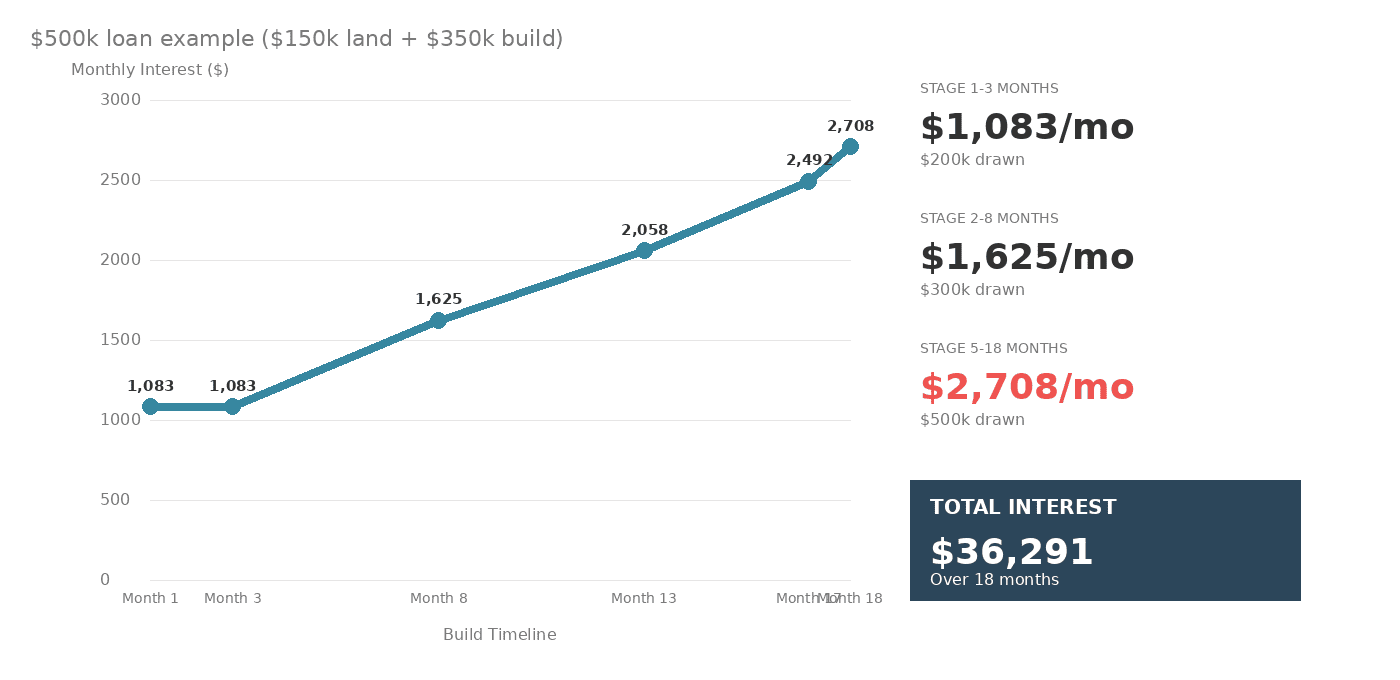
Line graph showing construction loan interest payment escalation from $1,083 to $2,708 per month over 18 months for $500K Australian home build with total interest of $36,291

Stage Amount Drawn Monthly Interest Timeline
Land + Deposit $200,000 $1,083/month Months 1-3
Slab $250,000 $1,354/month Months 4-5
Frame $325,000 $1,760/month Months 6-9
Lock-up $400,000 $2,167/month Months 10-13
Fit-out $475,000 $2,573/month Months 14-17
Completion $500,000 $2,708/month Month 18

Your interest payments nearly triple from $1,083/month to $2,708/month over the 18-month build period.

Total interest paid over 18 months: Approximately $36,291

The rent + interest overlap: If you’re renting at $2,200/month while building, you’re paying combined costs of:

  • Months 1-3: $3,283/month (rent + initial interest)
  • Months 14-18: $4,908/month (rent + maximum interest)

This is why cashflow planning is absolutely critical. Many builders budget for the initial $1,083/month interest payment and get shocked when combined rent + interest hits nearly $5,000/month by completion.

With Building Loans Australia’s ProgressProtect™ Buffer & Breathe methodology, we create a detailed month-by-month cashflow forecast showing exactly what you’ll pay at each stage—so there are no surprises.


What Slows Down Progress Payments (And How to Avoid Delays)

The most common causes of delayed progress payments:

1. Incomplete Stage Documentation

Your builder submits a drawdown request, but hasn’t provided all required documentation (insurances, licences, invoices, etc.). The lender won’t process until everything is complete.

Solution: Use a construction finance specialist broker who knows exactly what each lender requires and ensures your builder submits complete documentation first time.

2. Failed Inspections

The lender’s inspector identifies defects or incomplete work. Funds won’t release until issues are rectified.

Solution: Your builder should do their own quality checks before requesting the drawdown. Reputable builders rarely fail inspections.

3. Lender Processing Delays

Some lenders are simply slower than others at processing progress payments. While most release funds within 7-10 days, some take 14-21 days.

Solution: Work with a broker who knows which lenders have fast progress payment processes and avoids slow lenders for construction finance.


Progress Payments for Different Build Types

Not all builds follow the same drawdown schedule:

Owner-builder projects:

  • Generally require 6-8 stages instead of 5-6 (more frequent inspections due to higher risk)
  • More detailed quantity surveyor involvement at each stage
  • Often stricter inspection requirements
  • Funds may be released to you rather than directly to tradespeople

Learn more about owner-builder construction loans.

Renovations:

  • Payment stages based on specific renovation milestones (demolition, structural work, fit-out, completion)
  • Often 4-5 stages instead of 6
  • May require before-and-after valuations

Knock-down rebuilds:

  • Additional stage for demolition (typically 5% of build cost)
  • Otherwise follows standard 6-stage process

How ProgressProtect™ Keeps Your Payments Flowing

At Building Loans Australia, we’ve seen hundreds of builds delayed simply because progress payment coordination broke down between builder and lender.

Our ProgressProtect™ Builder-Lender Sync system prevents this:

We act as the intermediary coordinating between your builder’s progress claims and your lender’s inspection and payment processes. When your builder says “frame stage is complete,” we know exactly:

  • What documentation the lender needs
  • What inspections are required
  • How to fast-track the payment release

We track lender timeframes proactively, arranging extensions before approvals lapse (construction loan approvals typically expire after 12 months—if your build extends beyond that, you need to re-apply, which we handle before it becomes urgent).

We keep everyone connected: builder, lender, valuer, and you. Everyone knows where the build stands, what’s coming next, and what actions are required.

Result: Smooth progress payments, no funding delays, happy builder, construction timeline maintained.


Your Next Steps

Understanding the 6-stage progress payment process is critical to managing your build successfully. Now you know:

✅ Why banks use construction progress payments/drawdowns (to protect everyone)
✅ The critical payment limits that prevent front-loading and ensure completion incentives
✅ Exactly what happens at each of the 6 stages
✅ How much you’ll pay in inspection and admin fees
✅ How your interest payments escalate throughout the build
✅ What causes payment delays and how to avoid them

But knowledge alone doesn’t keep your build moving smoothly. The families who succeed are the ones who work with construction finance specialists who coordinate the entire process from approval through completion.

Ready to build with confidence?

Book a free ProgressProtect™ consultation with Building Loans Australia. We’ll review your build plans, show you exactly how our Builder-Lender Sync system keeps payments flowing smoothly, and create your customized construction finance roadmap.

Or call us today: 1300 410 149

For more construction loan guidance:

  • Complete Australian Construction Loan Guide
  • Construction Loans Australia
  • Download: The Quick-Start Guide to Construction Loans
About the Author

Craig Vaughan, Founder — Building Loans Australia
Craig founded Building Loans Australia in 2011 after building his first home and realizing the construction loan process was unnecessarily complicated. With over 20 years of experience in finance and 15 years specializing exclusively in construction lending, Craig and his team have helped thousands of Australian families navigate the complexities of building finance through the proven ProgressProtect™ methodology.


Disclaimer: This content is for general information and educational purposes only. It does not constitute financial, legal, or taxation advice. Progress payment structures, percentages, and fees vary by lender and may change. Individual circumstances differ: always seek professional advice for your specific situation.

Filed Under: Construction Loan Guides

The Complete Australian Construction Loan Guide: Everything You Need to Know (2025)

November 4, 2025 by Craig Vaughan

Australian construction loan guide - house building finance illustration

Reading Time: 12 minutes
Last Updated: November 2025


Ask anyone who’s built a home how they felt about their construction loan and they’ll usually reply with one word: “confused.”

And honestly? That’s completely understandable.

Although most Australians dream of building their perfect home, the construction loan process is fundamentally different from a standard home loan. You’re not just borrowing money once. You’re managing staged drawdowns, progress inspections, interest-only payments that triple over time, and a timeline that can stretch 18 months or more. Add in builder contracts, council approvals, and government grants worth up to $50,000, and it’s no wonder most people feel overwhelmed before they even break ground.

Here’s the reality: your typical mortgage broker probably handles one or two construction loans per year. They’re generalists who can help with standard home purchases, but when it comes to the complexity of construction finance, they simply don’t have the depth of experience you need.

“I founded Building Loans Australia in 2011. I just built my first house and realized this is way harder than it needed to be. So I thought I’d jump in and actually help solve that problem. Over the last 15 years or so, there isn’t really anything we haven’t seen from a building or construction perspective for a residential property.” – Craig Vaughan, Founder

This is precisely why we’ve specialized exclusively in construction finance since 2011.

In this comprehensive guide, we’ll walk you through everything you need to know about construction loans in Australia: from the 8 different build types and how they’re financed, to the 6 construction stages and exactly when money gets released, to the government grants you might be eligible for. We’ll show you real numbers from actual builds, reveal the top 6 mistakes that derail projects, and introduce you to the ProgressProtect™ method that’s helped thousands of families build with confidence.

By the end of this guide, you’ll understand exactly how construction loans work and what you need to navigate your build successfully.

Ready to explore your construction loan options? Book a free ProgressProtect™ consultation with our construction loan specialists.

Table of Contents

Which Build Type Are You Planning?

Before you can structure your construction loan properly, you need to understand which build scenario applies to your project. Not all construction loans are created equal: a house-and-land package has completely different financing requirements than an owner-builder project or a duplex development.

Let’s explore the 8 most common build scenarios and what each means for your finance options.

The 4 Most Common Construction Scenarios

1. House & Land Package (Most Common) ️

This is by far the most streamlined construction finance option. You’re purchasing a bundled deal from a developer where the land and build contract are signed together at the same time.

Think of it like this: You’ve gone to a big land release or estate, and builders have display homes set up right there. You walk through, pick your lot, and choose your house design from hundreds of pre-approved plans the builder already has ready to go. Done. Land contract and build contract signed simultaneously.

“A house and land package is when you go to an estate and say ‘I’ll have lot one here and I’ll have this house, please.’ You’re literally getting the land contract at the same time as getting the build contract, plans, and so on. It’s by far the most common and quite streamlined.” – Craig Vaughan

Why lenders love house-and-land packages:

  • ✅ Lower risk profile (established builder, fixed price, proven designs)
  • ✅ Faster approval timelines (streamlined process, known variables)
  • ✅ Competitive interest rates similar to standard home loans
  • ✅ Available from most major and non-bank lenders

Typical structure: One construction loan covering both land settlement and the build contract. The developer often has preferred lender relationships, which can speed up the process even further.

2. Land First, Then Build (Most Common)

With this approach, you buy land separately in one transaction, then source your own builder later in a second transaction.

The difference from a house-and-land package? You find the land yourself (it might be in an estate, or it might be a standalone block you’ve discovered). You settle on that land first. You now own the land, you’re paying a mortgage on it and paying council rates. Then you go find a builder to build your house on that land you already own.

The benefits:

  • ✅ More flexibility in choosing your builder
  • ✅ Greater control over design and contract terms
  • ✅ Ability to wait for the right builder or timing

The slightly increased risk: You’ve purchased the land, you’ve settled on it, you’re making repayments. Let’s say you lose your job, or there’s a market downturn and property prices fall. You could find yourself owning a block of land that you can no longer afford to build on. Maybe at the time of buying, you could afford to build and there was enough value there. But by the time you came to build separately, valuations have fallen or you’ve increased your debt or your circumstances changed.

“Don’t take too long between buying the land and getting the builder underway. That’s where the slight increase in risk comes from. You could find yourself owning a block of land that you can no longer afford to build on.” – Craig Vaughan

That said, this scenario is manageable with proper planning. Just don’t leave your land sitting for 12+ months before starting the build.

3. Off-The-Plan Purchase

You’re paying at completion when the property is built by the developer. There are no progress payments during construction: you simply settle when it’s finished.

Key difference: This isn’t technically a construction loan in the traditional sense. You’re getting a standard home loan that settles upon completion. The developer carries all the construction risk and financing during the build phase, not you.

Higher risk considerations: If the developer encounters financial difficulties or the project is delayed, you may face extended waiting periods or, in worst cases, the development might not proceed. Always check the developer’s track record, financial stability, and contract terms before committing. Look for sunset clauses and what happens if completion dates aren’t met.

4. Renovations & Knock-Down Rebuild

This category covers extending or renovating an existing property, or demolishing completely and rebuilding from scratch.

Renovation loans might include:

  • Kitchen and bathroom upgrades
  • Second-storey additions or extensions
  • Swimming pools and outdoor entertaining areas
  • Structural changes and major improvements

Knock-down rebuild (KDR) means:

  • Demolishing your existing home completely
  • Building a new home on the same land
  • Often used when the land is more valuable than the existing structure
  • Popular in established suburbs where land values have grown significantly

Finance structure: If you already own the property, you’re using your existing equity to fund the work (essentially a construction loan secured against your current property). If you’re buying specifically to knock down and rebuild, you’ll need a construction loan for knock down rebuild that accounts for both the purchase price and the rebuild costs.

Yes, you do need a construction loan for major renovations unless you’re funding it with cash. If you’re borrowing for significant renovation work, this is generally structured as a construction loan with progressive drawdowns.

Less Common Construction Scenarios (Specialized)

1. Building a Dual Occupancy or Duplex

Two dwellings on one title: either side-by-side or a granny flat style arrangement.

Why consider this: Increase rental income and property yield. You can often get up to 90% LVR (Loan-to-Value Ratio) at normal interest rates (not commercial rates), which makes the investment strategy attractive.

The catch: Higher complexity in approvals. You’ll need detailed plans, council approval for dual occupancy (not all areas allow this), and a lender comfortable with this build type. Not all lenders offer competitive rates for duplexes: this is where specialist construction loan brokers make a significant difference in lender selection.

What to expect: Slightly more scrutiny, potentially slightly higher rates (0.25% to 0.5% premium), but still within residential lending territory as long as you stay under 4 dwellings.

2. Multi-Dwelling Projects (Up to 4 Units) ️

Small-scale development with 3-4 dwellings on one title: typically townhouses or apartment-style units.

Maximum 4 dwellings to stay within “residential construction loan” territory rather than commercial development finance. Beyond 4 units, you’re entering commercial lending with significantly different requirements, rates, and deposit levels.

Requires specialist lenders: Only a handful of lenders offer competitive construction finance for multi-dwelling projects. You’ll need generally some development experience, detailed feasibility studies, and often a higher deposit (20%+ is common).

3. Owner-Builder Projects

You act as your own builder and manage the construction yourself.

Why lenders are extremely cautious:

  • Considered much higher risk (statistically higher rates of delays, cost overruns, incomplete builds)
  • Generally requires proven construction experience and extensive documentation
  • Typically limited to 60% LVR maximum (you need 40% deposit)
  • ⚠️ Very limited lender options (most major banks won’t touch owner-builder projects)
  • Higher interest rates (can be 1% to 2% above standard construction loans during the build phase generally reverting to regular interest rates once the build is complete)

What you’ll need: Generally a trade qualification or previous building experience, comprehensive plans and specifications and a full quantity surveyor’s report checking all your costs. Even with all this documentation, expect more scrutiny and higher rates.

“Owner-builder applications are seen as higher risk because the bank doesn’t want to be left with a property that’s half-completed. They’re also concerned about the quality. If you don’t do a good job and then disappear or go bankrupt, the bank’s got to sell that property to get their money back.” – Craig Vaughan

The bank needs assurance you actually know what you’re doing. They’ll require a full quantity surveyor’s check of your costs to make sure you know what your building is going to cost and that you can come in on budget.

4. Kit Homes & Modular Builds ️

Pre-fabricated or flat-pack homes assembled on-site.

Advantages: Faster construction time (generally), controlled factory environment, potentially lower costs, less weather-dependent construction.

Finance challenges:

  • Limited lender options (many banks don’t understand modular construction)
  • Restrictive loan terms
  • “As if complete” valuations can be problematic if there’s limited comparable sales data
  • Some lenders have concerns about resale values

The key is finding a lender familiar with modular construction who understands that these builds can be just as solid, valuable, and permanent as traditional stick-built homes. Not all banks recognize this yet, which limits your options.

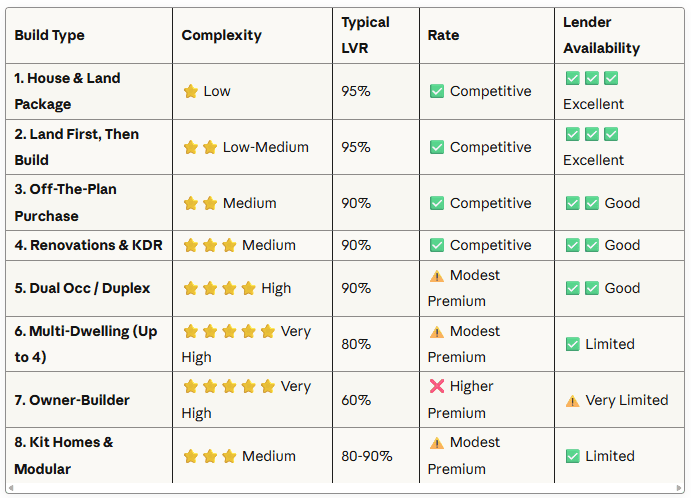
Comparison table of 8 Australian construction loan types showing complexity ratings, deposit requirements, interest rates and lender availability for house and land packages, land first then build, renovations, knock down rebuild, duplex, multi-dwelling, owner builder and kit home projects

How Construction Loans Actually Work

Here’s where construction loans diverge completely from standard home loans.

With a traditional home loan, you borrow the full amount once, settle on the property, and start making principal-and-interest repayments immediately. Simple.

Construction loans? Not even close.

The Progressive Drawdown System

Construction loans work on a staged drawdown schedule. Instead of receiving the full loan amount upfront, money is released progressively as your build reaches specific milestones: usually across 5 to 6 stages over 6 to 18 months (sometimes longer if there are delays).

Here’s why this matters:

For the lender: They’re only advancing money as value is actually being created. If your builder abandons the project halfway through, the lender hasn’t lost the full loan amount, only what’s been drawn so far. This is their risk management.

For you: Your interest costs build gradually. In month one, you might only be paying interest on $200,000. By month eighteen, you’re paying interest on the full $500,000. This creates what we call “interest creep”: a critical factor many first-time builders underestimate.

Interest-Only During Construction

During the construction phase, you will generally only be paying interest on the funds drawn so far, not principal repayments.

This keeps your repayments manageable while you’re potentially still paying rent or a mortgage somewhere else. But here’s the critical point: these interest-only payments can nearly triple from start to finish as more money is drawn.

Real example on a $500,000 construction loan at 6.5% interest:

  • Stage 1 (Month 1 to 3): $1,083/month interest on $200,000 drawn
  • Stage 2 (Month 8): $1,625/month interest on $300,000 drawn
  • Stage 5 (Month 18): $2,708/month interest on full $500,000 drawn

Many builders forget to budget for this escalation. They calculate based on the initial interest payment, then get a shock when it nearly triples by completion.

Total interest paid over 18 months: Approximately $36,291 in this example. That’s over $36,000 on top of your loan amount: money you’ll never get back.

How Construction Loans Compare to Standard Home Loans

Feature Standard Home Loan Construction Loan
Loan drawdown Full amount at settlement Progressive over 5-6 stages
Repayments Principal & Interest from day one Interest-only during construction
Interest paid Fixed monthly amount Increases as funds drawn
Timeline Immediate 12-18+ months construction
Valuation Current market value “As if complete” valuation
Risk to lender Property secures loan Incomplete property during build
Approval complexity Standard income/deposit check Detailed builder contracts, plans, specs
Progress inspections None Required at each stage before release

The “as if complete” valuation is particularly important. The lender values your property based on what it will be worth once finished, not what an empty block is worth today. This projected value determines your borrowing capacity.

The 6 Construction Stages Explained

Every construction loan is structured around specific build milestones. Understanding these stages and what percentage of funds releases at each helps you plan your cashflow and coordinate with your builder.

Here’s the standard 6-stage drawdown schedule (percentages can vary slightly by lender and builder, but this is typical):

Stage 0: Land Settlement & Deposit (5-10%)

Before construction even begins, you’ll need to settle on the land and pay your builder’s deposit.

What gets paid:

  • Land purchase settlement
  • Builder’s initial deposit (usually 5% to 10% of build contract)
  • Any upfront loan fees (application fees, valuation fees)

When funds release: At land settlement and upon signing the building contract with deposit due.

Your interest payments start here: even though not a single brick has been laid yet.

Stage 1: Slab/Base Stage (10-15%)

The foundation stage includes all the groundwork and base preparation.

What’s completed:

  • Site preparation, clearing, and cut/fill
  • Footings and foundation work
  • Concrete slab poured (or pier-and-beam base depending on your design)
  • Underground plumbing and essential services
  • Termite treatment if required

Progress inspection required: The lender sends a qualified building inspector to verify the stage is complete to the required standard before releasing funds. This usually takes 5 to 10 business days from your builder’s request for drawdown.

Typical drawdown: 10% to 15% of the total build cost.

Here’s how it works in practice: Your builder completes slab stage and requests the drawdown from the lender. The lender’s inspector visits (you typically pay around $200 per inspection fee), confirms it’s done properly, and then funds are released directly to your builder. You don’t handle the money: it goes straight from lender to builder.

Concrete slab foundation being poured during Stage 1 of construction loan drawdown for Australian home build showing site preparation and base construction phase

Stage 2: Frame Stage (20-25%)

The skeleton of your home takes shape. This is usually your biggest single-stage drawdown.

What’s completed:

  • Timber or steel frame erected
  • Roof trusses installed and secured
  • External wall frames up
  • Windows and external doors fitted
  • Structural inspections passed

Why this is a big drawdown: The frame represents substantial material costs (timber, steel, trusses) and significant labour. This is typically your largest single-stage release.

Typical drawdown: 20% to 25% of build cost.

House frame structure with roof trusses during Stage 2 of construction loan drawdown showing timber framing and structural work for Australian residential build

Stage 3: Lock-Up Stage (20-25%)

Your home becomes weatherproof and secure.

What’s completed:

  • External cladding and rendering applied
  • Roof tiles or metal roofing fully installed
  • Garage doors fitted
  • Property is fully enclosed and weatherproof
  • Can be locked and secured

Why it’s called “lock-up”: The building is now protected from weather and can be locked. This is a significant milestone because internal work can proceed without weather delays affecting schedules.

Typical drawdown: 20% to 25% of build cost.

From this point forward, your builder should be able to work in all weather conditions, which theoretically means fewer weather-related delays (though tradespeople schedules can still cause timing issues).

House at lock-up stage with external cladding, windows and doors installed during Stage 3 of construction loan drawdown showing weatherproof exterior for Australian residential build

Stage 4: Fixing/Fit-Out Stage (20-25%)

All the internal fixtures and finishes go in. This is where your house transforms from a shell into a home.

What’s completed:

  • Plasterboard (gyprock) walls and ceilings installed
  • Kitchen cabinetry and appliances fitted
  • Bathroom fixtures, tiles, and vanities installed
  • Flooring throughout (tiles, carpet, timber, vinyl)
  • Internal doors and hardware
  • Painting completed (walls, ceilings, trim)
  • Light fittings, switches, and power points
  • Major fixtures like ovens, cooktops, rangehoods

Why this stage takes time: This is where your selections and upgrades become reality. Delays in tile delivery, custom cabinetry lead times, or appliance availability can push this stage out by weeks. If you’ve added stone benchtops, custom joinery, or upgraded fixtures, expect longer lead times.

Typical drawdown: 20% to 25% of build cost.

Kitchen installation in progress during Stage 4 fixing stage of construction loan drawdown showing cabinets, benchtops and appliances being fitted for Australian home build

Stage 5: Practical Completion & Final Inspection (10-15%)

The final drawdown happens when you get the keys.

What’s completed:

  • Generarlly all defects identified and rectified
  • Final clean completed throughout
  • Occupancy Certificate or Certificate of Completion issued by council
  • All warranties and manuals provided
  • Keys handed over

The final inspection: Both the lender’s inspector and often the council do final checks. Your builder should walk you through the property for your “defects inspection”: this is your opportunity to identify any minor issues for rectification before final payment.

Loan conversion: Once this final payment is made, your construction loan automatically converts to a standard principal-and-interest home loan unless you have opted for a longer interest only period (eg, perhaps its an investment property and you wanted a 5 year interest only period). Your repayments will now increase because you’re now paying down principal, not just interest.

Happy new homeowners receiving keys at practical completion of construction loan build standing in front of their completed Australian home after final progress payment and settlement

“Never rush practical completion. Take your time during the defects inspection. Once you sign off and the final payment is released, getting your builder back to fix issues becomes much harder. They’ve been paid in full, moved on to the next project.” – Craig Vaughan

Interest Costs During Your Build: The Reality Check

Let’s talk numbers, because understanding how interest accumulates during construction is critical to avoiding nasty surprises.

Real Example: $500K Construction Loan Over 18 Months

Here’s a typical scenario: $150,000 land purchase and $350,000 build contract (total $500,000), financed with a construction loan at 6.5% interest.

Months 1-3 (Land + Slab): $200,000 drawn

  • Monthly interest payment: $1,083
  • Total interest paid over 3 months: $3,250

Months 4-8 (Frame + Lock-Up): $300,000 drawn

  • Monthly interest payment: $1,625
  • Total interest paid over 5 months: $8,125

Months 9-12 (Fit-Out begins): $400,000 drawn

  • Monthly interest payment: $2,167
  • Total interest paid over 4 months: $8,668

Months 13-18 (Completion): $500,000 fully drawn

  • Monthly interest payment: $2,708
  • Total interest paid over 6 months: $16,248

Total interest paid over 18 months: $36,291

That’s over $36,000 in interest before you’ve paid down a single dollar of principal. And this is assuming an 18-month timeline. If your build runs to 20 or 24 months (not uncommon), add thousands more.

Line graph showing construction loan interest payment escalation from $1,083 to $2,708 per month over 18 months for $500K Australian home build with total interest of $36,291

The Rent + Interest Overlap Nobody Warns You About

Here’s the financial reality most first-time builders don’t fully grasp until they’re in it:

You’ll likely be paying rent AND construction loan interest simultaneously for 12 to 18+ months.

Let’s say your rent is $2,000/month, and your construction loan interest starts at $1,083/month. In the first few months, you’re paying $3,083/month in combined rent plus interest. By month 18, your interest has grown to $2,708/month, so you’re paying $4,708/month total.

Budgeting tip: Calculate the average combined cost over your full build timeline and ensure you can afford it. Many builders budget for the initial payment only, then get shocked when combined costs push towards $5,000/month by completion.

“Budget 18 months even if you think 12. Delays happen: bad weather, material shortages, trade availability. And delays mean rent plus loan overlap extends. This is one of the most common sources of financial stress during builds.” – Craig Vaughan

For more detail see this article on Construction Loan Progress Payments.

How Construction Loan Rates Compare

Not all construction scenarios attract the same interest rate. Here’s what to expect in 2025:

Standard Builds: Competitive Rates (5.36% to 6.5%)

✅ House-and-land packages or turnkey homes
✅ Similar rates to regular home loans
✅ Available from most major and non-bank lenders

These are your lowest-risk builds from the lender’s perspective: fixed-price contracts, experienced licensed builders, standard residential construction. You’ll get competitive rates here.

Custom & Complex Builds: Modest Premium (6.0% to 7.0%)

⚠️ Acreage or rural builds
⚠️ Duplex or dual occupancy projects
⚠️ Vacant land in fringe or regional areas

May attract a 0.25% to 0.75% rate premium due to fewer lender options and slightly higher perceived risk. Still very manageable, but not quite as competitive as standard house-and-land packages.

Owner-Builder: Higher Rates (6.5% to 8.5%+)

Considered significantly higher risk by lenders
Requires extensive experience documentation
Rates generally 1% to 2% higher than standard builds
⚠️ Very few lenders will consider owner-builder projects

Why the substantial premium? Statistically, owner-builder projects have higher rates of delays, cost overruns, and incomplete builds. Lenders price for this elevated risk. If you’re serious about owner-building, factor these higher rates into your feasibility calculations.

What You’ll Need to Get Approved

Getting construction loan approval requires significantly more documentation than a standard home loan. Here’s your complete checklist.

Build Documentation

This is what differentiates a construction loan from a regular mortgage:

✅ Fixed-price building contract with detailed plans and specifications
✅ Builder’s license (copy of current QBCC, VBA, or relevant state license)
✅ Contract works insurance (also called home warranty insurance)
✅ Council approvals before build begins (your builder typically arranges this)
✅ Soil test results if required for your site

The building contract is critical. Lenders want to see a comprehensive fixed-price contract that details exactly what’s included, what’s excluded, and the full scope of works. Vague or incomplete contracts will delay (or derail) your approval.

Financial Documentation

Standard lending documentation plus some construction-specific items:

✅ Proof of income: Payslips (recent 3 months), tax returns (1-2 years if self-employed), PAYG summaries
✅ Bank statements: 3 to 6 months showing savings pattern and spending behavior
✅ Proof of deposit funds: Evidence your deposit has been genuinely saved or gifted (lenders track this closely). Note there are exceptions for genuine savings with a Guarantor Construction Loan or Rent as Genuine Savings Construction Loan.
✅ Existing debts documentation: Credit cards, car loans, personal loans, HECS debt
✅ Living expenses breakdown: Detailed monthly expenses (rent, groceries, transport, childcare, etc.)

Land & Valuation

✅ Contract of sale (if you haven’t settled yet) or Council rates notice (if you already own the land)
✅ “As if complete” valuation arranged by your broker (they organize this)

The “as if complete” valuation is crucial. The bank is valuing your property based on what it will be worth once built, not what an empty block is worth today. This projected value determines your maximum borrowing capacity.

If the valuation comes in lower than expected, your LVR (Loan-to-Value Ratio) increases, which might mean you need a bigger deposit or have to pay Lenders Mortgage Insurance (LMI).

Timeline expectation: From lodging your complete application to formal approval typically takes 5 to 10 days for straightforward cases. Complex scenarios (owner-builder, acreage, self-employed) can take longer.

Government Grants & Incentives by State (2025)

Don’t leave thousands of dollars on the table. Here’s what’s available across Australia as of late 2025. To get the latest grants and schemes available visit the firsthome.gov.au website.

First Home Guarantee (National Scheme)

Deposit required: As low as 5% (instead of 20%)
What you save: Avoid Lenders Mortgage Insurance (LMI), saving $15,000 to $30,000+
Eligibility: Must be first home buyer OR not owned a property in Australia in the last 10 years
Available for: New builds and established homes

This is a federal government scheme where the government guarantees part of your loan, allowing you to borrow with just 5% deposit without paying LMI. For construction loans, this is incredibly valuable because LMI on a $500,000 loan with 10% deposit can easily be $15,000 to $20,000.

First Home Owner Grants by State (2025)

These are cash grants paid directly to you for building or purchasing a new home. Note that state governments change these programs regularly, so always verify current eligibility before proceeding here.

Queensland: $30,000

Amount: $30,000 cash grant
For contracts signed: November 2023 to June 2026
Property value cap: Must be under $750,000 (for land and build combined)
Requirements: New home, must move in within 12 months of completion

This is one of the most generous grants currently available. If you’re building in Queensland, this $30,000 can cover a significant portion of your deposit or upgrades.

Northern Territory: $50,000 (New) / $10,000 (Established)

Amount: $50,000 for new homes OR $10,000 for established homes
For contracts signed: October 2024 to September 2026
Property value cap: No value cap
Requirements: New home or established, must move in as primary residence

The NT has the highest grant available nationally: $50,000 is substantial. No value cap makes this particularly attractive for higher-end builds.

New South Wales: $10,000

Amount: $10,000
Property value cap: Maximum $600,000 for existing home OR $750,000 for house-and-land package
Requirements: New home, must move in within 12 months

NSW has one of the lower grants, but combined with stamp duty concessions (which can save another $20,000 to $30,000 for first home buyers), it’s still valuable.

Victoria: $10,000

Amount: $10,000
Property value cap: Maximum $750,000
Requirements: New home, must move in within 12 months

Victoria also offers substantial stamp duty concessions for first home buyers on top of this grant.

South Australia: $15,000

Amount: $15,000
Property value cap: No cap
Requirements: New home, must move in within 12 months

No value cap in SA means even higher-value builds qualify, which is attractive in the higher-end Adelaide market.

Western Australia: $10,000

Amount: $10,000
Property value cap: Maximum $750,000 (Perth metro) OR $1,000,000 (regional WA)
Requirements: New home, must move in within 12 months

Regional WA has a higher cap reflecting different market conditions outside Perth.

Tasmania: $10,000

Amount: $10,000
Property value cap: No cap
Requirements: New home, must move in within 12 months

No value cap makes this accessible across Tasmania’s diverse property markets.

Australian Capital Territory: No FHOG

Instead: Stamp duty concessions available
Maximum saving: Up to $34,270 in stamp duty exemptions for eligible first home buyers
Requirements: Various thresholds and criteria apply

ACT doesn’t offer a cash grant but provides substantial stamp duty relief instead, which can be just as valuable depending on your property value.

Australian government construction loan grants by state for 2025 showing First Home Owner Grant amounts including Queensland $30,000, Northern Territory $50,000, NSW Victoria WA Tasmania $10,000, South Australia $15,000 and First Home Guarantee scheme details

Stamp Duty Concessions

In addition to cash grants, most states offer stamp duty concessions or exemptions for first home buyers. These can save $10,000 to $30,000+ depending on your property value and state.

“We help you maximize the grants, make sure they’re paid on time, and you know when they’re going to be paid so you can manage your cashflow. We’ll also help you include extras from the start: pools, fences, things like that. Save you cash or just get you the complete property you want.” – Craig Vaughan

Pro tip: Engage with a construction loan specialist broker (like Building Loans Australia) to ensure you’re accessing all available grants and incentives. We’ll make sure grants are applied for on time, paid when expected, and factored into your cashflow planning so you’re not caught short.

Top 6 Construction Loan Pitfalls (And How to Avoid Them)

These are real mistakes that cost Australians thousands of dollars: prevented with the right structure and specialist guidance from day one.

❶ Underestimating Build Timeline

The mistake: Budgeting for a 12-month build when reality is closer to 18 months (or longer).

Why it happens: Optimism bias. Your builder gives you a 12-month estimate (or less), and you budget based on that. But delays happen: bad weather, material shortages (timber, bricks, windows are common culprits), trade availability issues, council inspection delays.

What it costs you: Every extra month means another month of:

  • Rent payments (if you’re still renting): $2,000 to $3,000/month
  • Construction loan interest: $1,000 to $2,700/month (escalating)
  • Land holding costs: Rates, water, maintenance

How to avoid it: Budget for 18 months minimum, even if your builder says 12. If it finishes early, that’s a bonus. If it runs to 18 months (very common), you’re financially prepared.

❷ Choosing the Cheapest Builder Without Due Diligence

The mistake: Going with the lowest quote without thoroughly reviewing the contract and understanding what’s included (and what’s not).

Why it happens: Price pressure. When you’re stretching your budget, that builder who comes in $30,000 cheaper looks incredibly attractive.

What it costs you: The “cheap” builder hasn’t allowed enough concrete for the driveway. They’ve excluded retaining walls you need. They’ve underspecified materials. Suddenly you’re hit with $15,000 to $40,000 in variations mid-build.

“Cheap is okay, but often there will be extras you have to pay for. For example, they haven’t allowed enough concrete for the driveway, or they’ve missed other things. So review the contract carefully: what’s included, what’s excluded, and whether the price is genuinely fixed or if there are likely variations ahead.” – Craig Vaughan

How to avoid it: Don’t choose on price alone. Review contracts meticulously. Ask:

  • What’s specifically excluded?
  • How do variations work and what’s the pricing?
  • What’s your track record on finishing on time and on budget?

Sometimes paying $20,000 more upfront for a reputable builder saves you $50,000 in variations and stress.

❸ No Contingency Buffer

The mistake: Building a budget with $0 contingency for cost overruns or unexpected expenses.

Why it happens: You’ve maximized your borrowing capacity to get the house you want. There’s no room in the budget for extras.

What it costs you: When the inevitable variation arises (different soil conditions requiring extra foundation work, need for retaining walls, upgrade materials because original selection is discontinued), you have no buffer. Builders turn to credit cards at 15% to 22% interest or stress about how to pay.

How to avoid it: Build a 5% to 10% contingency buffer into your budget from the start. On a $400,000 build, that’s $20,000 to $40,000 set aside for unknowns.

If you don’t have cash savings for this, work with your broker to structure the loan to include a reasonable buffer. It’s far cheaper to borrow an extra $30,000 at 6.5% construction loan rates than to hit a credit card at 20% when you run short.

Where the buffer helps:

  • Soil testing reveals poor ground requiring deeper footings
  • Council requires additional engineering work
  • Material selections are discontinued, upgrades needed
  • Site access issues require crane or special equipment
  • Upgrade opportunities mid-build (better fixtures, stone benchtops)

❹ Ignoring Interest Creep

The mistake: Budgeting based on your initial interest payment ($1,000/month) and forgetting it nearly triples by completion ($2,700/month).

Why it happens: Nobody explains the progressive drawdown impact clearly upfront. Builders see that initial $1,000/month and think “I can afford that” without realizing it escalates every few months.

What it costs you: Financial stress mid-build when interest payments hit $2,500 to $2,700/month combined with ongoing rent. Some builders find themselves unable to afford the increasing payments and get into arrears.

How to avoid it:

  • Calculate your average interest payment over the full timeline (not just the initial amount)
  • Budget for the maximum payment you’ll face in the final months
  • Create a monthly cashflow forecast showing escalating interest alongside your rent
  • Set aside extra buffer in the early months when interest is low to offset higher costs later

We covered the real numbers earlier: on a $500,000 loan, you go from $1,083/month to $2,708/month. That’s a $1,625/month increase over 18 months. Plan for it.

❺ Not Reading Contract Fine Print

The mistake: Assuming the builder’s contract is “standard” and signing without detailed review or legal advice.

Why it happens: Excitement. You’ve chosen your design, you love the builder, you just want to get started. Reading 50 pages of legal contract feels tedious.

What it costs you: Risky clauses can cost you tens of thousands:

  • No Liquidated Damages clause: If your builder finishes 6 months late, you have no recourse for your extra rent and interest costs
  • Variation pricing: Variations priced at builder’s discretion with no cap
  • Payment terms: Overly aggressive payment schedule that doesn’t align with work completed

How to avoid it:

  • Engage a building solicitor to review your contract ($500 to $1,500: worth every cent)
  • Ensure there’s a Liquidated Damages clause (typically $70 to $200/day for delays)
  • Understand the variation process and pricing methodology
  • Review the payment schedule against HIA/MBA recommended guidelines

❻ Not Communicating Changes or Delays to Your Lender

The mistake: Your build is running late, or you need a variation, but you don’t tell your lender until the last minute.

Why it happens: Fear. You’re worried the lender will say no or cause problems, so you avoid the conversation.

What it costs you: Your loan approval might lapse if construction takes longer than the approved construction period (usually 12 months). Suddenly you need to re-apply, re-value the property, potentially face different lending criteria. Or your variation isn’t approved and your builder stops work while you scramble to find alternative funding.

“Tell your lender about delays EARLY. They’ll work with you if you’re upfront. But if you wait until your approval is about to lapse, your options become much more limited and stressful. Communication is key.” – Craig Vaughan

How to avoid it:

  • Keep your broker (and through them, your lender) updated monthly on build progress
  • Flag potential delays or variations as soon as you become aware of them
  • Many lenders will extend construction periods if notified early
  • Variation approvals are faster when raised proactively rather than reactively

With Building Loans Australia’s ProgressProtect™ Builder-Lender Sync system, we keep everyone connected: lender, builder, valuer, and you. We track lender timeframes to ensure approvals don’t lapse and handle variations quickly to avoid construction delays.

Real Case Study: Sarah’s Brisbane Build

Let’s look at a real example to see how all these pieces come together. This is based on an actual client build (names and minor details changed for privacy).

The Project

Location: North Lakes, Brisbane (northern growth corridor)
Build type: House-and-land package
Land cost: $180,000
Build cost: $380,000
Total project: $560,000

Sarah’s Starting Position

Age: 32, first home buyer
Employment: Full-time marketing manager
Income: $120,000 per year (stable employment, 3+ years same employer)
Deposit saved: $80,000 (14.3% of project cost)
Current situation: Renting at $2,100/month

The Challenge

Sarah had saved diligently but only had $80,000 deposit: just over 14%. For a $560,000 build, a traditional 20% deposit would require $112,000. She was short $32,000.

Without specialist construction finance advice, she would have:

  • Needed to save another 18 to 24 months to reach 20% deposit
  • Paid significant Lenders Mortgage Insurance (LMI) if she proceeded with under 20%
  • Potentially missed out on builder incentives and grant timing

The Solution: Structured Correctly from Day One

Working with Building Loans Australia, we structured Sarah’s build to maximize available assistance:

Grants Applied:

  • ✅ First Home Guarantee: Approved for 5% deposit scheme
  • ✅ Queensland First Home Owner Grant: $30,000 cash grant

Impact of First Home Guarantee:

  • Saved approximately $18,000 by avoiding Lenders Mortgage Insurance
  • Allowed her to proceed with just 14.3% deposit instead of waiting for 20%

Impact of QLD Grant:

  • $30,000 cash paid shortly after build commencement
  • Effectively increased her equity position to 19.6% ($80k plus $30k equals $110k)
  • Provided buffer for any variations or unexpected costs

Final Loan Structure

Total project cost: $560,000
Less: Cash deposit: $80,000
Less: QLD Grant: $30,000
Less: Stamp duty concession: $0 (first home buyer, new build)
Loan amount: $465,000 (after QLD grant applied)

Loan details:

  • Interest rate: 5.36% (excellent rate for construction loan in 2025)
  • LVR: 83% (under the 85% threshold, which helped secure better rate)
  • Construction period: 18 months
  • Lender: Major bank with strong construction lending expertise

The Build Timeline & Cashflow

Here’s how Sarah’s actual drawdowns and costs flowed over her 18-month build:

Months 1-3: Land + Slab

  • Drawdown: $200,000 (land $180k plus slab $20k)
  • Monthly interest: $893/month
  • Monthly rent: $2,100/month
  • Combined: $2,993/month

Months 4-8: Frame + Lock-Up

  • Drawdown: $315,000 (frame $80k plus lock-up $35k progression)
  • Monthly interest: $1,405/month
  • Monthly rent: $2,100/month
  • Combined: $3,505/month
  • QLD Grant received Month 5: $30,000 hit her offset account, reducing effective loan

Months 9-14: Fit-Out

  • Drawdown: $425,000 (fit-out stages $110k)
  • Monthly interest: $1,898/month
  • Monthly rent: $2,100/month
  • Combined: $3,998/month

Months 15-18: Final Stages + Completion

  • Drawdown: $465,000 (final $40k completion payment)
  • Monthly interest: $2,076/month
  • Months 15-17 rent: $2,100/month (combined $4,176/month)
  • Month 18: Moved in, stopped paying rent (interest only $2,076/month)

Total Interest Paid During Build: $38,760 over 18 months

Total Finance Costs:

  • Interest during build: $38,760
  • Application fees, valuation, inspections: $3,350
  • Total: $42,110

The Outcome

Final position at completion:

  • Property value (independent valuation): $620,000
  • Final loan amount: $465,000 (after QLD grant applied)
  • Instant equity: $155,000 (24.8% equity)

What Sarah avoided:

  • ❌ Lenders Mortgage Insurance: Saved $18,000
  • ❌ Waiting 2+ years to save 20% deposit: Started building immediately
  • ❌ Financial stress: Comprehensive cashflow planning meant she knew exactly what to expect each month
  • ❌ Builder disputes: ProgressProtect™ Builder-Lender Sync kept everything coordinated

What Sarah achieved:

  • ✅ Brand new 4-bedroom home in growth corridor worth $620,000
  • ✅ Walked in with $155,000 equity (24.8%)
  • ✅ No stress with progress payments: all handled smoothly
  • ✅ Completed on time (18 months as budgeted)
  • ✅ No cost overruns (5% buffer included in structure, not needed)

Key Lessons from Sarah’s Build

  1. Specialist expertise matters: General mortgage brokers wouldn’t have known about First Home Guarantee timing or how to structure around the QLD grant optimally
  2. Grants are significant: $30,000 cash made a material difference to Sarah’s equity position and buffer
  3. Planning prevents stress: Sarah knew her exact monthly costs 18 months in advance: no surprises
  4. Timeline realism: We budgeted 18 months from the start; build finished in 18 months
  5. Interest creep is real: Her interest payments more than doubled from Month 1 to Month 18

Sarah’s story represents what’s possible with the right structure and specialist guidance. If you’re in a similar position (good income, solid deposit but not quite 20%, first home buyer), you might be surprised what’s achievable with the right construction finance strategy.

The ProgressProtect™ Method: Your Build Finance Safety Net

After 15 years specializing exclusively in construction finance and our team having helped thousands of Australian families build their homes, we’ve refined our approach into a proven three-stage system.

We call it ProgressProtect™: specifically designed to safeguard your timeline, budget, and peace of mind from pre-approval through to final settlement.

“Too many Australians struggle with generic lending advice. We built ProgressProtect™ to ensure you never do. It’s not only our expertise and knowledge in getting you approved, but also making sure your timeline is protected, your budget is protected, and you have peace of mind throughout the build: not living on baked beans and stressing about money.” – Craig Vaughan

The ABC System for Construction Finance

Think of ProgressProtect™ as your ABC’s:
A equals Approval
B equals Build
C equals Cashflow

Let’s break down each stage.

A: Approval (Clear-Path Approval Methodology)

Navigate complexity with confidence

Most mortgage brokers handle one or two construction loans per year. They’re generalists. When your application hits their desk, they’re often learning alongside you: which is why so many construction loan approvals get delayed or declined unnecessarily.

Our Clear-Path Approval methodology is built on 15 years of construction lending exclusively. Here’s what it delivers:

Avoid restrictive lenders
Not all lenders understand construction. Some have overly restrictive policies that will cause problems mid-build. We know which lenders are flexible with owner-builders, which ones handle acreage builds well, which ones have fast progress payment processes. We match you to the right lender for your specific build type from day one.

Maximize government grants
We ensure you’re accessing every grant and incentive you’re eligible for: First Home Guarantee, state First Home Owner Grants, stamp duty concessions. We’ll make sure grants are applied for correctly, on time, and that you understand exactly when they’ll be paid so you can manage your cashflow around that timing.

Include extras from the start
Want a swimming pool? Fence? Driveway? Landscaping? Many builders exclude these from the main contract to keep the quote competitive. But paying for them separately means using your savings or (worse) credit cards at 20% interest.

We structure your loan to include these extras upfront where possible. You’re borrowing at 6% instead of paying cash or using high-interest debt. This gives you the complete property you actually want: not a half-finished home where you’re saving for years to add the pool.

Fund out-of-contract items through your own contractors
Sometimes you can save money by engaging your own contractors for specific items (fencing, driveways, landscaping). We can structure finance to accommodate this, releasing funds directly to you for these components rather than everything going through the builder.

Secure faster approvals
We know exactly what documentation each lender requires, what they scrutinize, and how to present your application for fastest possible approval. For straightforward scenarios, we’re talking 7 to 10 days to formal approval. Even complex scenarios (owner-builder, self-employed) are handled efficiently because we’ve done hundreds of them.

Outcome: You get approved fast, with the right lender for your build, accessing maximum grants, and including everything you want in the structure from day one. No surprises, no restrictions, no re-applications mid-build.

B: Build (Builder-Lender Sync System)

Keep your build moving smoothly

This is where many construction loans fall apart. Your builder and your lender operate on different timelines, different documentation requirements, and often poor communication between them. The result? Delayed progress payments, frustrated builders, construction delays, and stress for you.

Our Builder-Lender Sync System prevents this.

Align builder and lender processes
We act as the intermediary coordinating between your builder’s progress claims and your lender’s inspection and payment processes. When your builder says “frame stage is complete,” we know exactly what documentation the lender needs, what inspections are required, and how to fast-track the payment release.

Handle variations fast
Need to add something mid-build? Need to address an unexpected issue? Variations can delay everything if not handled correctly. We manage the lender approval process for variations, ensuring funding is available when your builder needs it and your build doesn’t stop.

Track lender timeframes to avoid lapses
Construction loan approvals have expiry dates (usually 12 months). If your build extends beyond that (common), you need to re-apply. We track these timeframes proactively, arranging extensions before approvals lapse. You never face the nightmare scenario of being mid-build with no active loan approval.

Keep everyone connected
We maintain regular contact with your builder, your lender, your valuer (who does progress inspections), and you. Everyone knows where the build stands, what’s coming next, and what actions are required. No communication gaps, no surprises.

Prevent funding gaps
Construction stops fast if the builder isn’t getting paid on time. We ensure drawdown requests are submitted correctly, inspections are scheduled promptly, and funds flow to your builder according to the agreed schedule. Your builder stays on-site, your build stays on track.

Outcome: Smooth progress payments, no funding delays, happy builder, construction timeline maintained. You avoid the chaos and stress of misaligned builder-lender processes.

C: Cashflow (Buffer & Breathe)

Protect your finances during build

Building a home is expensive. Not just the obvious costs (land, construction), but the ongoing costs during the build that catch people off-guard: rent plus escalating interest, rates, inspections, variations, moving costs.

Our Buffer & Breathe approach ensures you can afford every stage without financial stress.

Plan repayments for each stage
Before you start building, we create a detailed month-by-month cashflow forecast showing:

  • What your interest payments will be at each stage (from $1,000/month initially to $2,700/month at completion)
  • Your ongoing rent (if renting)
  • When grants will be paid and how that affects your cash position
  • When major costs hit (land settlement, builder deposits, etc.)

You walk into your build knowing exactly what you’ll pay every month for the next 18 months. No surprises, no panic.

Create clear cashflow plans
We help you understand the overlap period: how long you’ll be paying rent AND construction interest simultaneously. We identify the peak cost months (usually months 12 to 18 when interest is highest and you’re still renting). We ensure you can actually afford this before you commit.

Many builders find out mid-construction they can’t afford the combined costs. By then, it’s too late: you’ve already signed contracts and started building. We prevent this with upfront cashflow reality checks.

Set aside buffers early
We structure your loan to include a contingency buffer (typically 5% to 10% of build cost) from the start where possible. This buffer sits in an offset account against your loan, reducing interest costs until needed, but available immediately if variations or unexpected costs arise.

You’re not scrambling to find $15,000 cash mid-build when the builder identifies poor soil conditions. The buffer is already there, already approved, ready to deploy.

Understand when incentives and grants are paid
The $30,000 QLD First Home Grant isn’t paid at settlement: it’s paid early in construction (often after slab stage). We ensure you know exactly when each grant hits your account so you can plan around it. Need the grant to cover a variation? We time the drawdowns accordingly.

Support through every stage until keys are in hand
We don’t disappear after approval. We’re with you throughout the entire build: fielding questions, coordinating payments, managing lender extensions if needed, providing guidance when issues arise. You have an expert construction finance partner from start to finish.

Outcome: Financial stability throughout your build. No credit card debt, no stress about affording next month’s payments, peace of mind that you can complete your build without financial strain.

Why ProgressProtect™ Works

The traditional construction loan approach is fragmented:

  • Your broker gets you approved (maybe), then disappears
  • You’re left coordinating between builder and lender alone
  • Nobody’s checking if you can actually afford the escalating costs
  • Variations and delays throw everything into chaos
  • You’re stressed, your builder’s frustrated, and the lender is just a faceless bureaucracy

ProgressProtect™ is different: It’s an end-to-end system that safeguards every stage. Approval is just the beginning: we protect your timeline, budget, and mental health throughout the entire build process.

That’s the difference between generalist mortgage brokers and construction finance specialists.

If you’re ready to build with confidence rather than confusion, book a free ProgressProtect™ consultation with our construction loan specialists. We’ll review your build plans, show you exactly how our three-stage system keeps your project on track, and create your customized construction finance roadmap.

Frequently Asked Questions

Loan Structure & Mechanics

Q: What does “interest-only during construction” really mean and how will it affect my repayments?

A: During construction, you only pay interest on the funds drawn so far: not principal repayments. This keeps repayments lower while you’re potentially still paying rent. However, once construction completes, your loan will generally automatically convert to principal-and-interest, and your repayments will increase significantly (often 30% to 40% higher) because you’re now paying down the loan principal as well as interest.

Q: How long can my construction loan drawdown period be before I must convert to a regular home loan?

A: Most lenders approve construction periods of 12 months initially. If your build extends beyond that (common), you need to request an extension. Most lenders will grant 6 to 12 month extensions if you’re making progress and keeping them informed. The key is communicating delays early: don’t wait until your approval is about to lapse.

Q: Can I combine land purchase plus build into one construction loan, or do I need separate loans?

A: Yes, you can absolutely combine both into one construction loan (this is very common with house-and-land packages). However, if you purchase land separately first, then want to build later, you might have two transactions: a land loan that converts to a construction loan, or a land loan that you refinance into a construction loan when you’re ready to build. A specialist broker can structure this efficiently to minimize costs.

Q: Can I include a pool, shed, or use a different contractor than the builder to save money on things like fencing?

A: Yes! This is exactly what we help with in the ProgressProtect™ Clear-Path Approval stage. You can often structure your construction loan to include out-of-contract items like pools, sheds, fences, driveways, and landscaping. You can sometimes engage your own contractors for these items (often cheaper than the builder’s subcontractors) and have funds released directly to you or those contractors. This is a huge advantage if structured correctly from day one.


Build Issues & Property Valuations

Q: What happens if the build doesn’t finish on schedule or costs more than expected?

A: For delays: You’ll pay more interest because the loan is drawn for longer. If your delay extends beyond your approved construction period, you’ll need a lender extension (usually granted if you communicate early). For cost overruns: If you have a fixed-price contract, the builder generally wears cost overruns (that’s why fixed-price contracts are valuable). If you’re owner-builder or cost-plus contract, you’ll need access to additional funds: either your contingency buffer, additional borrowing (if equity allows), or your own savings.

Q: How do lenders value the property “as if complete” and why does this affect my borrowing capacity?

A: Lenders order an “as if complete” valuation which values your property as though it’s already built (not just the empty land). A qualified valuer reviews your plans, specifications, and comparable completed sales in the area to estimate final value. This projected value determines your LVR (Loan-to-Value Ratio) and maximum borrowing capacity. If the valuation comes in lower than expected, you might need a bigger deposit or have to reduce the build scope.

Q: Can I use the equity in my land or existing home to fund a construction loan?

A: Absolutely. If you already own land or another property with sufficient equity, you can use that equity as your “deposit” for the construction loan. This is common for renovations, knock-down rebuilds, or if you purchased land years ago that’s now increased in value. Your broker will calculate available equity: (Property value times 80%) minus existing debt equals usable equity.


Eligibility & Special Situations

Q: What deposit is typically needed for a construction loan?

A: For standard builds with good credit: 5% to 20% deposit. With the First Home Guarantee scheme, first home buyers can go as low as 5% for new builds and avoid LMI. For owner-builder projects: Usually 30% to 40% deposit minimum (60% LVR maximum). For complex builds (acreage, duplex, multi-dwelling): Usually 10% to 20% deposit. The deposit level affects your interest rate: higher deposits generally mean better rates.

Q: Are owner-builder construction loans treated differently, and what are the extra requirements?

A: Yes, very differently. Requirements include:

  • Much larger deposit (30% to 40%)
  • Trade qualifications or proven building experience
  • Detailed plans and specifications
  • Full quantity surveyor’s report verifying your cost estimates
  • A detailed construction schedule
  • Higher interest rates (1% to 2% premium)
  • Very limited lender options

Lenders see owner-builder as much higher risk due to statistically higher rates of delays, cost overruns, and incomplete projects.

Q: If I’m doing a major renovation (not a full new build), do I need a construction loan or can I use a standard home loan?

A: For major renovations (anything over approximately $50,000 with staged construction work), you’ll generally need a construction loan. Standard home loans provide the full amount at settlement: not suitable for progressive drawdowns as renovation work completes. For minor renovations ($10,000 to $50,000), you might be able to get a standard loan releasing equity without the need to go through progressive drawdowns.


How to Get Started: Your Next Steps

Building a home is one of the biggest financial and emotional decisions you’ll make. After reading this comprehensive guide, you now understand:

✅ The 8 different build types and how they’re financed
✅ How construction loans work with progressive drawdowns
✅ The 6 construction stages and when money is released
✅ Interest costs and how they nearly triple during your build
✅ Documents and approvals you’ll need
✅ Government grants worth thousands (up to $50,000 in some states)
✅ The top 6 mistakes that derail builds and how to avoid them
✅ Real case study numbers showing how it all comes together
✅ The ProgressProtect™ method for safeguarding your build

But knowledge alone doesn’t get your house built: action does.

Option 1: Book Your Free ProgressProtect™ Consultation

If you’re serious about building in the next 6 to 12 months, the most valuable next step is a strategy session with our construction loan specialists.

In this free consultation, we’ll:

  • Review your specific build plans and financial position
  • Identify which build type and lender best suit your project
  • Calculate exactly how much you can borrow (including out-of-contract items like pools and fences)
  • Show you which government grants you’re eligible for and when they’ll be paid
  • Create a month-by-month cashflow forecast so you know exactly what to expect
  • Explain how ProgressProtect™ would safeguard your specific build

No obligation. No pressure. Just expert guidance to help you build with confidence.

Call us today: 1300 410 149
Or book online: buildingloansaustralia.com.au/book-strategy-session

Option 2: Download Our Free Construction Loan Guide

Want to dive deeper before booking a consultation? Download our comprehensive Quick-Start Guide to Building & Construction Loans.

Why Building Loans Australia?

Since 2011, we’ve specialized exclusively in construction finance. We’ve helped thousands of Australian families build their dream homes across every build type imaginable: from standard house-and-land packages to complex owner-builder projects, from duplexes to knock-down rebuilds.

What makes us different:

  • Specialists, not generalists: Construction loans are all we do, every day
  • Access to 50+ lenders: We find the right lender for your specific build type
  • ️ ProgressProtect™ Method: End-to-end support from approval through completion
  • Maximize grants: We ensure you access every dollar you’re entitled to
  • ⚡ Fast approvals: 5 to 10 days for standard builds, even complex scenarios handled efficiently
  • Builder-Lender Coordination: We keep everyone connected so your build stays on track

“Over the last 15 years or so, there isn’t really anything we haven’t seen from a building or construction perspective. We built the ProgressProtect™ method to ensure your timeline is protected, your budget is protected, and you have peace of mind throughout the build: not living on baked beans and stressing about money.” – Craig Vaughan, Founder

Ready to Start Building?

Your dream home doesn’t build itself. The families who succeed are the ones who take the first step: getting expert guidance before signing contracts, choosing builders, or committing to timelines.

Whether you’re planning a simple house-and-land package or a complex owner-builder project, whether you have 5% deposit or 40%, whether you’re in Brisbane, Sydney, Melbourne, or regional Australia: we can help structure your construction finance correctly from day one.

Let’s build your dream home together.

1300 410 149
buildingloansaustralia.com.au

About the Author

Craig Vaughan, Founder — Building Loans Australia

Craig founded Building Loans Australia in 2011 after building his first home and realizing the construction loan process was unnecessarily complicated and poorly explained by general mortgage brokers. With over 20 years of experience in finance and 15 years specializing exclusively in construction lending, Craig and his team have helped thousands of Australian families navigate the complexities of building finance.

Craig developed the ProgressProtect™ methodology based on decades of real-world construction lending experience: identifying the common failure points in the traditional approach and systematizing solutions that protect timeline, budget, and client peace of mind from approval through completion.

Disclaimer: This content is for general information and educational purposes only. It does not constitute financial, legal, or taxation advice. All rates, fees, grant amounts, and eligibility criteria are current as of November 2025 and subject to change. Lender and government program requirements may vary. Individual circumstances differ: always seek professional advice for your specific situation.

Filed Under: Construction Loan Guides

Book Your Free Consult

"*" indicates required fields

We respect your privacy.

Just wanted to stop for a minute and express that how grateful we are for all the help and professionalism you have demonstrated thus far. You have shown an utmost customer service in addition to your knowledge and experience. You have made this experience a pleasure for us and I am very happy to refer your services to others and also provide a formal reference. Once again, many thanks.

David Singh (Western Australia)

Special thanks to Craig Vaughan, who all though the process was very forthcoming and always available to my queries. Job well done!

Srindhi Alphonse

Extremely helpful and prompt in service. Dealing with Ian and his team was easy and we will not hesitate recommending his services, and using his services in the future.

Kirsty Jackson

CALL 1300 410 149

Talk to the experts

  • Australia wide
  • Free service
Enquire Online Now

Our Partners

logo_afg
logo_amp
logo_anz
logo_bankwest
logo_cba
logo_heritage
logo_ingdirect
logo_nab
logo_stgeorge
logo_suncorp
logo_westpac
Footer Logo

Building Loans Australia are Australia's #1 Specialists in Helping Professionals Get Fast Home Loan Approval, at a Great Rate.

Footer Logo

Contact Building Loans Australia

1300 410 149

Offices in Sydney, Melbourne and Brisbane

© buildingloanaustralia.com.au | Copyright . All Rights Reserved. | Privacy Statement

Please enter your email to gain Free Instant Access to...

"The Quick-Start Guide To Building & Construction Loans"

Discover how to save time, money and stress when building your dream home or investment property.

We respect your privacy

Book Your Free Consult

We respect your privacy

90%

Please enter your email to gain Free Instant Access to ...

“The Quick-Start Guide to Building & Constraction Loans”

Discover how to save time, money and stress when building your dream home or investment property.

We respect your privacy